


Год: 2017
Разделы: Исследовательская работа
Темы: Вода, Водная безопасность
Авторы: Frederike Klümper, Thomas Herzfeld, Insa Theesfeld
Страны: Таджикистан
Источник: Water
This scientific article examines the concept of water security in the irrigation sector of Tajikistan at the individual farm level. The authors develop a comprehensive Water Security Index that incorporates hydrological, governance, and hybrid dimensions to assess the actual availability and accessibility of water resources. The study reveals that, despite the physical abundance of water, weak governance and institutional barriers are the primary sources of water insecurity. Based on a survey of 399 farming households, the authors establish a typology of farms, demonstrating that large and small producers face fundamentally different water-related challenges. The findings show that effective governance can compensate for infrastructure deficiencies, thereby enhancing the resilience of agricultural production. The article concludes by emphasizing the need to shift from broad national water security indicators toward targeted support for local water distribution and management systems.
Файлы для скачивания:
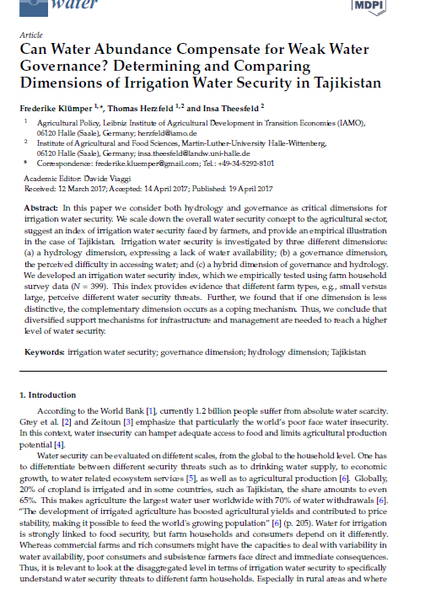
In this paper we consider both hydrology and governance as critical dimensions for irrigation water security. We scale down the overall water security concept to the agricultural sector, suggest an index of irrigation water security faced by farmers, and provide an empirical illustration in the case of Tajikistan. Irrigation water security is investigated by three different dimensions: (a) a hydrology dimension, expressing a lack of water availability; (b) a governance dimension, the perceived difficulty in accessing water; and (c) a hybrid dimension of governance and hydrology. We developed an irrigation water security index, which we empirically tested using farm household survey data (N = 399). This index provides evidence that different farm types, e.g., small versus large, perceive different water security threats. Further, we found that if one dimension is less distinctive, the complementary dimension occurs as a coping mechanism. Thus, we conclude that diversified support mechanisms for infrastructure and management are needed to reach a higher level of water security
По всем вопросам сотрудничества обращайтесь по эл.адресу или телефону: