

Год: 2014
Разделы: Исследовательская работа
Темы: Вода, Трансграничные водные ресурсы, Гидроэнергетика
Авторы: Sonoko Ito, Sameh El Khatib, Mikiyasu Nakayama
Страны: Узбекистан, Таджикистан
Источник: International Journal of Water Resources Development
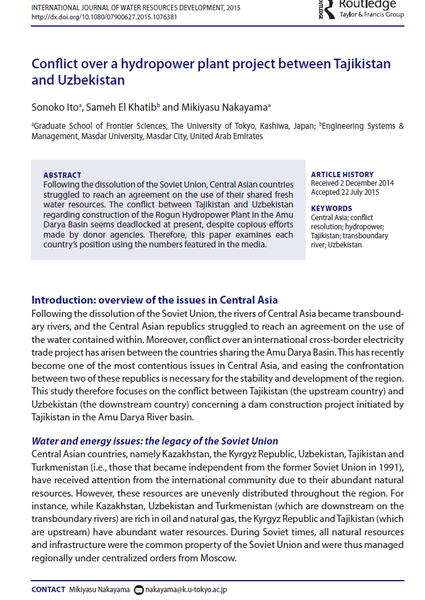
Following the dissolution of the Soviet Union, Central Asian countries struggled to reach an agreement on the use of their shared fresh water resources. The conflict between Tajikistan and Uzbekistan regarding construction of the Rogun Hydropower Plant in the Amu Darya Basin seems deadlocked at present, despite copious efforts made by donor agencies. Therefore, this paper examines each country’s position using the numbers featured in the media.
Файлы для скачивания:
This article, published in the International Journal of Water Resources Development, examines the long-standing conflict between Tajikistan and Uzbekistan over the construction of the Rogun Hydropower Plant (Rogun HPP). It explains how the collapse of the Soviet Union disrupted the region’s integrated energy system, forcing the newly independent states to pursue national interests at the expense of regional cooperation. As an upstream country, Tajikistan seeks to achieve energy independence and stimulate economic development, while downstream Uzbekistan is concerned about reduced water availability for cotton irrigation and potential environmental impacts. The authors analyze the economic and political positions of both countries, highlighting that the CASA-1000 project has further intensified existing mistrust. As a possible solution, the study proposes integrating Uzbekistan into regional trade mechanisms to transform the conflict into mutually beneficial cooperation. The article emphasizes the importance of finding a compromise to promote long-term stability, sustainable water governance, and regional security in Central Asia.
По всем вопросам сотрудничества обращайтесь по эл.адресу или телефону: