
Год: 2020
Разделы: Научные публикации, Обзорная статья
Темы: Вода, Стратегическое управление водными ресурсами Водная дипломатия,
Авторы: et al., Margaret O. Wilder
Страны:
Источник: Environmental Science and Policy
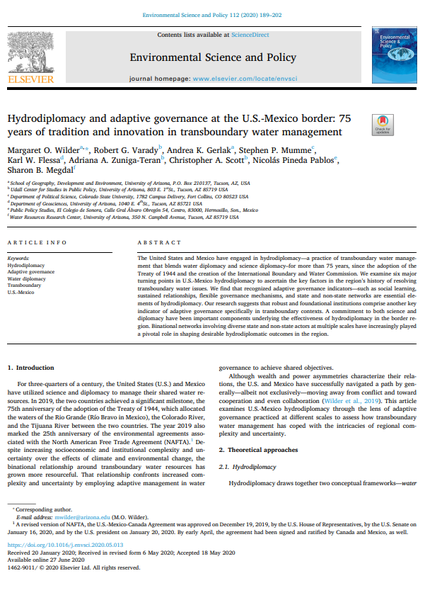
The United States and Mexico have engaged in hydrodiplomacy—a practice of transboundary water management that blends water diplomacy and science diplomacy–for more than 75 years, since the adoption of the Treaty of 1944 and the creation of the International Boundary and Water Commission. We examine six major turning points in U.S.-Mexico hydrodiplomacy to ascertain the key factors in the region’s history of resolving transboundary water issues. We find that recognized adaptive governance indicators—such as social learning, sustained relationships, flexible governance mechanisms, and state and non-state networks are essential elements of hydrodiplomacy. Our research suggests that robust and foundational institutions comprise another key indicator of adaptive governance specifically in transboundary contexts. A commitment to both science and diplomacy have been important components underlying the effectiveness of hydrodiplomacy in the border region. Binational networks involving diverse state and non-state actors at multiple scales have increasingly played a pivotal role in shaping desirable hydrodiplomatic outcomes in the region.
Файлы для скачивания:
The United States and Mexico have engaged in hydrodiplomacy—a practice of transboundary water management that blends water diplomacy and science diplomacy–for more than 75 years, since the adoption of the Treaty of 1944 and the creation of the International Boundary and Water Commission. We examine six major turning points in U.S.-Mexico hydrodiplomacy to ascertain the key factors in the region’s history of resolving transboundary water issues. We find that recognized adaptive governance indicators—such as social learning, sustained relationships, flexible governance mechanisms, and state and non-state networks are essential elements of hydrodiplomacy. Our research suggests that robust and foundational institutions comprise another key indicator of adaptive governance specifically in transboundary contexts. A commitment to both science and diplomacy have been important components underlying the effectiveness of hydrodiplomacy in the border region. Binational networks involving diverse state and non-state actors at multiple scales have increasingly played a pivotal role in shaping desirable hydrodiplomatic outcomes in the region.
По всем вопросам сотрудничества обращайтесь по эл.адресу или телефону: