

Год: 2017
Разделы: Исследовательская работа
Темы: Вода, Климат, ИУВР, Трансграничные водные ресурсы, Трансграничное сотрудничество
Авторы: Sarah Hummel
Страны:
Источник: International Studies Quarterly
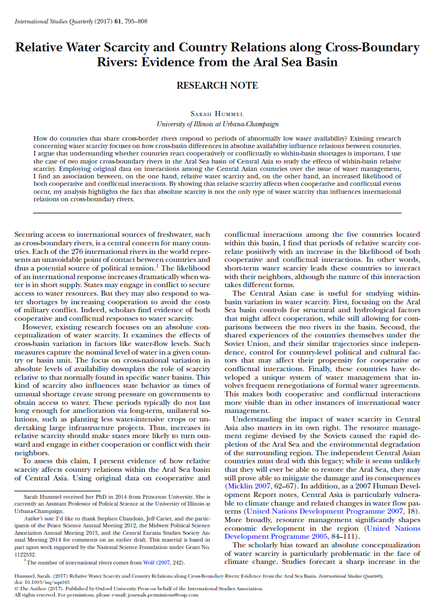
This scientific article examines the impact of relative water scarcity on international relations in the Aral Sea Basin. The author distinguishes between absolute water scarcity, determined by the overall availability of water resources, and relative water scarcity, defined as temporary deviations from normal water availability within a specific river basin. Based on an analysis of hydrological and political data from the Amu Darya and Syr Darya river basins in Central Asia, the study concludes that short-term water shortages stimulate states to take more active policy actions. The findings demonstrate that periods of water scarcity increase the likelihood of both cooperative and conflictual interactions among neighboring countries. This suggests that states employ a variety of foreign policy instruments to address transboundary water challenges under conditions of resource variability. The results highlight the importance of considering climate variability when assessing and forecasting transboundary water disputes and cooperation.
Файлы для скачивания:
How do countries that share cross-border rivers respond to periods of abnormally low water availability? Existing research concerning water scarcity focuses on how cross-basin differences in absolute availability influence relations between countries. I argue that understanding whether countries react cooperatively or conflictually to within-basin shortages is important. I use the case of two major cross-boundary rivers in the Aral Sea basin of Central Asia to study the effects of within-basin relative scarcity. Employing original data on interactions among the Central Asian countries over the issue of water management, I find an association between, on the one hand, relative water scarcity and, on the other hand, an increased likelihood of both cooperative and conflictual interactions. By showing that relative scarcity affects when cooperative and conflictual events occur, my analysis highlights the fact that absolute scarcity is not the only type of water scarcity that influences international relations on cross-boundary rivers.
По всем вопросам сотрудничества обращайтесь по эл.адресу или телефону: