
Год: 2018
Разделы: Исследовательская работа
Темы: Стратегическое управление водными ресурсами, Водная дипломатия, Гидроэнергетика
Авторы: Denise Michèle Staubli Anoulak Kittikhoun,
Страны:
Источник: Journal of Hydrology
The Mekong region, home to one of the world’s great rivers – the Mekong – is also one of the world’s most geostrategic regions, featuring seemingly conflicting interests among regional states including Viet Nam, Thailand, Myanmar, Laos and Cambodia and world powers such as China and the United States of America.
For nearly a century, some of the riparian states have developed parts of the basin in their territories – to great benefits and harm – and recently the remaining late developing countries are catching up with water and related resources development plans to dam, withdraw and use the mighty Mekong to fund national progress and alleviate poverty.
World leaders, academics, NGOs, media and even some government officials have warned that the current rush to development is not only bringing a sure death to a great previously untamed river, potentially displacing millions of people, and threatening livelihoods, but would also usher in an era of aggravated tensions and possibly even conflict. The Mekong River Commission (MRC), tasked to manage the river for the sake of the environment and the people, is failing its mission with work that has been ineffective, uninfluential and wasted, critics say.
Год: 2019
Разделы:
Темы: Водная дипломатия, Трансграничные водные ресурсы, Водная безопасность, Трансграничное сотрудничество
Авторы: Martina Klimes, David Michel, Elizabeth Yaari, Phillia Restiani
Страны:
Источник: Journal of Hydrology
Why water diplomacy? What does diplomacy have to do with water? Is cooperation over transboundary surface and ground waters the exclusive domain of diplomats and foreign policy experts? Or mainly the purview of water professionals negotiating agreements on shared water resources? Why should non-governmental stakeholders be involved in transboundary water dialogues? These questions lie at the heart of debates and dialogues around the theory and practice of water diplomacy.
Год: 2020
Разделы:
Темы: Водная дипломатия, Вода, ИУВР, Трансграничные водные ресурсы, Гидрополитика
Авторы: Naho Mirumachi
Страны:
Источник: Environmental Science and Policy
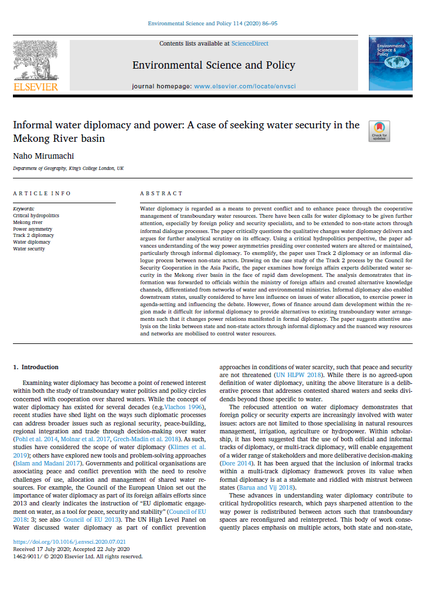
Water diplomacy is regarded as a means to prevent conflict and to enhance peace through the cooperative management of transboundary water resources. There have been calls for water diplomacy to be given further attention, especially by foreign policy and security specialists, and to be extended to non-state actors through informal dialogue processes. The paper critically questions the qualitative changes water diplomacy delivers and argues for further analytical scrutiny on its efficacy. Using a critical hydropolitics perspective, the paper advances understanding of the way power asymmetries presiding over contested waters are altered or maintained, particularly through informal diplomacy.
Год: 2000
Разделы:
Темы: Вода, Водная дипломатия, Трансграничные водные ресурсы, Трансграничное сотрудничество, Гидрополитика
Авторы: Bertram I. Spector
Страны:
Источник: International Negotiation
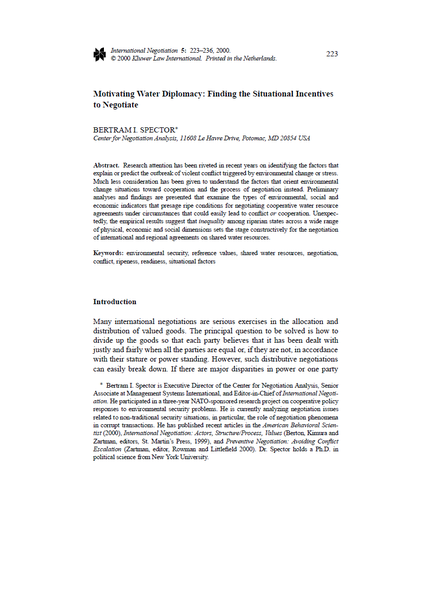
Recent research has focused mainly on factors linking environmental change or stress to violent conflict, while less attention has been paid to conditions that promote cooperation and negotiation. This study presents preliminary findings on environmental, social, and economic indicators that may create favourable conditions for cooperative water resource agreements. The results suggest that inequality among riparian states across physical, economic, and social dimensions can, unexpectedly, facilitate the negotiation of international and regional agreements on shared water resources.
Год: 2021
Разделы:
Темы: Климат, Устойчивое развитие, ИУВР, Водная дипломатия, Трансграничные водные ресурсы, Водная безопасность
Авторы: Soheila Zareie, Omid Bozorg‑Haddad, Hugo A. Loáiciga
Страны:
Источник: Environment, Development and Sustainability
Diplomacy is the art and skill of managing international relations through negotiations between representatives of states or agencies. Water diplomacy is an innovative approach and strategic tool to resolve water issues at local and trans-boundary scales when water conflicts rise in sharing water resources. Complex water supply and sharing issues arise from the existence of multiple stakeholders such as agriculture, industry, urban and domestic users, environmental use, and others competing for scarce water. Water diplomacy may contribute to solving a variety of water conflicts and in this sense is a tool for sustainable water resources management.
По всем вопросам сотрудничества обращайтесь по эл.адресу или телефону: