
Год: 2022
Разделы: Исследовательская работа
Темы: Вода, Устойчивое развитие, NEXUS, Стратегическое управление водными ресурсами, Трансграничные водные ресурсы
Авторы: Ahmad Hamidov, Katrin Daedlow, Heidi Webber, Hussam Hussein, Ilhom Abdurahmanov, Aleksandr Dolidudko, Ali Yawar Seerat, Umida Solieva, Tesfaye Woldeyohanes, Katharina Helming
Страны:
Источник: Ecology and Society
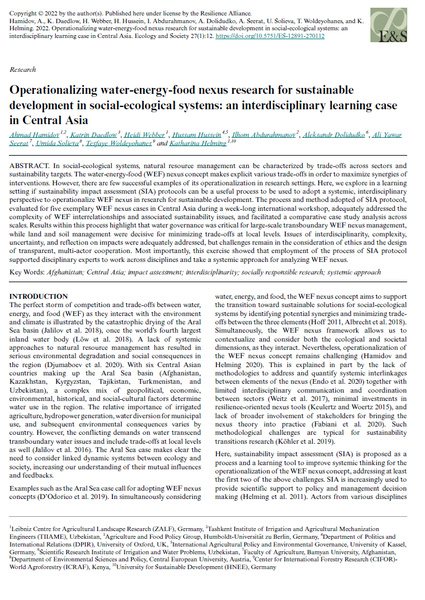
This article focuses on the operationalization of the Water–Energy–Food (WEF) Nexus concept as a framework for promoting sustainable development in Central Asia. The researchers examine the application of the Sustainability Impact Assessment (SIA) protocol as a tool for interdisciplinary analysis of five different environmental systems across the region. The findings demonstrate that a systems-based approach helps experts identify critical trade-offs between water resource management, energy production, and soil conservation. The authors emphasize that the SIA framework is effective in addressing interdisciplinary complexity; however, it requires further development in areas related to ethics and stakeholder engagement. Overall, the study highlights that regional cooperation and the integration of scientific approaches are essential for mitigating the impacts of environmental degradation, including challenges such as the desiccation of the Aral Sea. The article therefore provides a methodological foundation for translating theoretical nexus concepts into practical strategies for natural resource management and sustainable development.
Год: 2017
Разделы: Исследовательская работа
Темы: Устойчивое развитие, Стратегическое управление водными ресурсами, Трансграничные водные ресурсы, Трансграничное сотрудничество
Авторы: Thang Vo, Thong Tran, Duy Luong
Страны:
Источник: Journal of Economic Development
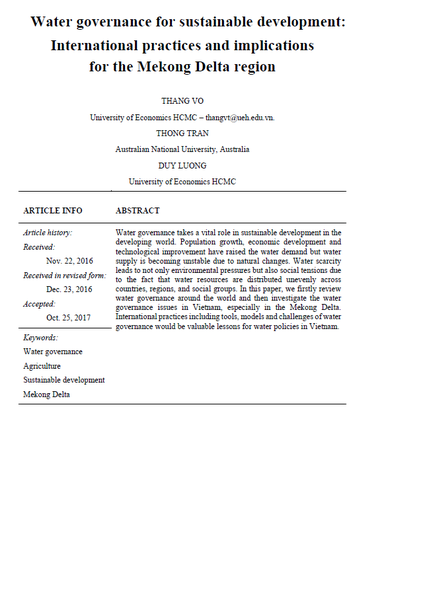
This scientific paper examines water resource management as a key factor in achieving sustainable development, with a particular focus on the Mekong Delta region of Vietnam. The authors analyze global challenges, including freshwater scarcity driven by population growth and climate change, which contribute to droughts and soil salinization. The paper reviews international water governance models implemented in OECD and Latin American countries and identifies common challenges, such as financial constraints and information gaps. The study highlights the critical dependence of Vietnam’s agricultural sector on effective water governance and the efficient allocation of water resources. International experience is presented as a valuable foundation for reforming institutional frameworks and preventing social conflicts arising from water scarcity. The authors conclude by emphasizing the need for a flexible and adaptive water governance system capable of responding to contemporary environmental challenges.
Год: 2022
Разделы: Книги
Темы: Вода, Устойчивое развитие, Стратегическое управление водными ресурсами
Авторы: Gabriela Cuadrado-Quesada
Страны:
Источник: Springer
This book explores the complex relationship between groundwater law and the practical realities of groundwater allocation, with particular emphasis on the principles of equity and sustainable development. The author examines how formal legal frameworks interact with the everyday experiences of communities facing groundwater pollution, scarcity, and overexploitation. Drawing on detailed case studies from Australia, the Netherlands, Costa Rica, and India, the book compares groundwater governance approaches in both the Global North and the Global South. Particular attention is given to the role of local governance and community participation in addressing the limitations of state regulation of these often “invisible” water resources. The book concludes with recommendations for improving environmental law by ensuring that legal frameworks better reflect social needs and local realities. Overall, it highlights that effective groundwater governance requires not only robust legal institutions but also a deep understanding of regional environmental challenges and the importance of collective action.
По всем вопросам сотрудничества обращайтесь по эл.адресу или телефону: