
Year: 2008
Collections: Books
Topics: Water, Sustainable Development, IWRM, Water diplomacy, Transboundary Water Resources, Water Security, Transboundary cooperation, Hydropolitics
Authors: Thomas Bernauer, Tobias Siegfried
Countries:
Source:
This book chapter examines the compliance and actual performance of an international water agreement in the Naryn/Syr Darya Basin in Central Asia. The authors analyze the 1998 agreement, which was designed to regulate the operation of the Toktogul Reservoir by balancing Kyrgyzstan’s need for winter hydropower production with Uzbekistan’s and Kazakhstan’s need for summer irrigation water. The main argument of the article is that formal compliance with an agreement does not necessarily mean that the agreement is effective in solving the real water allocation problem. Using the policy performance metric (PER), the authors show that although compliance with the agreement was relatively high, its actual performance was low and highly variable. The article concludes that the existing water management system in the Naryn/Syr Darya Basin requires urgent institutional reform.
Year: 2025
Collections: Books
Topics: Water, IWRM, Water governance, Water diplomacy, Transboundary Water Resources, Transboundary cooperation
Authors: Shafiqul Islam, Kevin Smith, Martina Klimes, Aaron Salzberg
Countries:
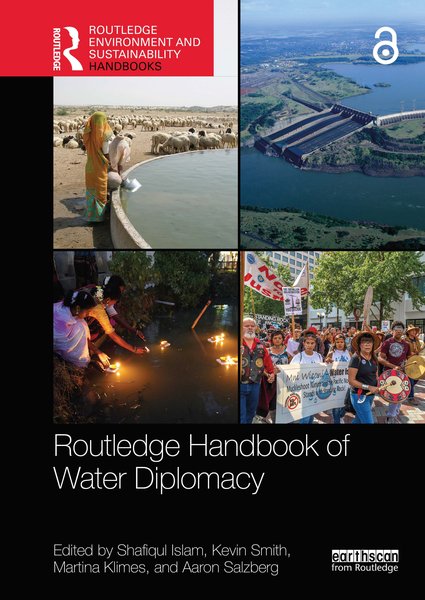
Source: Routledge Handbook of Water Diplomacy
Full book available here: https://drive.google.com/file/d/1V8lHqDiaqrMtHnU6JP9p9SBC2rsXY8gX/view?usp=sharing
The Routledge Handbook of Water Diplomacy is a comprehensive guide to understanding and practicing water diplomacy – a framework for building relationships, negotiating shared interests, and managing complex water challenges across physical, political, and societal boundaries.
In an era marked by rising scarcity, deepening uncertainty, and growing geopolitical tension, this timely volume offers actionable insights for negotiated problem-solving grounded in both scientific understanding and diplomatic skill. Moving beyond abstract theory and technical fixes, the Handbook introduces a dual-pathway structure designed to meet the diverse needs of its users. The “Working Together” pathway invites readers to engage with water diplomacy through the lens of their roles, whether as professionals, decision-makers, funders, researchers, or affected communities. The “What Matters and Why” pathway highlights key thematic dimensions, including process design, adaptive learning, trust-building, divergent worldviews, and the management of uncertainty.
Year: 2022
Collections: Books
Topics: Water, Sustainable Development, Water governance
Authors: Gabriela Cuadrado-Quesada
Countries:
Source: Springer
This book explores the complex relationship between groundwater law and the practical realities of groundwater allocation, with particular emphasis on the principles of equity and sustainable development. The author examines how formal legal frameworks interact with the everyday experiences of communities facing groundwater pollution, scarcity, and overexploitation. Drawing on detailed case studies from Australia, the Netherlands, Costa Rica, and India, the book compares groundwater governance approaches in both the Global North and the Global South. Particular attention is given to the role of local governance and community participation in addressing the limitations of state regulation of these often “invisible” water resources. The book concludes with recommendations for improving environmental law by ensuring that legal frameworks better reflect social needs and local realities. Overall, it highlights that effective groundwater governance requires not only robust legal institutions but also a deep understanding of regional environmental challenges and the importance of collective action.
For questions about cooperation, please contact us at: