
Year: 2025
Collections: Scientific Publications
Topics: Agriculture
Authors: Ankit Garg, Sai Krishna Akash Ramineni, Neelima Satyam, Askar Zhussupbekov
Countries: Kazakhstan, Kyrgyzstan, Uzbekistan, Tajikistan, Turkmenistan
Source: https://cajscr.com/
Soil salinity in Central Asia negatively impacts soil structure, leading to degradation and reduced water infiltration. This not only hampers agricultural productivity but also makes the land less suitable for construction due to its high susceptibility to deformation. Environmentally friendly materials like biochar, a carbon-rich substance, show promise in reducing the deformation of saline soils. However, the mechanisms behind its effectiveness are not yet fully understood. This study aims to analyse saline clays’ dispersion and sedimentation behaviour under varying pore water salinity levels (0 % to 10%). A biochar content of 5 % was selected as it is found to be optimum for plant growth and erosion resistance. It was found from the study that the biochar increases the aggregation of soil particles and enhances flocculation, improving soil dispersion characteristics. Biochar facilitates soil particle aggregation by increasing the cation exchange capacity. At higher pore water salinity levels (5% and 10%), the sedimentation behaviour of biochar-treated soil particles deviates from expectations, showing slower sedimentation rates and lower sedimentation heights. This is because the sodium ions are adsorbed by biochar, reducing salt’s effect on dispersion and sedimentation. The results demonstrate that biochar effectively enhances the stability of saline soils and, hence, has a potential use for ground improvement in the Central Asian region.
![Manual_5.0_FINAL_12.3_3rd_edition[1]_Страница_001](/media/images/Manual_5.0_FINAL_12.3_3rd_edition1.2e16d0ba.fill-425x600.png)
Year: 2025
Collections: Manuals
Topics: Water, IWRM
Authors: Kogutenko Larissa, Safiya Asalbekova, Michael Walther
Countries: Kazakhstan, Kyrgyzstan, Uzbekistan, Tajikistan, Turkmenistan
Source: Journal of MOLARE Research Centre (MRC)
Why water monitoring and assessment are important?
Water quality assessment is one of the crucial scientific and practical analyses to identify the possibility of water consumption for different human needs and nature/ecosystem conservation for future generations. Water quality can be measured and monitored in rivers, springs, creeks, swamps, estuaries, wetlands and lakes what is called aquatic systems. Quality parameters, such as biological, chemical and physical indicators identify the combination of values that influence the composition of water. Monitoring and comparison of different water habitats (macro invertebrates) in biological monitoring provides an information of water quality and allows to make a quick assessment.
Year: 2018
Collections: Research Paper
Topics: Water governance, IWRM, Transboundary cooperation Irrigation,
Authors: Iroda Amirova, Martin Petrick, Nodir Djanibekov
Countries: Kazakhstan, Uzbekistan
Source: World Development
This study contributes to the understanding of long- and short-term determinants of cooperation among water users. We experimentally investigate the potential of water users’ self-governance in enhancing their contributions to a common pool as opposed to external regulation. Our focus is on the irrigated areas of Kazakhstan and Uzbekistan.
Year: 2012
Collections:
Topics: Water, Climate, NEXUS, Hydropolitics
Authors: Thomas Bernauer, Tobias Siegfried
Countries: Kazakhstan, Kyrgyzstan, Uzbekistan, Tajikistan
Source: Journal of Peace Research
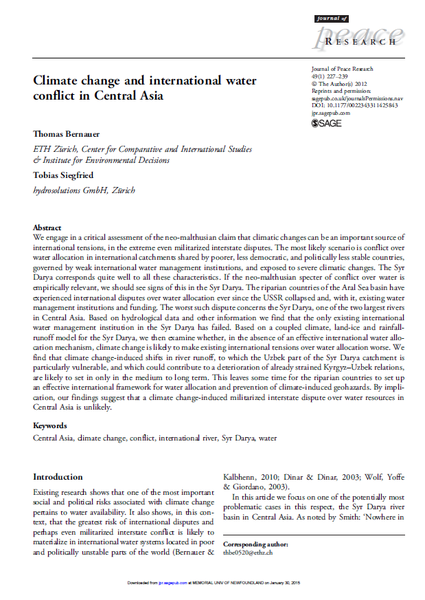
The authors engage in a critical assessment of the neo-malthusian claim that climatic changes can be an important source of international tensions, in the extreme even militarized interstate disputes.
Year: 2013
Collections: Research Paper
Topics: Water, Water governance
Authors: Michael Eichholz, Kristof Van Assche, Lisa Oberkircher, Anna-Katharina Hornidge
Countries: Uzbekistan
Source: Journal of Environmental Planning and Management
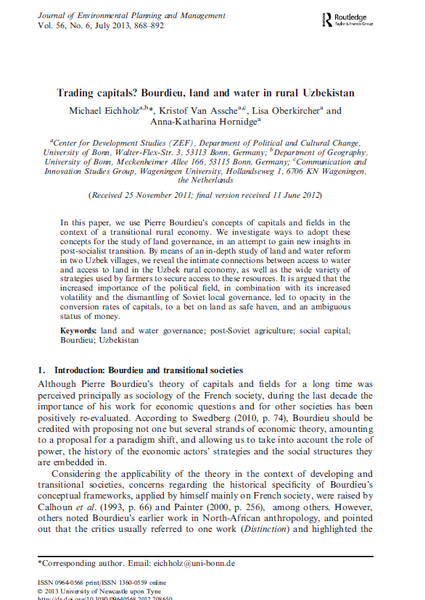
This article analyzes the governance of land and water resources in rural Uzbekistan through the lens of Pierre Bourdieu’s sociological theory. The authors explore how farmers adapt to post-socialist reforms and successive waves of land consolidation by relying on different forms of capital, including social, political, and symbolic capital. The study demonstrates that, in the absence of an open market and transparent rules, access to resources becomes the outcome of continuous negotiations and exchanges of favors. Under conditions of high uncertainty, social networks and proximity to political authorities prove to be more important than direct financial investments. As a result, the rural economy is transformed into a complex system of personal arrangements, where the survival and success of farming households depend on farmers’ ability to convert their informal assets into actual access to land and water resources.
For questions about cooperation, please contact us at: