
Year: 2000
Collections:
Topics: Water, Water diplomacy, Transboundary Water Resources, Transboundary cooperation, Hydropolitics
Authors: Bertram I. Spector
Countries:
Source: International Negotiation
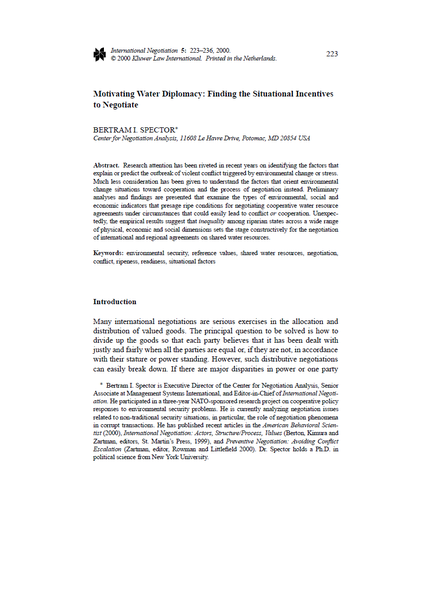
Recent research has focused mainly on factors linking environmental change or stress to violent conflict, while less attention has been paid to conditions that promote cooperation and negotiation. This study presents preliminary findings on environmental, social, and economic indicators that may create favourable conditions for cooperative water resource agreements. The results suggest that inequality among riparian states across physical, economic, and social dimensions can, unexpectedly, facilitate the negotiation of international and regional agreements on shared water resources.
Downloads:
Research attention has been riveted in recent years on identifying the factors that explain or predict the outbreak of violent conflict triggered by environmental change or stress. Much less consideration has been given to understand the factors that orient environmental change situations toward cooperation and the process of negotiation instead. Preliminary analyses and findings are presented that examine the types of environmental, social and economic indicators that presage ripe conditions for negotiating cooperative water resource agreements under circumstances that could easily lead to conflict or cooperation. Unexpectedly, the empirical results suggest that inequality among riparian states across a wide range of physical, economic and social dimensions sets the stage constructively for the negotiation of international and regional agreements on shared water resources.
По всем вопросам сотрудничества обращайтесь по эл.адресу или телефону: