

Year: 2017
Collections: Research Paper
Topics: Water, Water governance, Transboundary Water Resources, Transboundary cooperation, Hydropolitics
Authors: Sarah Acquah, Frank A. Ward
Countries:
Source: Water Resources Management
Afghanistan contributes water supplies to Iran, Pakistan, Tajikistan, Turkmenistan, and Uzbekistan. However, with the exception of the Helmand Basin, Afghanistan has negotiated transboundary water sharing agreements with no downstream country. This paper describes a constrained optimization framework to minimize economic costs within each of nine Afghan transboundary basins of adapting to potential water sharing agreements.
Downloads:
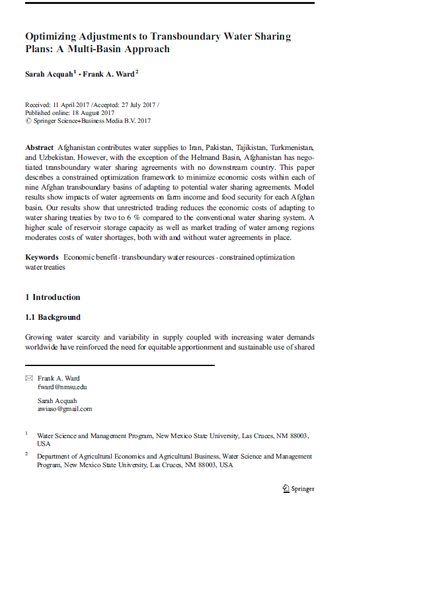
Afghanistan contributes water supplies to Iran, Pakistan, Tajikistan, Turkmenistan, and Uzbekistan. However, with the exception of the Helmand Basin, Afghanistan has negotiated transboundary water sharing agreements with no downstream country. This paper describes a constrained optimization framework to minimize economic costs within each of nine Afghan transboundary basins of adapting to potential water sharing agreements. Model results show impacts of water agreements on farm income and food security for each Afghan basin. Our results show that unrestricted trading reduces the economic costs of adapting to water sharing treaties by two to 6 % compared to the conventional water sharing system. A higher scale of reservoir storage capacity as well as market trading of water among regions moderates costs of water shortages, both with and without water agreements in place.
По всем вопросам сотрудничества обращайтесь по эл.адресу или телефону: