
Year: 2016
Collections: Scientific Publications, Research Paper, Review article, Concept paper
Topics: Water, Sustainable Development, IWRM, Water law, Water diplomacy, Water governance
Authors: Patrick Huntjens, Yumiko Yasuda, Ashok Swain, Rens de Man, Bjørn-Oliver Magsig, Shafiqul Islam
Countries: N/A
Source: The Hague Institute for Global Justice
This publication is part of the project Water Diplomacy: Making Water Cooperation Work, led by The Hague Institute for Global Justice, in collaboration with Stockholm International Water Institute (SIWI), UNESCO Category II Centre for International Water Cooperation (ICWC), International Union for Conservation of Nature (IUCN), Uppsala University, University of Otago, University College Cork and Tufts University Water Diplomacy Program.
Downloads:
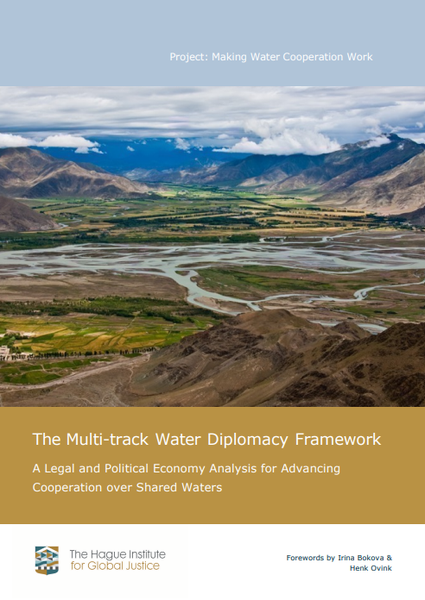
This publication is developed within the context of the research project ‘Water Diplomacy: Making Water Cooperation Work’, led by The Hague Institute for Global Justice in collaboration with Stockholm International Water Institute (SIWI), UNESCO Category II Centre for International Water Cooperation (ICWC), International Union for the Conservation of Nature (IUCN), Uppsala University, University of Otago, University College Cork and Tufts University Water Diplomacy Program. The common aim of the project and this publication is to identify and operationalize the key factors affecting transboundary water cooperation.
The framework helps to diagnose water problems across sectors and administrative boundaries, and at different levels of governance. To this end, it identifies intervention points, and proposes sustainable solutions that are sensitive to diverse views and values, and can accommodate ambiguity and uncertainty as well as changing and competing needs. The framework has great potential to build a sound bridge from actual or potential conflict to effective cooperation and practical solutions. Its initial application to the Brahmaputra basin uniquely identifies a zone of possible effective cooperation (ZOPEC), and has already gained the strong commitment from delegates representing all riparian countries (including China, India, Bangladesh and Bhutan), for example to identifying and developing benefit-sharing arrangements across sectors. This case study demonstrates the potential of the framework to facilitate a paradigm shift among key stakeholders in water-related disputes from a zero-sum approach to one of mutual gains.
По всем вопросам сотрудничества обращайтесь по эл.адресу или телефону: