

Year: 2021
Collections: Research Paper
Topics: Water, Water law, Water Security, Transboundary cooperation, Hydropolitics
Authors: Abdulsalam Amini, Hamidreza Jafari, Bahram Malekmohammadi, Touraj Nasrabadi
Countries: Iran Turkmenistan, Afghanistan,
Source: Discrete Dynamics in Nature and Society
The present paper aims to analyze, using the Graph Model for Conflict Resolution (GMCR), a game theory model, the conflict between the three countries regarding the utilization of the water resources of the border river, Harirud. To this purpose, first, the current state of the conflict was investigated.
Downloads:
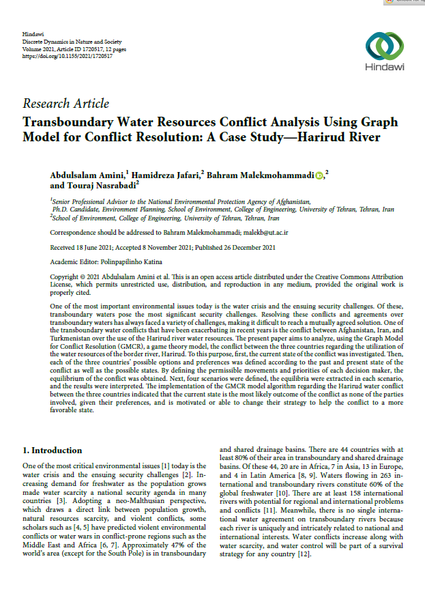
One of the most important environmental issues today is the water crisis and the ensuing security challenges. Of these, transboundary waters pose the most significant security challenges. Resolving these conflicts and agreements over transboundary waters has always faced a variety of challenges, making it difficult to reach a mutually agreed solution. One of the transboundary water conflicts that have been exacerbating in recent years is the conflict between Afghanistan, Iran, and Turkmenistan over the use of the Harirud river water resources. The present paper aims to analyze, using the Graph Model for Conflict Resolution (GMCR), a game theory model, the conflict between the three countries regarding the utilization of the water resources of the border river, Harirud. To this purpose, first, the current state of the conflict was investigated. Then, each of the three countries’ possible options and preferences was defined according to the past and present state of the conflict as well as the possible states. By defining the permissible movements and priorities of each decision maker, the equilibrium of the conflict was obtained. Next, four scenarios were defined, the equilibria were extracted in each scenario, and the results were interpreted. The implementation of the GMCR model algorithm regarding the Harirud water conflict between the three countries indicated that the current state is the most likely outcome of the conflict as none of the parties involved, given their preferences, and is motivated or able to change their strategy to help the conflict to a more favorable state.
По всем вопросам сотрудничества обращайтесь по эл.адресу или телефону: