
Year: 2025
Collections: Scientific Publications
Topics: Water, Climate
Authors: Maiwand Omary
Countries: Afghanistan
Source: https://water-ca.org
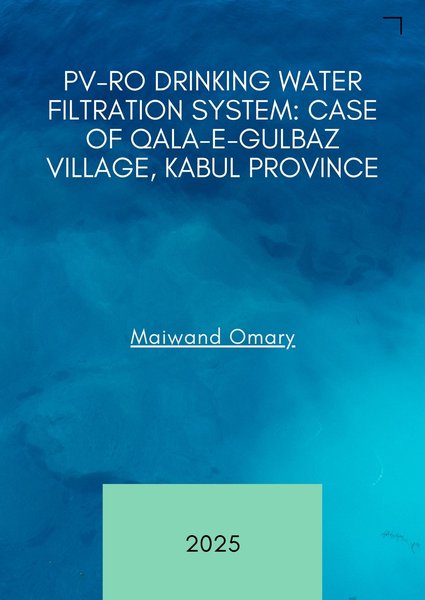
Pollution and over-exploitation of groundwater aquifers in Kabul Province have led to deteriorated water quality and decreased quantity. In its turn, these have caused elevation of physical, chemical, and biological contaminant concentrations in the province’s groundwater beyond national and international drinking water quality standards. The article describes the outcomes of a pilot photovoltaic reverse osmosis (PV-RO) system for drinking water treatment in Qala-e-Gulbaz Village, Kabul Province, Afghanistan. The main system’s components include PV solar panels, three dosing pumps, two alternative current pumps, two alternative-to-direct-current inverters, sand and carbon filters, two sediment filters, one ultra-violet filter, two water flow meters, and a complete water supply distribution system. The study was assisted by the Danish Committee for Aid to Afghan Refugees (DACAAR) ground monitoring well (GMW) system; quality analysis of different physical, chemical, and biological parameters of raw and filtered water samples; measuring filtered water and wastewater flow rates; determining associated limitations and pressures; as well as valuating different related expenses during cost per capita calculations. Water quality testing has shown the system’s removal efficiency of 97% for salinity, 97% for total dissolved solids, above 90% for other chemicals (anions & cations), 65.52% for turbidity, and 100% for bacteria. The plant’s mean quantity efficiency has amounted to 50%. The study highlights certain key challenges including high initial cost, significant wastewater volume, and need for professional operators leading to high operational and maintenance expenditures, with the initial system’s cost per capita of USD79.54. Therefore, under the condition of optimizing efficiency, improving wastewater management, reducing original costs, implementing training programs, and developing the necessary policy framework PV-RO water treatment systems represent a viable alternative.
Year: 2025
Collections: Scientific Publications
Topics: Water, Climate
Authors: Rohullah Mayar, Mohammad Assem Mayar, Mohammad Hamid Omar
Countries: Afghanistan
Source: https://water-ca.org
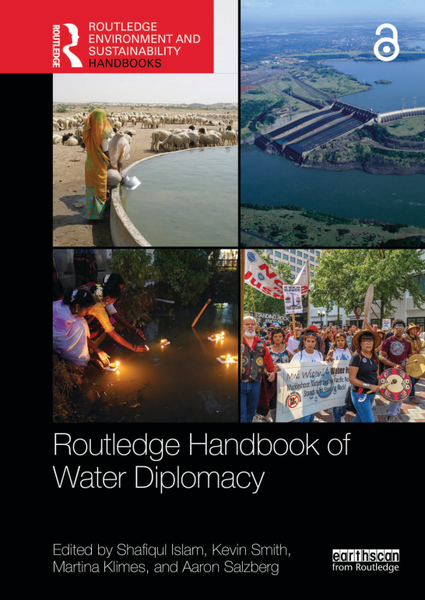
Year: 2025
Collections: Books
Topics: Water, Climate, Sustainable Development, Management, Water diplomacy, Water governance Gender, IWRM, Agriculture, Irrigation,
Authors: Shafiqul Islam, Kevin Smith, Martina Klimes, Aaron Salzberg
Countries: N/A
Source: Routledge
The Routledge Handbook of Water Diplomacy is a comprehensive guide to understanding and practicing water diplomacy – a framework for building relationships, negotiating shared interests, and managing complex water challenges across physical, political, and societal boundaries.
Year: 2024
Collections: Scientific Publications, Review article
Topics: Water, Climate, Water governance
Authors: Susanne Schmeier, Alexandra Turgul, Melissa McCracken, Zoe H. Rosenblum, Lynette de Silva, Aaron T. Wolf
Countries:
Source: Water International, 49(3-4), 274-288
This article explores major findings and evolutions in understandings of transboundary water conflict and cooperation over the last three decades, focusing on the trends emerging from the Transboundary Freshwater Diplomacy Database. It is found that since the 1940s, countries tend to cooperate over shared water resources, in contrast to media portrayals of 'water wars'. Water conflicts, which have increased slightly since 2000, are mostly fuelled by water quantity disputes or unilateral infrastructure developments. Institutions play a role in facilitating cooperation and reducing conflict over shared waters, but their growth and adoption have slowed over the last few decades.
Year: 2021
Collections:
Topics: Climate, Sustainable Development, IWRM, Water diplomacy, Transboundary Water Resources, Water Security
Authors: Soheila Zareie, Omid Bozorg‑Haddad, Hugo A. Loáiciga
Countries:
Source: Environment, Development and Sustainability
Diplomacy is the art and skill of managing international relations through negotiations between representatives of states or agencies. Water diplomacy is an innovative approach and strategic tool to resolve water issues at local and trans-boundary scales when water conflicts rise in sharing water resources. Complex water supply and sharing issues arise from the existence of multiple stakeholders such as agriculture, industry, urban and domestic users, environmental use, and others competing for scarce water. Water diplomacy may contribute to solving a variety of water conflicts and in this sense is a tool for sustainable water resources management.
For questions about cooperation, please contact us at: