
Year: 2012
Collections:
Topics: Water, Climate, NEXUS, Hydropolitics
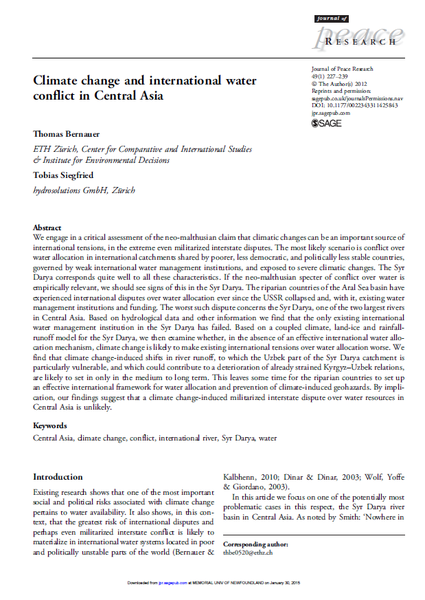
Authors: Thomas Bernauer, Tobias Siegfried
Countries: Kazakhstan, Kyrgyzstan, Uzbekistan, Tajikistan
Source: Journal of Peace Research
The authors engage in a critical assessment of the neo-malthusian claim that climatic changes can be an important source of international tensions, in the extreme even militarized interstate disputes.
Year: 2017
Collections:
Topics: Water governance Climate, IWRM, Irrigation,
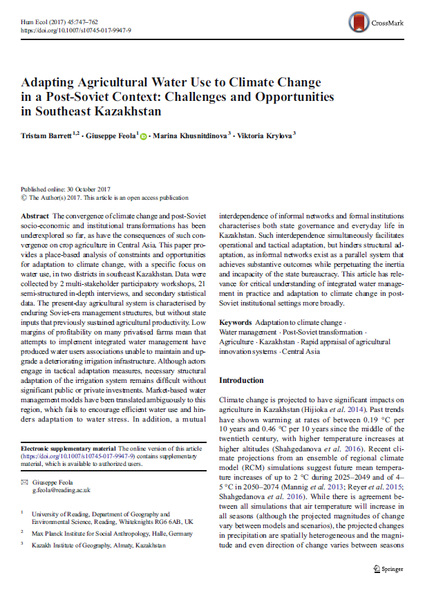
Authors: Tristam Barrett, Giuseppe Feola, Marina Khusnitdinova, Viktoria Krylova
Countries: Kazakhstan
Source: Human Ecology
The convergence of climate change and post-Soviet socio-economic and institutional transformations has been underexplored so far, as have the consequences of such convergence on crop agriculture in Central Asia. This paper provides a place-based analysis of constraints and opportunities for adaptation to climate change, with a specific focus on water use, in two districts in southeast Kazakhstan.
Year: 2020
Collections:
Topics: Water, Climate, IWRM, Water diplomacy, Transboundary Water Resources, Water Security, Hydropower
Authors: Melinda Davies, Nathanial Matthews
Countries:
Source: International Journal of Water Resources Development
The article focuses on how China’s Belt and Road Initiative (BRI) may affect water resources and water governance in Central Asia. The authors consider Central Asia as a region that already faces a complex water situation, including transboundary rivers, water scarcity, the dependence of agriculture on irrigation, the environmental problems of the Aral Sea, weak coordination between countries, and the impacts of climate change. Against this background, the development of infrastructure, industry, hydropower, and agriculture under the BRI may increase pressure on water resources.
Year: 2017
Collections: Research Paper
Topics: Water, Climate, IWRM, Transboundary Water Resources, Transboundary cooperation
Authors: Sarah Hummel
Countries:
Source: International Studies Quarterly
This scientific article examines the impact of relative water scarcity on international relations in the Aral Sea Basin. The author distinguishes between absolute water scarcity, determined by the overall availability of water resources, and relative water scarcity, defined as temporary deviations from normal water availability within a specific river basin. Based on an analysis of hydrological and political data from the Amu Darya and Syr Darya river basins in Central Asia, the study concludes that short-term water shortages stimulate states to take more active policy actions. The findings demonstrate that periods of water scarcity increase the likelihood of both cooperative and conflictual interactions among neighboring countries. This suggests that states employ a variety of foreign policy instruments to address transboundary water challenges under conditions of resource variability. The results highlight the importance of considering climate variability when assessing and forecasting transboundary water disputes and cooperation.
Year: 2025
Collections: Research Paper
Topics: Climate, Water governance, Transboundary Water Resources, Transboundary cooperation, Hydropolitics
Authors: Albina Prniyazova, Suriya Turaeva, Daniyar Turgunov, Ben Jarihani
Countries:
Source: Sustainability
Sustainable transboundary water governance in Central Asia faces significant challenges, including political tensions, ecological issues, such as the drying Aral Sea, and seasonal hydropower disruptions impacting downstream countries. This study aims to address these problems by examining the complexities of water resource governance in the region, emphasizing the interplay between national interests and regional cooperation.
For questions about cooperation, please contact us at: