

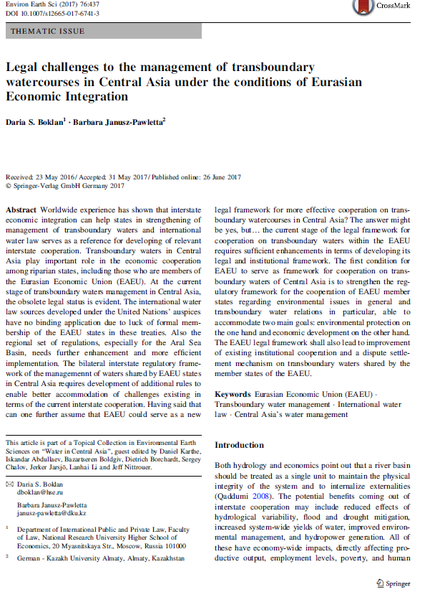
Year: 2017
Collections: Research Paper
Topics: IWRM, Water law, Water diplomacy, Transboundary Water Resources, Hydropolitics
Authors: Daria Boklan, Barbara Janusz-Pawletta
Countries:
Source: Environmental Earth Sciences
This article explores the legal challenges of managing transboundary watercourses in Central Asia in the context of the Eurasian Economic Union (EAEU). The authors analyze whether existing international, regional, and bilateral legal mechanisms are sufficient for regulating shared rivers such as the Syr Darya, Chu, Talas, Irtysh, Ural, and others.
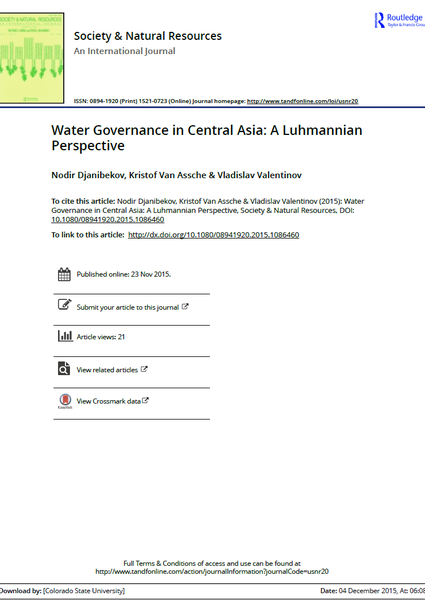
Year: 2015
Collections: Research Paper
Topics: Water governance, Transboundary Water Resources, Hydropolitics
Authors: Nodir Djanibekov, Kristof Van Assche, Vladislav Valentinov
Countries:
Source: Society & Natural Resources
The article focuses on the problems of transboundary water governance in Central Asia from the perspective of Niklas Luhmann’s social systems theory. The authors examine why, after the collapse of the Soviet Union, it became difficult to coordinate the use of the water-energy infrastructure of the Amu Darya and Syr Darya rivers. During the Soviet period, water, energy, and agriculture were managed through a centralized system. However, after 1991, each country began to develop its own national policy. This strengthened contradictions between upstream countries, which need water for hydropower production, and downstream countries, which need water for irrigation.
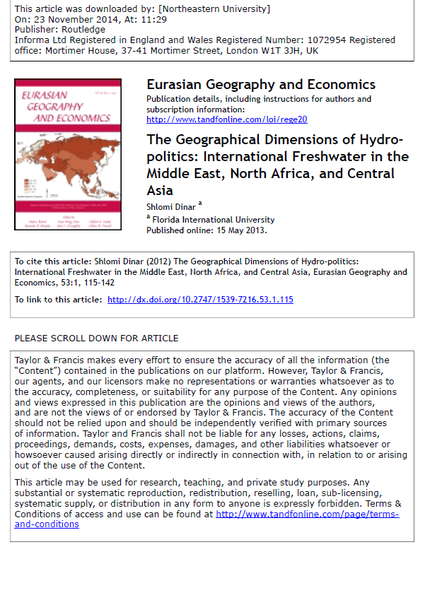
Year: 2013
Collections:
Topics: Transboundary cooperation, Hydropower, Hydropolitics Irrigation,
Authors: Shlomi Dinar
Countries:
Source: Eurasian Geography and Economics
The article focuses on the role of geography and the relative power of states in international hydropolitics. The author analyzes how a country’s position within a river basin — upstream or downstream — affects its ability to participate in water negotiations. It is often assumed that a state with greater military and economic power can dictate the terms of water allocation. However, the author shows that geographical location is also an important source of power. Even a weaker state, if it is located upstream, can influence the water regime and challenge the existing status quo.
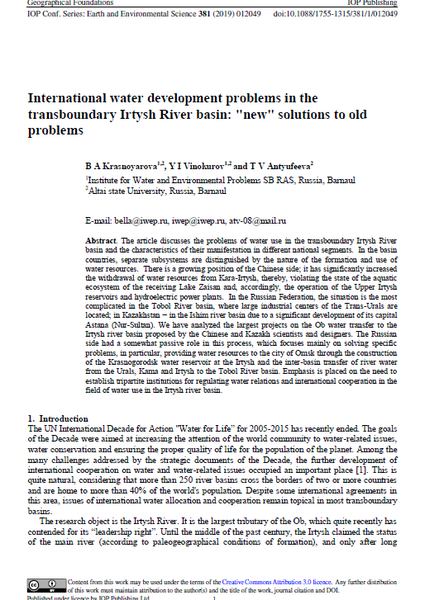
Year: 2019
Collections: Conferences
Topics: Water governance, Water diplomacy, Transboundary Water Resources, Transboundary cooperation, Hydropolitics
Authors: B. A. Krasnoyarova, Y. I. Vinokurov, T. V. Antyufeeva
Countries:
Source: IOP Conference Series: Earth and Environmental Science
This article examines the complex challenges of water management in the transboundary Irtysh River Basin shared by China, Kazakhstan, and Russia. The authors emphasize that intensive water withdrawals by China and ongoing infrastructure development in Kazakhstan are contributing to water resource depletion and ecosystem degradation, particularly in the downstream reaches of the river. The study discusses proposed inter-basin water transfer projects aimed at addressing water scarcity, as well as the environmental risks associated with industrial pollution. Particular attention is given to Russia’s limited engagement in transboundary water governance and the need to establish trilateral institutional mechanisms for the joint management of shared water resources. The authors argue that achieving international consensus is essential to preventing further ecological deterioration of the basin. The study concludes by advocating a shift from isolated technical solutions toward an integrated transboundary water governance framework.
Year: 2025
Collections: Research Paper
Topics: Climate, Water governance, Transboundary Water Resources, Transboundary cooperation, Hydropolitics
Authors: Albina Prniyazova, Suriya Turaeva, Daniyar Turgunov, Ben Jarihani
Countries:
Source: Sustainability
Sustainable transboundary water governance in Central Asia faces significant challenges, including political tensions, ecological issues, such as the drying Aral Sea, and seasonal hydropower disruptions impacting downstream countries. This study aims to address these problems by examining the complexities of water resource governance in the region, emphasizing the interplay between national interests and regional cooperation.
For questions about cooperation, please contact us at: