

Year: 2023
Collections: Scientific Publications, Review article
Topics: Water, Water diplomacy
Authors: Wondwosen Michago Seide, Emanuele Fantini
Countries:
Source: Water Alternatives 16(3): 912-929
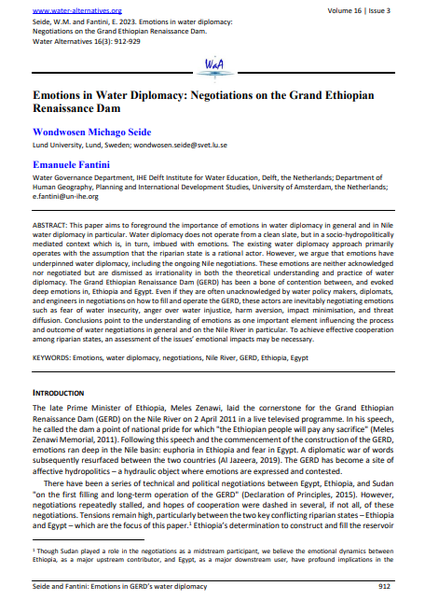
This paper aims to foreground the importance of emotions in water diplomacy in general and in Nile water diplomacy in particular. Water diplomacy does not operate from a clean slate, but in a socio-hydropolitically mediated context which is, in turn, imbued with emotions. The existing water diplomacy approach primarily operates with the assumption that the riparian state is a rational actor. However, we argue that emotions have underpinned water diplomacy, including the ongoing Nile negotiations. These emotions are neither acknowledged nor negotiated but are dismissed as irrationality in both the theoretical understanding and practice of water diplomacy.
Year: 2022
Collections: Scientific Publications, Review article
Topics: Water, Water governance Water diplomacy,
Authors: Bota Sharipova, Susanne Schmeier, Rozemarijn ter Horst, Alyssa Offutt, Jenniver Sehring
Countries:
Source: Diplomatica, 4(2), 200-221
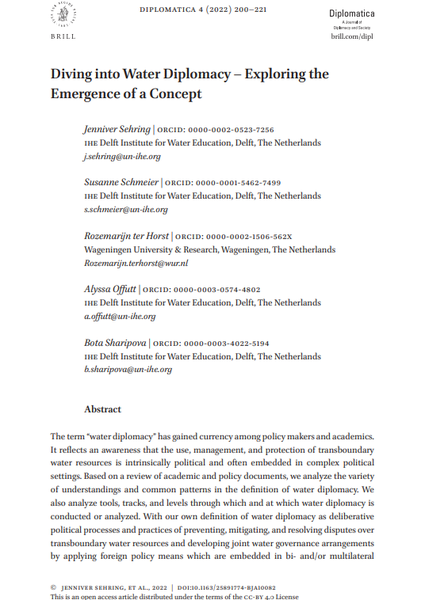
Based on a review of academic and policy documents, we analyze the variety of understandings and common patterns in the definition of water diplomacy. We also analyze tools, tracks, and levels through which and at which water diplomacy is conducted or analyzed.
Year: 2023
Collections: Scientific Publications, Books
Topics: Water diplomacy, Water, Gender, Water governance
Authors: Rozemarijn ter Horst, Jenniver Sehring, Margreet Zwarteveen
Countries:
Source: Routledge. Taylor & Francis
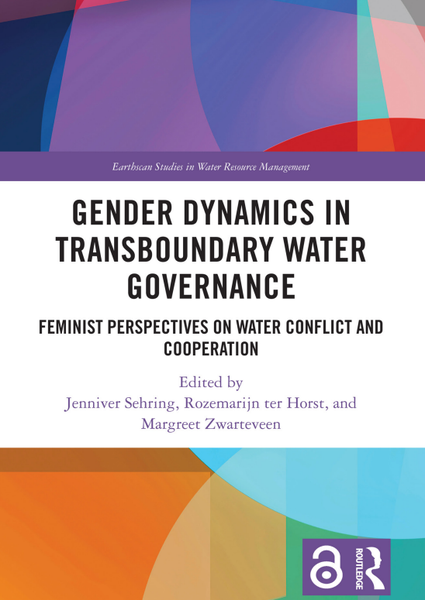
This volume assesses the nexus of gender and transboundary water governance, containing empirical case studies, discourse analyses, practitioners’ accounts, and theoretical refections.
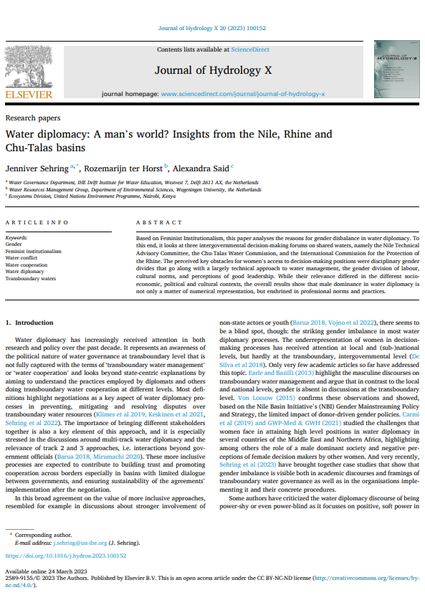
Year: 2023
Collections: Scientific Publications, Review article
Topics: Water, Water governance Water diplomacy,
Authors: Rozemarijn ter Horst, Jenniver Sehring, Alexandra Said
Countries:
Source: Journal of Hydrology X
Based on Feminist Institutionalism, this paper analyses the reasons for gender disbalance in water diplomacy. To this end, it looks at three intergovernmental decision-making forums on shared waters, namely the Nile Technical Advisory Committee, the Chu-Talas Water Commission, and the International Commission for the Protection of the Rhine. The perceived key obstacles for women’s access to decision-making positions were disciplinary gender divides that go along with a largely technical approach to water management, the gender division of labour, cultural norms, and perceptions of good leadership. While their relevance differed in the different socioeconomic, political and cultural contexts, the overall results show that male dominance in water diplomacy is not only a matter of numerical representation, but enshrined in professional norms and practices.
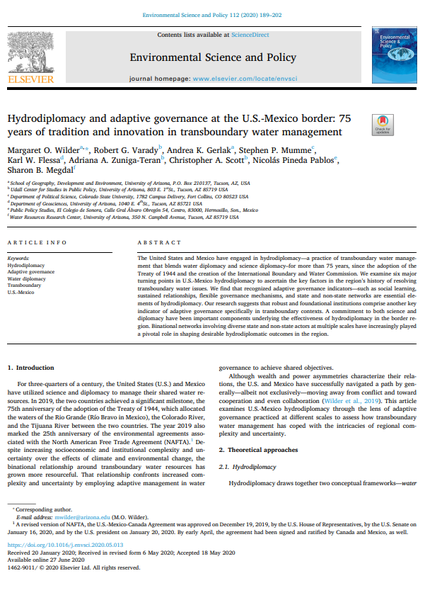
Year: 2020
Collections: Scientific Publications, Review article
Topics: Water, Water governance Water diplomacy,
Authors: et al., Margaret O. Wilder
Countries:
Source: Environmental Science and Policy
The United States and Mexico have engaged in hydrodiplomacy—a practice of transboundary water management that blends water diplomacy and science diplomacy–for more than 75 years, since the adoption of the Treaty of 1944 and the creation of the International Boundary and Water Commission. We examine six major turning points in U.S.-Mexico hydrodiplomacy to ascertain the key factors in the region’s history of resolving transboundary water issues. We find that recognized adaptive governance indicators—such as social learning, sustained relationships, flexible governance mechanisms, and state and non-state networks are essential elements of hydrodiplomacy. Our research suggests that robust and foundational institutions comprise another key indicator of adaptive governance specifically in transboundary contexts. A commitment to both science and diplomacy have been important components underlying the effectiveness of hydrodiplomacy in the border region. Binational networks involving diverse state and non-state actors at multiple scales have increasingly played a pivotal role in shaping desirable hydrodiplomatic outcomes in the region.
For questions about cooperation, please contact us at: