
Year: 2020
Collections: Books
Topics: Water, Sustainable Development, Irrigation, IWRM, NEXUS, Water law, Water diplomacy, Water governance, Transboundary Water Resources, Water Security
Authors: Anoulak Kittikhoun, Susanne Schmeier
Countries:
Source: Routledge
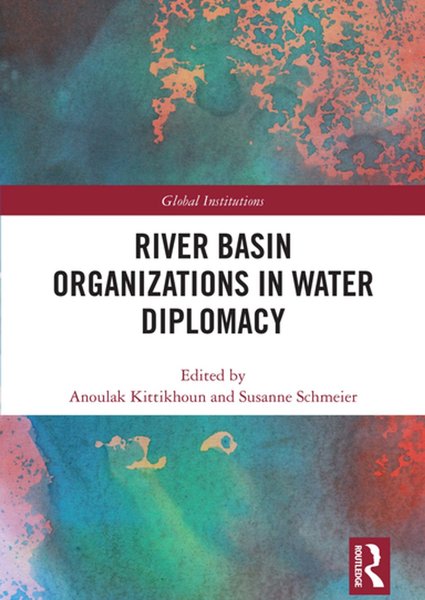
River Basin Organizations in Water Diplomacy explores the role of River Basin Organizations (RBOs) in preventing and resolving conflicts related to transboundary water resources. Through a comparative analysis of international river basins, the book examines how institutional mechanisms, legal frameworks, and diplomatic tools promote cooperation among states and support the sustainable management of shared water resources.
Year: 2018
Collections:
Topics: Water, Water law, Water diplomacy, Water governance, Transboundary Water Resources, Water Security
Authors: Charlotte Grech-Madin, Stefan Döring, Kyungmee Kim, Ashok Swain
Countries:
Source: Journal of Hydrology
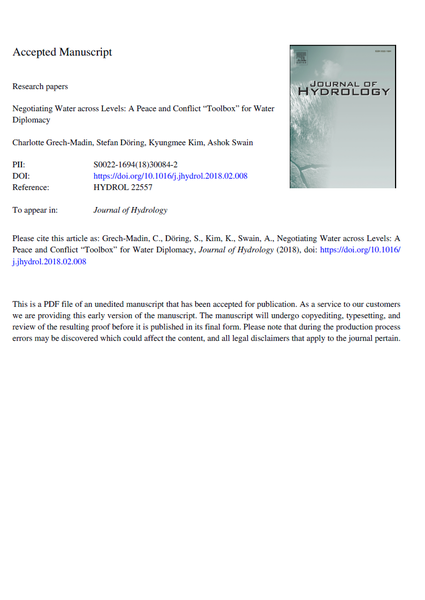
This article explores how water diplomacy can be strengthened through multi-level governance approaches. Drawing on peace and conflict research, it highlights the importance of political norms, stakeholder engagement, and local-level data in improving cooperation over shared water resources and enhancing the effectiveness of water diplomacy.
Year: 2018
Collections: Research Paper
Topics: Water governance, Water diplomacy, Hydropower
Authors: Denise Michèle Staubli Anoulak Kittikhoun,
Countries:
Source: Journal of Hydrology
The Mekong region, home to one of the world’s great rivers – the Mekong – is also one of the world’s most geostrategic regions, featuring seemingly conflicting interests among regional states including Viet Nam, Thailand, Myanmar, Laos and Cambodia and world powers such as China and the United States of America.
For nearly a century, some of the riparian states have developed parts of the basin in their territories – to great benefits and harm – and recently the remaining late developing countries are catching up with water and related resources development plans to dam, withdraw and use the mighty Mekong to fund national progress and alleviate poverty.
World leaders, academics, NGOs, media and even some government officials have warned that the current rush to development is not only bringing a sure death to a great previously untamed river, potentially displacing millions of people, and threatening livelihoods, but would also usher in an era of aggravated tensions and possibly even conflict. The Mekong River Commission (MRC), tasked to manage the river for the sake of the environment and the people, is failing its mission with work that has been ineffective, uninfluential and wasted, critics say.
Year: 2018
Collections: Research Paper
Topics: Water governance, IWRM, Transboundary cooperation Irrigation,
Authors: Iroda Amirova, Martin Petrick, Nodir Djanibekov
Countries: Kazakhstan, Uzbekistan
Source: World Development
This study contributes to the understanding of long- and short-term determinants of cooperation among water users. We experimentally investigate the potential of water users’ self-governance in enhancing their contributions to a common pool as opposed to external regulation. Our focus is on the irrigated areas of Kazakhstan and Uzbekistan.
Year: 2017
Collections:
Topics: Water governance Climate, IWRM, Irrigation,
Authors: Tristam Barrett, Giuseppe Feola, Marina Khusnitdinova, Viktoria Krylova
Countries: Kazakhstan
Source: Human Ecology
The convergence of climate change and post-Soviet socio-economic and institutional transformations has been underexplored so far, as have the consequences of such convergence on crop agriculture in Central Asia. This paper provides a place-based analysis of constraints and opportunities for adaptation to climate change, with a specific focus on water use, in two districts in southeast Kazakhstan.
For questions about cooperation, please contact us at: