
Year: 2009
Collections: Research Paper
Topics: Water, IWRM, Transboundary Water Resources, Transboundary cooperation
Authors: Teresita Cruz-Del Rosario
Countries:
Source: Australian Journal of International Affairs
The article examines the challenges of cooperative management of transboundary water resources in Central Asia. The author analyzes water relations among Kazakhstan, Kyrgyzstan, Tajikistan, Turkmenistan, and Uzbekistan through Ulrich Beck’s concept of “risk society.” The article argues that water scarcity, the transboundary nature of the Amu Darya and Syr Darya rivers, the Soviet legacy of centralized water management, artificial borders, and ethnic tensions create significant risks for regional stability.
Year: 2017
Collections: Research Paper
Topics: IWRM, Water law, Water diplomacy, Transboundary Water Resources, Hydropolitics
Authors: Daria Boklan, Barbara Janusz-Pawletta
Countries:
Source: Environmental Earth Sciences
This article explores the legal challenges of managing transboundary watercourses in Central Asia in the context of the Eurasian Economic Union (EAEU). The authors analyze whether existing international, regional, and bilateral legal mechanisms are sufficient for regulating shared rivers such as the Syr Darya, Chu, Talas, Irtysh, Ural, and others.
Year: 2015
Collections: Research Paper
Topics: Water governance, Transboundary Water Resources, Hydropolitics
Authors: Nodir Djanibekov, Kristof Van Assche, Vladislav Valentinov
Countries:
Source: Society & Natural Resources
The article focuses on the problems of transboundary water governance in Central Asia from the perspective of Niklas Luhmann’s social systems theory. The authors examine why, after the collapse of the Soviet Union, it became difficult to coordinate the use of the water-energy infrastructure of the Amu Darya and Syr Darya rivers. During the Soviet period, water, energy, and agriculture were managed through a centralized system. However, after 1991, each country began to develop its own national policy. This strengthened contradictions between upstream countries, which need water for hydropower production, and downstream countries, which need water for irrigation.
Year: 2020
Collections:
Topics: Water, Climate, IWRM, Water diplomacy, Transboundary Water Resources, Water Security, Hydropower
Authors: Melinda Davies, Nathanial Matthews
Countries:
Source: International Journal of Water Resources Development
The article focuses on how China’s Belt and Road Initiative (BRI) may affect water resources and water governance in Central Asia. The authors consider Central Asia as a region that already faces a complex water situation, including transboundary rivers, water scarcity, the dependence of agriculture on irrigation, the environmental problems of the Aral Sea, weak coordination between countries, and the impacts of climate change. Against this background, the development of infrastructure, industry, hydropower, and agriculture under the BRI may increase pressure on water resources.
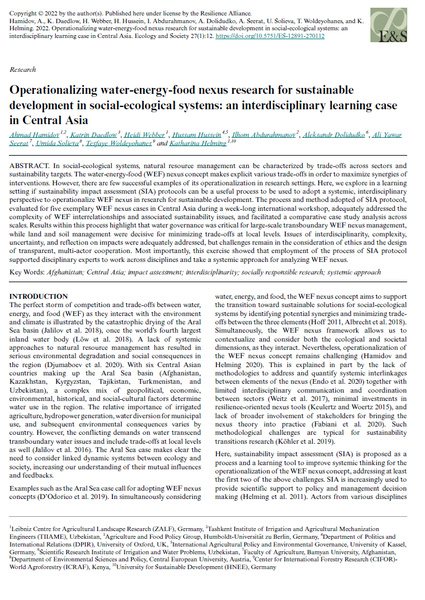
Year: 2022
Collections: Research Paper
Topics: Water, Sustainable Development, NEXUS, Water governance, Transboundary Water Resources
Authors: Ahmad Hamidov, Katrin Daedlow, Heidi Webber, Hussam Hussein, Ilhom Abdurahmanov, Aleksandr Dolidudko, Ali Yawar Seerat, Umida Solieva, Tesfaye Woldeyohanes, Katharina Helming
Countries:
Source: Ecology and Society
This article focuses on the operationalization of the Water–Energy–Food (WEF) Nexus concept as a framework for promoting sustainable development in Central Asia. The researchers examine the application of the Sustainability Impact Assessment (SIA) protocol as a tool for interdisciplinary analysis of five different environmental systems across the region. The findings demonstrate that a systems-based approach helps experts identify critical trade-offs between water resource management, energy production, and soil conservation. The authors emphasize that the SIA framework is effective in addressing interdisciplinary complexity; however, it requires further development in areas related to ethics and stakeholder engagement. Overall, the study highlights that regional cooperation and the integration of scientific approaches are essential for mitigating the impacts of environmental degradation, including challenges such as the desiccation of the Aral Sea. The article therefore provides a methodological foundation for translating theoretical nexus concepts into practical strategies for natural resource management and sustainable development.
For questions about cooperation, please contact us at: