

Year: 2020
Collections: Scientific Publications, Review article
Topics: Water, Water governance Water diplomacy,
Authors: Anita Milman, Andrea K. Gerlak
Countries:
Source: Environmental Science and Policy 107, 137–149
This paper examines the production and use of science by three IRBOs: the (US – Canada) International Joint Commission, the International Commission for the Protection of the Danube River, and the Mekong River Commission. We find the science produced by the IRBOs to support hydrodiplomacy extends beyond measuring and monitoring to include more advanced and analytical forms of science.
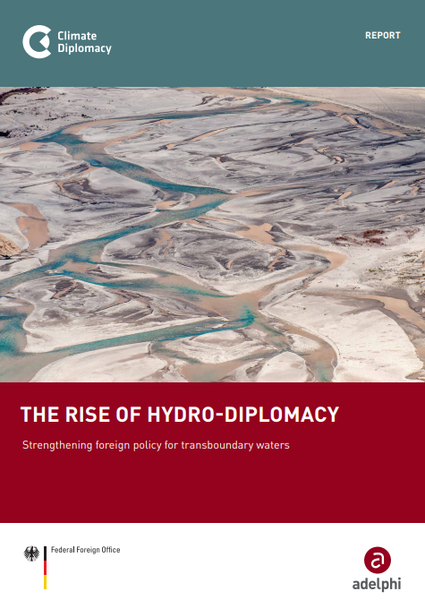
Year: 2014
Collections: Scientific Publications, Reports, Review article
Topics: Water diplomacy, Water, Water law, Water governance
Authors: Benjamin Pohl, et al.
Countries:
Source: Adelphi
Water is a fundamental precondition for human life. No substitute for freshwater exists, and it is scarce in many regions. Simultaneously, much of it transcends state borders via shared river and lake basins or groundwater aquifers. The resulting political, economic, social and environmental interdependencies give water resources the crucial potential to either foster cooperation or exacerbate conflict. The significance of access to water is growing as demographic and economic drivers as well as deteriorating water quality interact with climate change that will regionally increase water scarcity and variability.

Year: 2021
Collections: Scientific Publications, Review article
Topics: Water, Water law, Water diplomacy
Authors: Susanne Schmeier
Countries:
Source: American Journal of International Law, 115, 173-177
International water law (IWL) principles are often called upon to address disagreements and conflict between riparian states to a shared watercourse, with various parties invoking them to guide states’ behavior towards cooperative solutions that benefit the water resources as well as broader regional cooperation and peace. This essay argues that it is particularly important to acknowledge the role IWL principles play in negotiation processes, that is, in an ex ante and non-judicial function, providing a framework for cooperation and contributing to lawmaking, which makes them important tools of international relations and water diplomacy.
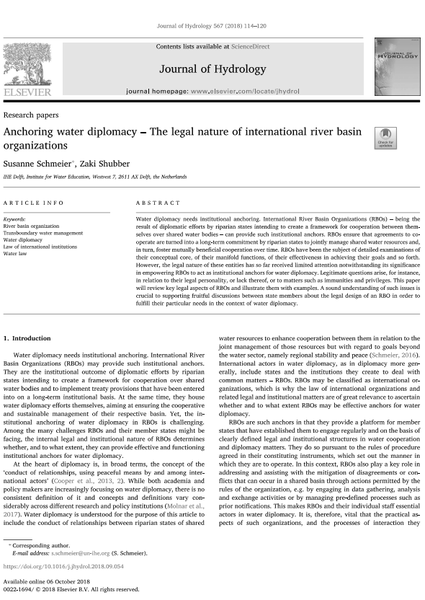
Year: 2018
Collections: Scientific Publications, Review article
Topics: Water, Water diplomacy
Authors: Susanne Schmeier, Zaki Shubber
Countries:
Source: Journal of Hydrology
Water diplomacy needs institutional anchoring. International River Basin Organizations (RBOs) – being the result of diplomatic efforts by riparian states intending to create a framework for cooperation between themselves over shared water bodies – can provide such institutional anchors. RBOs ensure that agreements to cooperate are turned into a long-term commitment by riparian states to jointly manage shared water resources and, in turn, foster mutually beneficial cooperation over time. RBOs have been the subject of detailed examinations of their conceptual core, of their manifold functions, of their effectiveness in achieving their goals and so forth. However, the legal nature of these entities has so far received limited attention notwithstanding its significance in empowering RBOs to act as institutional anchors for water diplomacy.
Year: 2023
Collections: Scientific Publications, Review article
Topics: Water, Water diplomacy
Authors: Wondwosen Michago Seide, Emanuele Fantini
Countries:
Source: Water Alternatives 16(3): 912-929
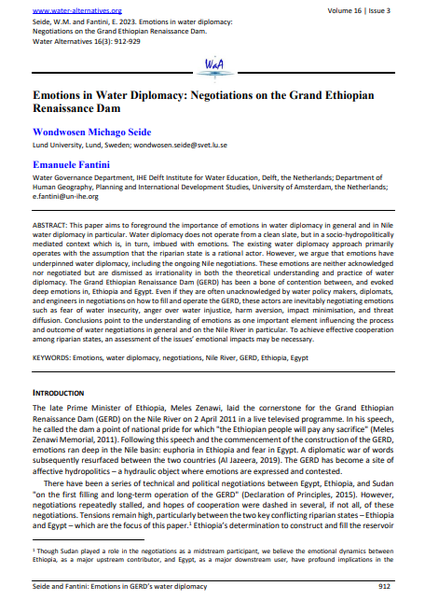
This paper aims to foreground the importance of emotions in water diplomacy in general and in Nile water diplomacy in particular. Water diplomacy does not operate from a clean slate, but in a socio-hydropolitically mediated context which is, in turn, imbued with emotions. The existing water diplomacy approach primarily operates with the assumption that the riparian state is a rational actor. However, we argue that emotions have underpinned water diplomacy, including the ongoing Nile negotiations. These emotions are neither acknowledged nor negotiated but are dismissed as irrationality in both the theoretical understanding and practice of water diplomacy.
For questions about cooperation, please contact us at: