
Year: 2015
Collections: Research Paper
Topics: Water governance, Transboundary Water Resources, Hydropolitics
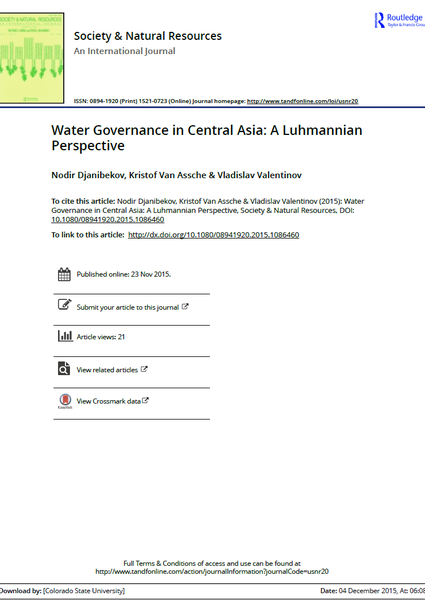
Authors: Nodir Djanibekov, Kristof Van Assche, Vladislav Valentinov
Countries:
Source: Society & Natural Resources
The article focuses on the problems of transboundary water governance in Central Asia from the perspective of Niklas Luhmann’s social systems theory. The authors examine why, after the collapse of the Soviet Union, it became difficult to coordinate the use of the water-energy infrastructure of the Amu Darya and Syr Darya rivers. During the Soviet period, water, energy, and agriculture were managed through a centralized system. However, after 1991, each country began to develop its own national policy. This strengthened contradictions between upstream countries, which need water for hydropower production, and downstream countries, which need water for irrigation.
Year: 2013
Collections: Research Paper
Topics: Water, Water governance
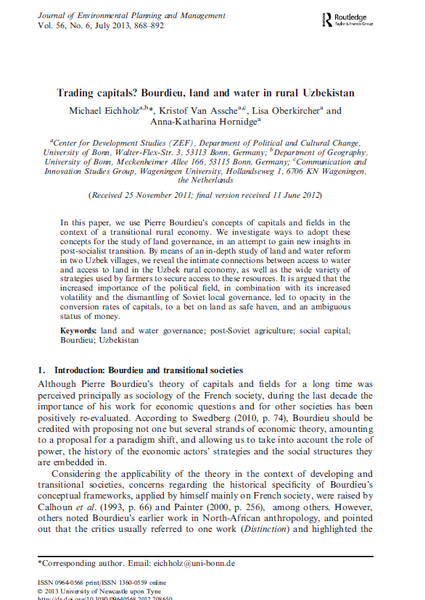
Authors: Michael Eichholz, Kristof Van Assche, Lisa Oberkircher, Anna-Katharina Hornidge
Countries: Uzbekistan
Source: Journal of Environmental Planning and Management
This article analyzes the governance of land and water resources in rural Uzbekistan through the lens of Pierre Bourdieu’s sociological theory. The authors explore how farmers adapt to post-socialist reforms and successive waves of land consolidation by relying on different forms of capital, including social, political, and symbolic capital. The study demonstrates that, in the absence of an open market and transparent rules, access to resources becomes the outcome of continuous negotiations and exchanges of favors. Under conditions of high uncertainty, social networks and proximity to political authorities prove to be more important than direct financial investments. As a result, the rural economy is transformed into a complex system of personal arrangements, where the survival and success of farming households depend on farmers’ ability to convert their informal assets into actual access to land and water resources.
Year: 2022
Collections: Research Paper
Topics: Water, Sustainable Development, NEXUS, Water governance, Transboundary Water Resources
Authors: Ahmad Hamidov, Katrin Daedlow, Heidi Webber, Hussam Hussein, Ilhom Abdurahmanov, Aleksandr Dolidudko, Ali Yawar Seerat, Umida Solieva, Tesfaye Woldeyohanes, Katharina Helming
Countries:
Source: Ecology and Society
This article focuses on the operationalization of the Water–Energy–Food (WEF) Nexus concept as a framework for promoting sustainable development in Central Asia. The researchers examine the application of the Sustainability Impact Assessment (SIA) protocol as a tool for interdisciplinary analysis of five different environmental systems across the region. The findings demonstrate that a systems-based approach helps experts identify critical trade-offs between water resource management, energy production, and soil conservation. The authors emphasize that the SIA framework is effective in addressing interdisciplinary complexity; however, it requires further development in areas related to ethics and stakeholder engagement. Overall, the study highlights that regional cooperation and the integration of scientific approaches are essential for mitigating the impacts of environmental degradation, including challenges such as the desiccation of the Aral Sea. The article therefore provides a methodological foundation for translating theoretical nexus concepts into practical strategies for natural resource management and sustainable development.
Year: 2015
Collections: Research Paper
Topics: Water, IWRM, Water law, Water governance, Transboundary Water Resources, Transboundary cooperation
Authors: Bunyod Holmatov, Jonathan Lautze, Jusipbek Kazbekov
Countries:
Source: International Environmental Agreements: Politics, Law and Economics
This research presents a systematic analysis of 123 agreements concerning small transboundary tributaries within the Syr Darya River Basin, highlighting the importance of sub-basin cooperation in Central Asia. The study identifies a significant increase in treaty-making activity during the first decade of the 21st century, demonstrating that local-level cooperation can remain effective even when basin-wide cooperation faces challenges. Most of the analyzed agreements are regulatory in nature and focus on technical issues, including water allocation, operation and maintenance of hydraulic infrastructure, and the management of shared water resources.
Year: 2019
Collections: Conferences
Topics: Water governance, Water diplomacy, Transboundary Water Resources, Transboundary cooperation, Hydropolitics
Authors: B. A. Krasnoyarova, Y. I. Vinokurov, T. V. Antyufeeva
Countries:
Source: IOP Conference Series: Earth and Environmental Science
This article examines the complex challenges of water management in the transboundary Irtysh River Basin shared by China, Kazakhstan, and Russia. The authors emphasize that intensive water withdrawals by China and ongoing infrastructure development in Kazakhstan are contributing to water resource depletion and ecosystem degradation, particularly in the downstream reaches of the river. The study discusses proposed inter-basin water transfer projects aimed at addressing water scarcity, as well as the environmental risks associated with industrial pollution. Particular attention is given to Russia’s limited engagement in transboundary water governance and the need to establish trilateral institutional mechanisms for the joint management of shared water resources. The authors argue that achieving international consensus is essential to preventing further ecological deterioration of the basin. The study concludes by advocating a shift from isolated technical solutions toward an integrated transboundary water governance framework.
For questions about cooperation, please contact us at: