

Year: 2021
Collections:
Topics: Climate, Sustainable Development, IWRM, Water diplomacy, Transboundary Water Resources, Water Security
Authors: Soheila Zareie, Omid Bozorg‑Haddad, Hugo A. Loáiciga
Countries:
Source: Environment, Development and Sustainability
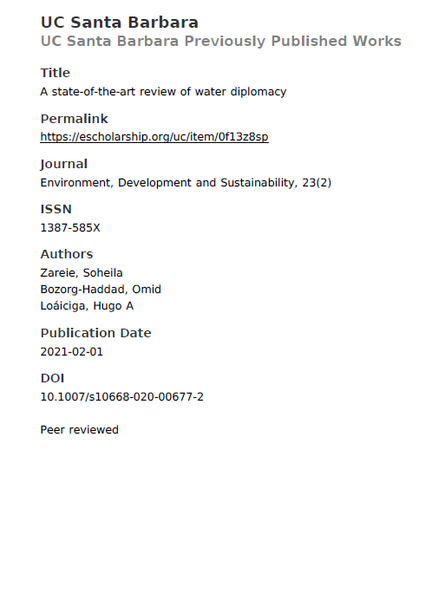
Diplomacy is the art and skill of managing international relations through negotiations between representatives of states or agencies. Water diplomacy is an innovative approach and strategic tool to resolve water issues at local and trans-boundary scales when water conflicts rise in sharing water resources. Complex water supply and sharing issues arise from the existence of multiple stakeholders such as agriculture, industry, urban and domestic users, environmental use, and others competing for scarce water. Water diplomacy may contribute to solving a variety of water conflicts and in this sense is a tool for sustainable water resources management.
Year: 2024
Collections: Research Paper
Topics: IWRM, Water law, Water diplomacy, Transboundary Water Resources, Transboundary cooperation
Authors: Ayşegül Kibaroğlu
Countries:
Source: Theorizing Transboundary Waters in International Relations
Water diplomacy encompasses the processes and institutions through which the national interests and identities of sovereign states are represented to one another. It is enshrined in international law, which states use to explain and justify their policies to concerned actors in the international system. States mostly prefer traditional tools of water diplomacy such as negotiation and mediation to resolve disputes in transboundary river basins.
Year: 2010
Collections: Research Paper
Topics: Water, Water law, Water diplomacy, Transboundary Water Resources, Transboundary cooperation
Authors: Ilias Bantekas
Countries:
Source: The International Journal of Marine and Coastal Law
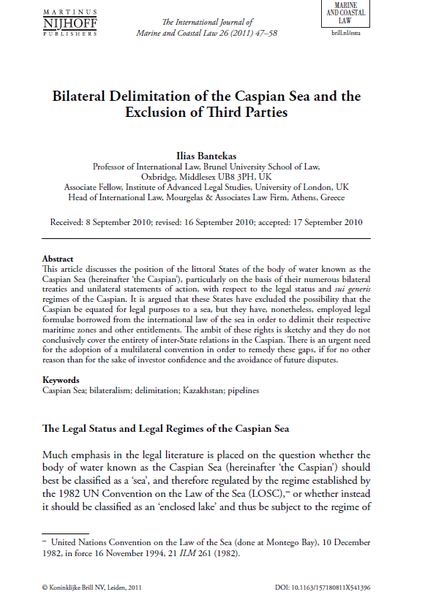
This article discusses the position of the littoral States of the body of water known as the Caspian Sea (hereinafter ‘the Caspian’), particularly on the basis of their numerous bilateral treaties and unilateral statements of action, with respect to the legal status and sui generis regimes of the Caspian.
Year: 2008
Collections: Books
Topics: Water, Sustainable Development, IWRM, Water diplomacy, Transboundary Water Resources, Water Security, Transboundary cooperation, Hydropolitics
Authors: Thomas Bernauer, Tobias Siegfried
Countries:
Source:
This book chapter examines the compliance and actual performance of an international water agreement in the Naryn/Syr Darya Basin in Central Asia. The authors analyze the 1998 agreement, which was designed to regulate the operation of the Toktogul Reservoir by balancing Kyrgyzstan’s need for winter hydropower production with Uzbekistan’s and Kazakhstan’s need for summer irrigation water. The main argument of the article is that formal compliance with an agreement does not necessarily mean that the agreement is effective in solving the real water allocation problem. Using the policy performance metric (PER), the authors show that although compliance with the agreement was relatively high, its actual performance was low and highly variable. The article concludes that the existing water management system in the Naryn/Syr Darya Basin requires urgent institutional reform.
Year: 2017
Collections: Research Paper
Topics: IWRM, Water law, Water diplomacy, Transboundary Water Resources, Hydropolitics
Authors: Daria Boklan, Barbara Janusz-Pawletta
Countries:
Source: Environmental Earth Sciences
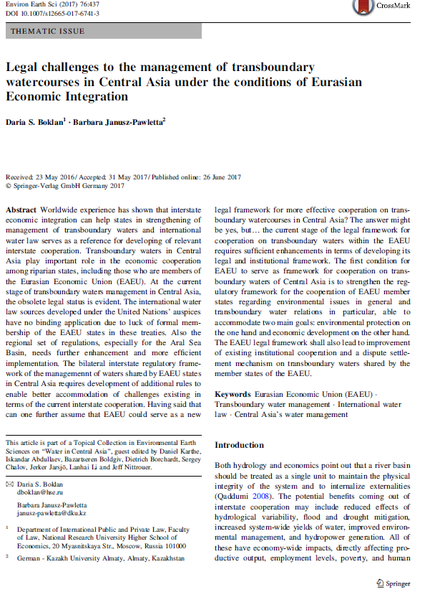
This article explores the legal challenges of managing transboundary watercourses in Central Asia in the context of the Eurasian Economic Union (EAEU). The authors analyze whether existing international, regional, and bilateral legal mechanisms are sufficient for regulating shared rivers such as the Syr Darya, Chu, Talas, Irtysh, Ural, and others.
For questions about cooperation, please contact us at: