

Year: 2020
Collections:
Topics: Water, Climate, IWRM, Water diplomacy, Transboundary Water Resources, Water Security, Hydropower
Authors: Melinda Davies, Nathanial Matthews
Countries:
Source: International Journal of Water Resources Development
The article focuses on how China’s Belt and Road Initiative (BRI) may affect water resources and water governance in Central Asia. The authors consider Central Asia as a region that already faces a complex water situation, including transboundary rivers, water scarcity, the dependence of agriculture on irrigation, the environmental problems of the Aral Sea, weak coordination between countries, and the impacts of climate change. Against this background, the development of infrastructure, industry, hydropower, and agriculture under the BRI may increase pressure on water resources.
Year: 2019
Collections: Conferences
Topics: Water governance, Water diplomacy, Transboundary Water Resources, Transboundary cooperation, Hydropolitics
Authors: B. A. Krasnoyarova, Y. I. Vinokurov, T. V. Antyufeeva
Countries:
Source: IOP Conference Series: Earth and Environmental Science
This article examines the complex challenges of water management in the transboundary Irtysh River Basin shared by China, Kazakhstan, and Russia. The authors emphasize that intensive water withdrawals by China and ongoing infrastructure development in Kazakhstan are contributing to water resource depletion and ecosystem degradation, particularly in the downstream reaches of the river. The study discusses proposed inter-basin water transfer projects aimed at addressing water scarcity, as well as the environmental risks associated with industrial pollution. Particular attention is given to Russia’s limited engagement in transboundary water governance and the need to establish trilateral institutional mechanisms for the joint management of shared water resources. The authors argue that achieving international consensus is essential to preventing further ecological deterioration of the basin. The study concludes by advocating a shift from isolated technical solutions toward an integrated transboundary water governance framework.
Year: 2025
Collections: Research Paper
Topics: Water diplomacy, Transboundary Water Resources, Transboundary cooperation
Authors: Dinara Ziganshina
Countries:
Source: Routledge Handbook of Water Diplomacy
This chapter explores the symbiotic relationship between international law and water diplomacy, emphasizing their role in promoting peace and security in the governance of shared water resources. The author examines the key legal principles that underpin interstate cooperation, including the principles of equitable and reasonable utilization and the obligation not to cause significant harm.
Year: 2025
Collections: Books
Topics: Water, IWRM, Water governance, Water diplomacy, Transboundary Water Resources, Transboundary cooperation
Authors: Shafiqul Islam, Kevin Smith, Martina Klimes, Aaron Salzberg
Countries:
Source: Routledge Handbook of Water Diplomacy
Full book available here: https://drive.google.com/file/d/1V8lHqDiaqrMtHnU6JP9p9SBC2rsXY8gX/view?usp=sharing
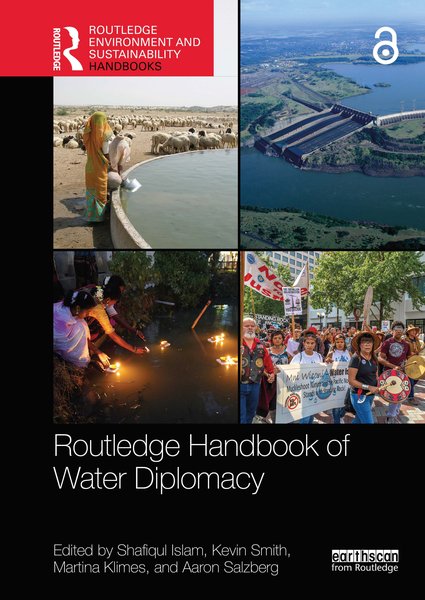
The Routledge Handbook of Water Diplomacy is a comprehensive guide to understanding and practicing water diplomacy – a framework for building relationships, negotiating shared interests, and managing complex water challenges across physical, political, and societal boundaries.
In an era marked by rising scarcity, deepening uncertainty, and growing geopolitical tension, this timely volume offers actionable insights for negotiated problem-solving grounded in both scientific understanding and diplomatic skill. Moving beyond abstract theory and technical fixes, the Handbook introduces a dual-pathway structure designed to meet the diverse needs of its users. The “Working Together” pathway invites readers to engage with water diplomacy through the lens of their roles, whether as professionals, decision-makers, funders, researchers, or affected communities. The “What Matters and Why” pathway highlights key thematic dimensions, including process design, adaptive learning, trust-building, divergent worldviews, and the management of uncertainty.
Year: 2022
Collections: Working paper
Topics: Water, IWRM, Water governance, Water diplomacy, Water Governance
Authors: OECD
Countries:
Source: Secretary-General of the OECD
This document is a practical guide developed by the Organisation for Economic Co-operation and Development (OECD) for analyzing water governance systems. It presents a ten-step methodology designed to assess the effectiveness, transparency, and inclusiveness of water governance policies. The guide is based on twelve key principles grouped into three dimensions: effectiveness, efficiency, and trust and engagement.
For questions about cooperation, please contact us at: