

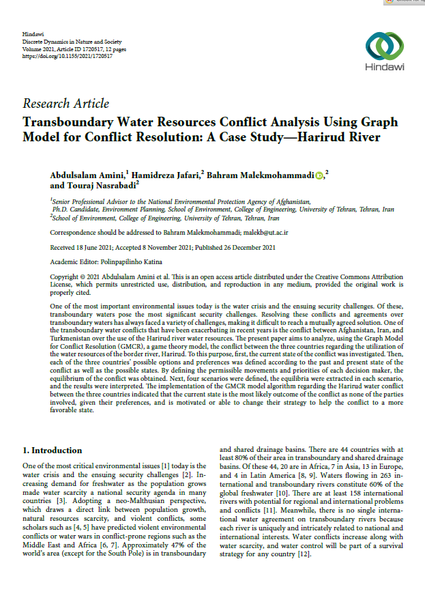
Год: 2021
Разделы: Исследовательская работа
Темы: Вода, Водное законодательство, Водная безопасность, Трансграничное сотрудничество, Гидрополитика
Авторы: Abdulsalam Amini, Hamidreza Jafari, Bahram Malekmohammadi, Touraj Nasrabadi
Страны: Иран Туркменистан, Афганистан,
Источник: Discrete Dynamics in Nature and Society
The present paper aims to analyze, using the Graph Model for Conflict Resolution (GMCR), a game theory model, the conflict between the three countries regarding the utilization of the water resources of the border river, Harirud. To this purpose, first, the current state of the conflict was investigated.
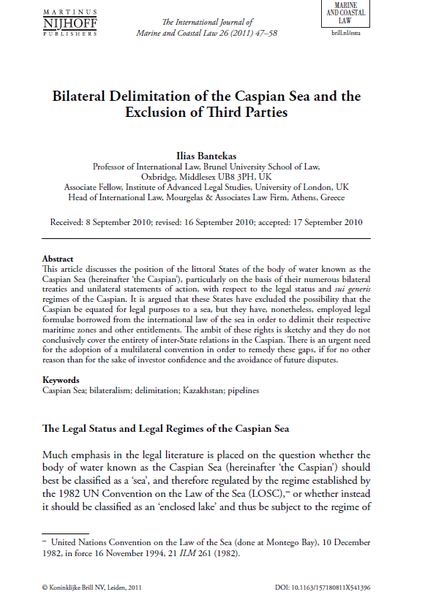
Год: 2010
Разделы: Исследовательская работа
Темы: Вода, Водное законодательство, Водная дипломатия, Трансграничные водные ресурсы, Трансграничное сотрудничество
Авторы: Ilias Bantekas
Страны:
Источник: The International Journal of Marine and Coastal Law
This article discusses the position of the littoral States of the body of water known as the Caspian Sea (hereinafter ‘the Caspian’), particularly on the basis of their numerous bilateral treaties and unilateral statements of action, with respect to the legal status and sui generis regimes of the Caspian.
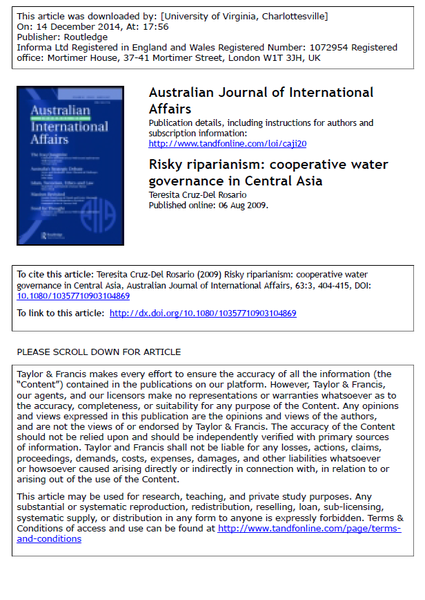
Год: 2009
Разделы: Исследовательская работа
Темы: Вода, ИУВР, Трансграничные водные ресурсы, Трансграничное сотрудничество
Авторы: Teresita Cruz-Del Rosario
Страны:
Источник: Australian Journal of International Affairs
The article examines the challenges of cooperative management of transboundary water resources in Central Asia. The author analyzes water relations among Kazakhstan, Kyrgyzstan, Tajikistan, Turkmenistan, and Uzbekistan through Ulrich Beck’s concept of “risk society.” The article argues that water scarcity, the transboundary nature of the Amu Darya and Syr Darya rivers, the Soviet legacy of centralized water management, artificial borders, and ethnic tensions create significant risks for regional stability.
Год: 2017
Разделы: Исследовательская работа
Темы: ИУВР, Водное законодательство, Водная дипломатия, Трансграничные водные ресурсы, Гидрополитика
Авторы: Daria Boklan, Barbara Janusz-Pawletta
Страны:
Источник: Environmental Earth Sciences
This article explores the legal challenges of managing transboundary watercourses in Central Asia in the context of the Eurasian Economic Union (EAEU). The authors analyze whether existing international, regional, and bilateral legal mechanisms are sufficient for regulating shared rivers such as the Syr Darya, Chu, Talas, Irtysh, Ural, and others.
Год: 2015
Разделы: Исследовательская работа
Темы: Стратегическое управление водными ресурсами, Трансграничные водные ресурсы, Гидрополитика
Авторы: Nodir Djanibekov, Kristof Van Assche, Vladislav Valentinov
Страны:
Источник: Society & Natural Resources
The article focuses on the problems of transboundary water governance in Central Asia from the perspective of Niklas Luhmann’s social systems theory. The authors examine why, after the collapse of the Soviet Union, it became difficult to coordinate the use of the water-energy infrastructure of the Amu Darya and Syr Darya rivers. During the Soviet period, water, energy, and agriculture were managed through a centralized system. However, after 1991, each country began to develop its own national policy. This strengthened contradictions between upstream countries, which need water for hydropower production, and downstream countries, which need water for irrigation.
По всем вопросам сотрудничества обращайтесь по эл.адресу или телефону: