
Год: 2013
Разделы:
Темы: Трансграничное сотрудничество, Гидроэнергетика, Гидрополитика Ирригация,
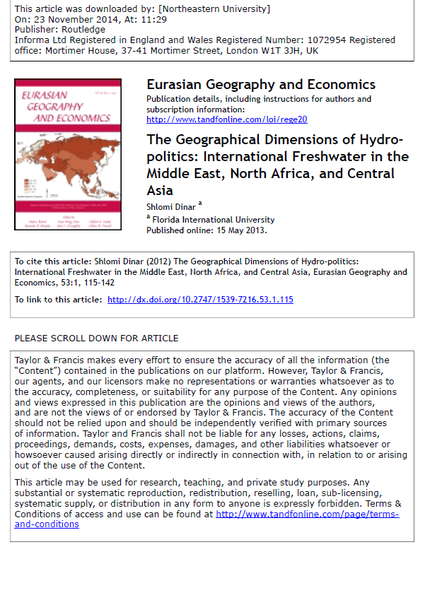
Авторы: Shlomi Dinar
Страны:
Источник: Eurasian Geography and Economics
The article focuses on the role of geography and the relative power of states in international hydropolitics. The author analyzes how a country’s position within a river basin — upstream or downstream — affects its ability to participate in water negotiations. It is often assumed that a state with greater military and economic power can dictate the terms of water allocation. However, the author shows that geographical location is also an important source of power. Even a weaker state, if it is located upstream, can influence the water regime and challenge the existing status quo.
Год: 2013
Разделы: Исследовательская работа
Темы: Вода, Стратегическое управление водными ресурсами
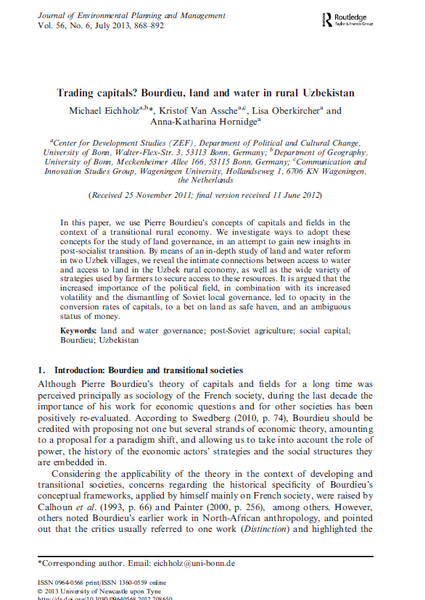
Авторы: Michael Eichholz, Kristof Van Assche, Lisa Oberkircher, Anna-Katharina Hornidge
Страны: Узбекистан
Источник: Journal of Environmental Planning and Management
This article analyzes the governance of land and water resources in rural Uzbekistan through the lens of Pierre Bourdieu’s sociological theory. The authors explore how farmers adapt to post-socialist reforms and successive waves of land consolidation by relying on different forms of capital, including social, political, and symbolic capital. The study demonstrates that, in the absence of an open market and transparent rules, access to resources becomes the outcome of continuous negotiations and exchanges of favors. Under conditions of high uncertainty, social networks and proximity to political authorities prove to be more important than direct financial investments. As a result, the rural economy is transformed into a complex system of personal arrangements, where the survival and success of farming households depend on farmers’ ability to convert their informal assets into actual access to land and water resources.
Год: 2022
Разделы: Исследовательская работа
Темы: Вода, Устойчивое развитие, NEXUS, Стратегическое управление водными ресурсами, Трансграничные водные ресурсы
Авторы: Ahmad Hamidov, Katrin Daedlow, Heidi Webber, Hussam Hussein, Ilhom Abdurahmanov, Aleksandr Dolidudko, Ali Yawar Seerat, Umida Solieva, Tesfaye Woldeyohanes, Katharina Helming
Страны:
Источник: Ecology and Society
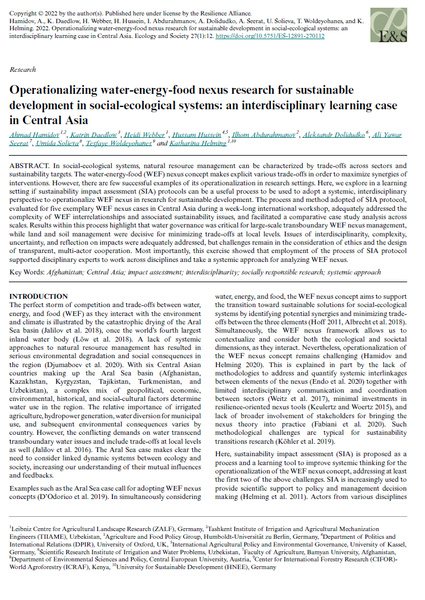
This article focuses on the operationalization of the Water–Energy–Food (WEF) Nexus concept as a framework for promoting sustainable development in Central Asia. The researchers examine the application of the Sustainability Impact Assessment (SIA) protocol as a tool for interdisciplinary analysis of five different environmental systems across the region. The findings demonstrate that a systems-based approach helps experts identify critical trade-offs between water resource management, energy production, and soil conservation. The authors emphasize that the SIA framework is effective in addressing interdisciplinary complexity; however, it requires further development in areas related to ethics and stakeholder engagement. Overall, the study highlights that regional cooperation and the integration of scientific approaches are essential for mitigating the impacts of environmental degradation, including challenges such as the desiccation of the Aral Sea. The article therefore provides a methodological foundation for translating theoretical nexus concepts into practical strategies for natural resource management and sustainable development.
Год: 2015
Разделы: Исследовательская работа
Темы: Вода, ИУВР, Водное законодательство, Стратегическое управление водными ресурсами, Трансграничные водные ресурсы, Трансграничное сотрудничество
Авторы: Bunyod Holmatov, Jonathan Lautze, Jusipbek Kazbekov
Страны:
Источник: International Environmental Agreements: Politics, Law and Economics
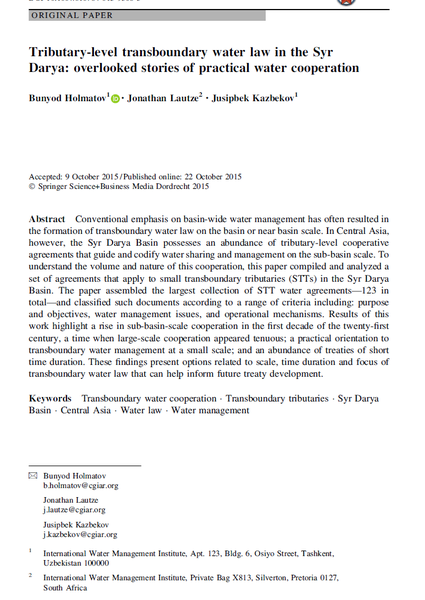
This research presents a systematic analysis of 123 agreements concerning small transboundary tributaries within the Syr Darya River Basin, highlighting the importance of sub-basin cooperation in Central Asia. The study identifies a significant increase in treaty-making activity during the first decade of the 21st century, demonstrating that local-level cooperation can remain effective even when basin-wide cooperation faces challenges. Most of the analyzed agreements are regulatory in nature and focus on technical issues, including water allocation, operation and maintenance of hydraulic infrastructure, and the management of shared water resources.
Год: 2017
Разделы: Исследовательская работа
Темы: Вода, Климат, ИУВР, Трансграничные водные ресурсы, Трансграничное сотрудничество
Авторы: Sarah Hummel
Страны:
Источник: International Studies Quarterly
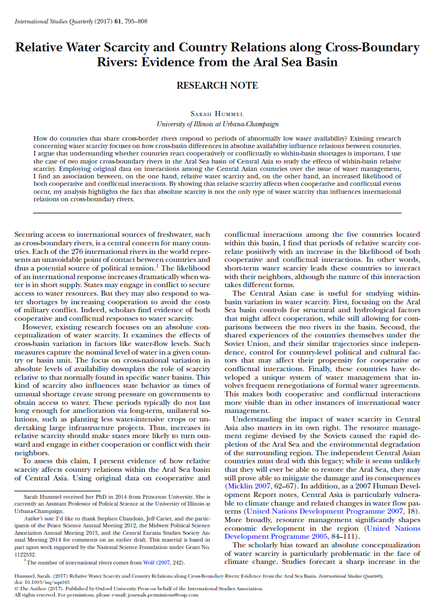
This scientific article examines the impact of relative water scarcity on international relations in the Aral Sea Basin. The author distinguishes between absolute water scarcity, determined by the overall availability of water resources, and relative water scarcity, defined as temporary deviations from normal water availability within a specific river basin. Based on an analysis of hydrological and political data from the Amu Darya and Syr Darya river basins in Central Asia, the study concludes that short-term water shortages stimulate states to take more active policy actions. The findings demonstrate that periods of water scarcity increase the likelihood of both cooperative and conflictual interactions among neighboring countries. This suggests that states employ a variety of foreign policy instruments to address transboundary water challenges under conditions of resource variability. The results highlight the importance of considering climate variability when assessing and forecasting transboundary water disputes and cooperation.
По всем вопросам сотрудничества обращайтесь по эл.адресу или телефону: