

Год: 2018
Разделы: Исследовательская работа
Темы: Стратегическое управление водными ресурсами, Водная дипломатия, Гидроэнергетика
Авторы: Denise Michèle Staubli Anoulak Kittikhoun,
Страны:
Источник: Journal of Hydrology
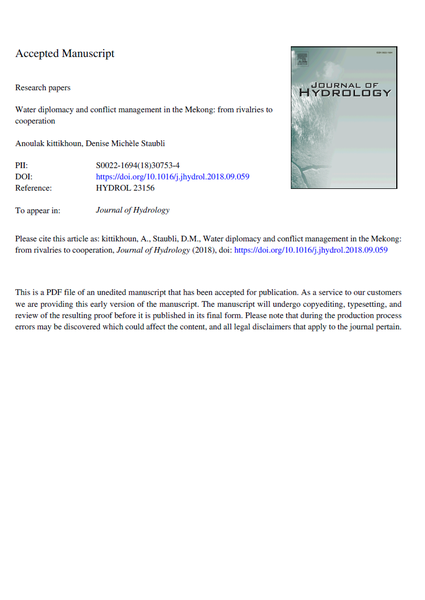
The Mekong region, home to one of the world’s great rivers – the Mekong – is also one of the world’s most geostrategic regions, featuring seemingly conflicting interests among regional states including Viet Nam, Thailand, Myanmar, Laos and Cambodia and world powers such as China and the United States of America.
For nearly a century, some of the riparian states have developed parts of the basin in their territories – to great benefits and harm – and recently the remaining late developing countries are catching up with water and related resources development plans to dam, withdraw and use the mighty Mekong to fund national progress and alleviate poverty.
World leaders, academics, NGOs, media and even some government officials have warned that the current rush to development is not only bringing a sure death to a great previously untamed river, potentially displacing millions of people, and threatening livelihoods, but would also usher in an era of aggravated tensions and possibly even conflict. The Mekong River Commission (MRC), tasked to manage the river for the sake of the environment and the people, is failing its mission with work that has been ineffective, uninfluential and wasted, critics say.
Год: 2020
Разделы:
Темы: Вода, Климат, ИУВР, Водная дипломатия, Трансграничные водные ресурсы, Водная безопасность, Гидроэнергетика
Авторы: Melinda Davies, Nathanial Matthews
Страны:
Источник: International Journal of Water Resources Development
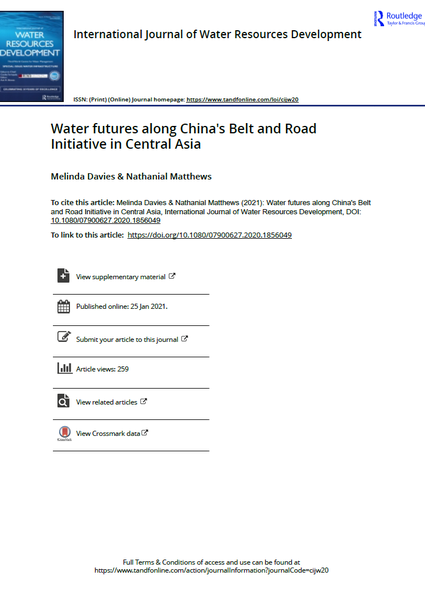
The article focuses on how China’s Belt and Road Initiative (BRI) may affect water resources and water governance in Central Asia. The authors consider Central Asia as a region that already faces a complex water situation, including transboundary rivers, water scarcity, the dependence of agriculture on irrigation, the environmental problems of the Aral Sea, weak coordination between countries, and the impacts of climate change. Against this background, the development of infrastructure, industry, hydropower, and agriculture under the BRI may increase pressure on water resources.
Год: 2013
Разделы:
Темы: Трансграничное сотрудничество, Гидроэнергетика, Гидрополитика Ирригация,
Авторы: Shlomi Dinar
Страны:
Источник: Eurasian Geography and Economics
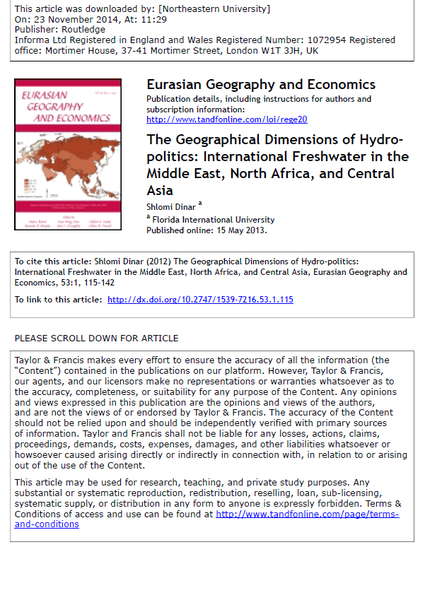
The article focuses on the role of geography and the relative power of states in international hydropolitics. The author analyzes how a country’s position within a river basin — upstream or downstream — affects its ability to participate in water negotiations. It is often assumed that a state with greater military and economic power can dictate the terms of water allocation. However, the author shows that geographical location is also an important source of power. Even a weaker state, if it is located upstream, can influence the water regime and challenge the existing status quo.
Год: 2014
Разделы: Исследовательская работа
Темы: Вода, Трансграничные водные ресурсы, Гидроэнергетика
Авторы: Sonoko Ito, Sameh El Khatib, Mikiyasu Nakayama
Страны: Узбекистан, Таджикистан
Источник: International Journal of Water Resources Development
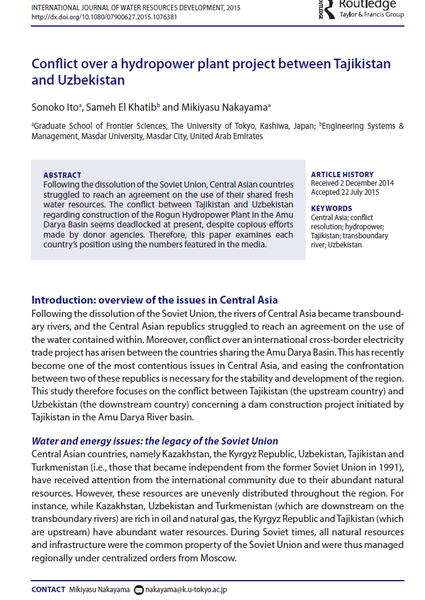
Following the dissolution of the Soviet Union, Central Asian countries struggled to reach an agreement on the use of their shared fresh water resources. The conflict between Tajikistan and Uzbekistan regarding construction of the Rogun Hydropower Plant in the Amu Darya Basin seems deadlocked at present, despite copious efforts made by donor agencies. Therefore, this paper examines each country’s position using the numbers featured in the media.
Год: 2013
Разделы: Исследовательская работа
Темы: Вода, Трансграничные водные ресурсы, Трансграничное сотрудничество, Гидроэнергетика
Авторы: Sanat Kushkumbayev, Azina Kushkumbayeva
Страны: Казахстан, Кыргызстан, Узбекистан, Таджикистан, Туркменистан
Источник: Chinese Journal of International Law
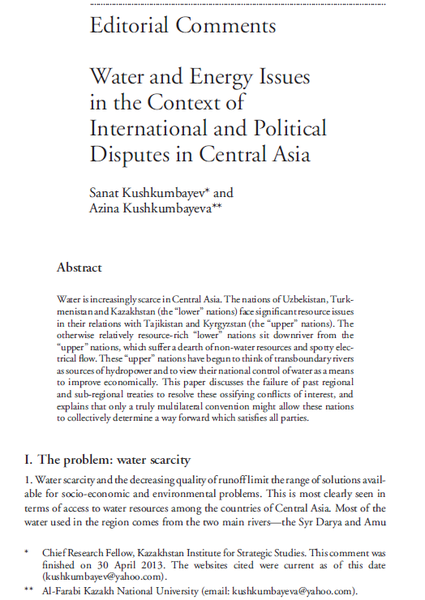
This paper discusses the failure of past regional and sub-regional treaties to resolve these ossifying conflicts of interest, and explains that only a truly multilateral convention might allow these nations to collectively determine a way forward which satisfies all parties.
По всем вопросам сотрудничества обращайтесь по эл.адресу или телефону: