
Год: 2020
Разделы: Научные публикации, Обзорная статья
Темы: Вода, Стратегическое управление водными ресурсами Водная дипломатия,
Авторы: et al., Margaret O. Wilder
Страны:
Источник: Environmental Science and Policy
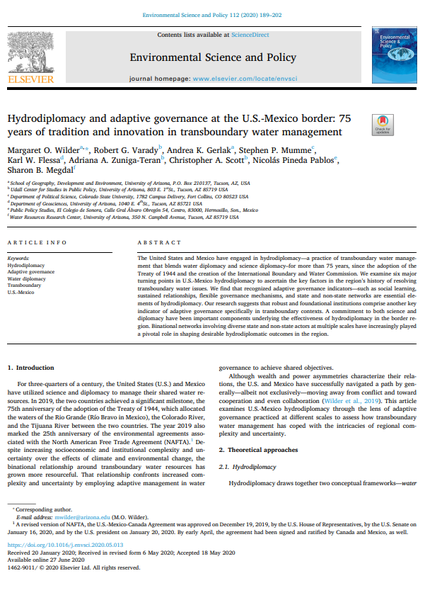
The United States and Mexico have engaged in hydrodiplomacy—a practice of transboundary water management that blends water diplomacy and science diplomacy–for more than 75 years, since the adoption of the Treaty of 1944 and the creation of the International Boundary and Water Commission. We examine six major turning points in U.S.-Mexico hydrodiplomacy to ascertain the key factors in the region’s history of resolving transboundary water issues. We find that recognized adaptive governance indicators—such as social learning, sustained relationships, flexible governance mechanisms, and state and non-state networks are essential elements of hydrodiplomacy. Our research suggests that robust and foundational institutions comprise another key indicator of adaptive governance specifically in transboundary contexts. A commitment to both science and diplomacy have been important components underlying the effectiveness of hydrodiplomacy in the border region. Binational networks involving diverse state and non-state actors at multiple scales have increasingly played a pivotal role in shaping desirable hydrodiplomatic outcomes in the region.
Год: 2018
Разделы: Научные публикации, Обзорная статья
Темы: Вода, Водная дипломатия
Авторы: Yumiko Yasuda, Douglas Hill, Dipankar Aich, Patrick Huntjens, Ashok Swain
Страны:
Источник: Water International
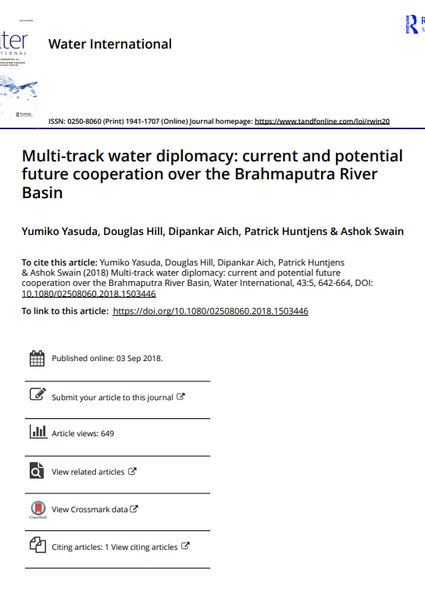
This article analyzes key factors affecting transboundary water cooperation in the Brahmaputra River basin at multiple scales. The analysis of multi-track diplomacy reaffirms the potential of actor-inclusive approaches, arguing for a need to go beyond purely focusing on formal legal norms and consider the possibilities of cultural norms of informal processes of cooperation. Various ‘windows of opportunity’ exist in the current phase of the Brahmaputra basin’s development, leading to exploration of a Zone of Possible Effective Cooperation, arising from the effort to scale up multi-track initiatives as well as broader geo-politicaleconomic changes happening across and beyond the basin.
Год: 2020
Разделы: Научные публикации
Темы: Вода, Водная дипломатия
Авторы: Harlan Koff, Carmen Maganda, Edith Kauffer
Страны:
Источник: Water International
Water diplomacy aims to shift water disputes from zero-sum games into positive-sum cooperation models though actor-driven approaches. Small states are often viewed as facilitators of diplomacy through a commitment to regionalism and consensus, which highlights their influence in international affairs. Responding to the research question, ‘How do “non-decisions” lead to status quo in water diplomacy?’ this article discusses how regional water diplomacy based on influence is weakened by the domestic shortcomings of small states’ political systems, where authorities use non-decision-making to maintain a status quo that guarantees their legitimized power.
Год: 2020
Разделы: Книги
Темы: Вода, Устойчивое развитие, Ирригация, ИУВР, NEXUS, Водное законодательство, Водная дипломатия, Стратегическое управление водными ресурсами, Трансграничные водные ресурсы, Водная безопасность
Авторы: Anoulak Kittikhoun, Susanne Schmeier
Страны:
Источник: Routledge
River Basin Organizations in Water Diplomacy explores the role of River Basin Organizations (RBOs) in preventing and resolving conflicts related to transboundary water resources. Through a comparative analysis of international river basins, the book examines how institutional mechanisms, legal frameworks, and diplomatic tools promote cooperation among states and support the sustainable management of shared water resources.
Год: 2018
Разделы: Научные публикации
Темы: Водная дипломатия, Вода, Трансграничные водные ресурсы, Трансграничное сотрудничество
Авторы: Anamika Barua
Страны:
Источник: Journal of Hydrology
The article examines challenges of transboundary water cooperation in the Brahmaputra River Basin shared by Bangladesh, Bhutan, China, and India. It highlights the lack of trust, information asymmetries, and absence of a regional governance framework that hinder cooperation. The authors emphasize the importance of inclusive, multi-stakeholder water diplomacy and informal dialogues as a foundation for sustainable and equitable basin-wide cooperation.
По всем вопросам сотрудничества обращайтесь по эл.адресу или телефону: