
Year: 2025
Collections: Research Paper
Topics: Climate, Water governance, Transboundary Water Resources, Transboundary cooperation, Hydropolitics
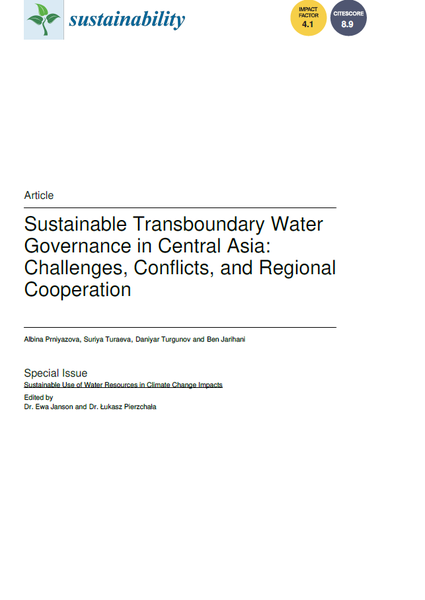
Authors: Albina Prniyazova, Suriya Turaeva, Daniyar Turgunov, Ben Jarihani
Countries:
Source: Sustainability
Sustainable transboundary water governance in Central Asia faces significant challenges, including political tensions, ecological issues, such as the drying Aral Sea, and seasonal hydropower disruptions impacting downstream countries. This study aims to address these problems by examining the complexities of water resource governance in the region, emphasizing the interplay between national interests and regional cooperation.
Year: 2025
Collections: Research Paper
Topics: Water, IWRM, Water governance, Water Security
Authors:
Countries:
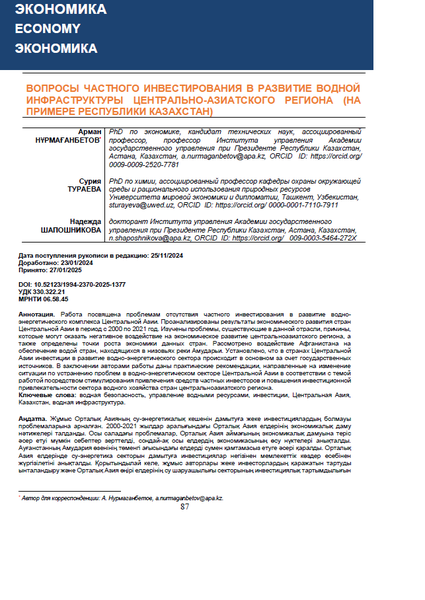
Source: Государственное управление и государственная служба
Работа посвящена проблемам отсутствия частного инвестирования в развитие водно-энергетического комплекса Центральной Азии. Проанализированы результаты экономического развития стран Центральной Азии в период с 2000 по 2021 год. Изучены проблемы, существующие в данной отрасли, причины, которые могут оказать негативное воздействие на экономическое развитие центральноазиатского региона, а также определены точки роста экономики данных стран. Рассмотрено воздействие Афганистана на обеспечение водой стран, находящихся в низовьях реки Амударьи. Установлено, что в странах Центральной Азии инвестиции в развитие водно-энергетического сектора происходит в основном за счет государственных источников.
Year: 2017
Collections: Research Paper
Topics: Water, Water governance, Transboundary Water Resources, Transboundary cooperation, Hydropolitics
Authors: Sarah Acquah, Frank A. Ward
Countries:
Source: Water Resources Management
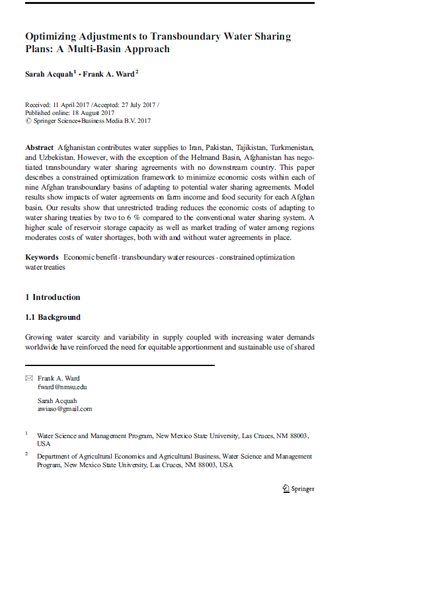
Afghanistan contributes water supplies to Iran, Pakistan, Tajikistan, Turkmenistan, and Uzbekistan. However, with the exception of the Helmand Basin, Afghanistan has negotiated transboundary water sharing agreements with no downstream country. This paper describes a constrained optimization framework to minimize economic costs within each of nine Afghan transboundary basins of adapting to potential water sharing agreements.
Year: 2017
Collections: Research Paper
Topics: Sustainable Development, Water governance, Transboundary Water Resources, Transboundary cooperation
Authors: Thang Vo, Thong Tran, Duy Luong
Countries:
Source: Journal of Economic Development
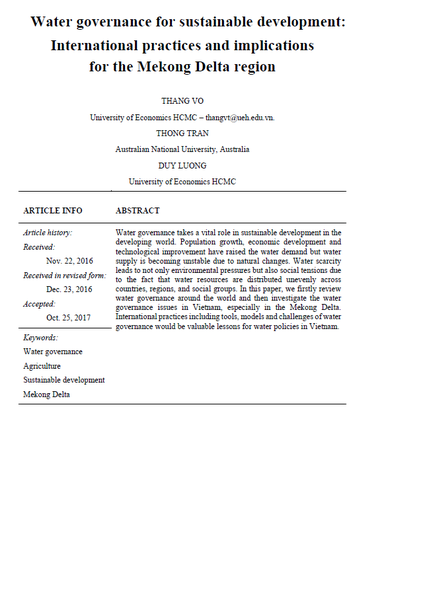
This scientific paper examines water resource management as a key factor in achieving sustainable development, with a particular focus on the Mekong Delta region of Vietnam. The authors analyze global challenges, including freshwater scarcity driven by population growth and climate change, which contribute to droughts and soil salinization. The paper reviews international water governance models implemented in OECD and Latin American countries and identifies common challenges, such as financial constraints and information gaps. The study highlights the critical dependence of Vietnam’s agricultural sector on effective water governance and the efficient allocation of water resources. International experience is presented as a valuable foundation for reforming institutional frameworks and preventing social conflicts arising from water scarcity. The authors conclude by emphasizing the need for a flexible and adaptive water governance system capable of responding to contemporary environmental challenges.
For questions about cooperation, please contact us at: