

Year: 2018
Collections: Scientific Publications
Topics: Water diplomacy, Water, Transboundary Water Resources, Transboundary cooperation
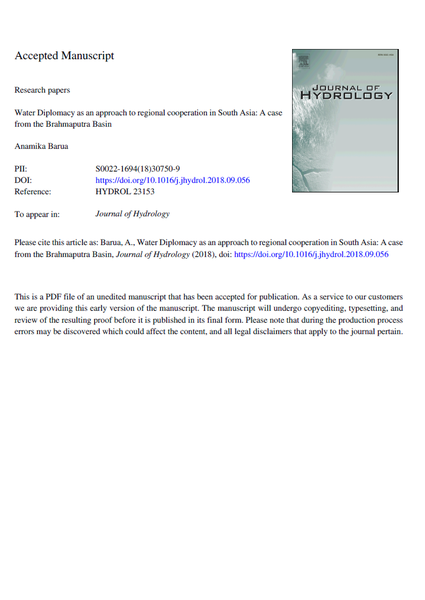
Authors: Anamika Barua
Countries:
Source: Journal of Hydrology
The article examines challenges of transboundary water cooperation in the Brahmaputra River Basin shared by Bangladesh, Bhutan, China, and India. It highlights the lack of trust, information asymmetries, and absence of a regional governance framework that hinder cooperation. The authors emphasize the importance of inclusive, multi-stakeholder water diplomacy and informal dialogues as a foundation for sustainable and equitable basin-wide cooperation.
Year: 2018
Collections: Research Paper
Topics: Water diplomacy, Gender, IWRM, Water Security
Authors: Natasha Carmi, Mey Alsayegh, Maysoon Zoubi
Countries:
Source: Journal of Hydrology
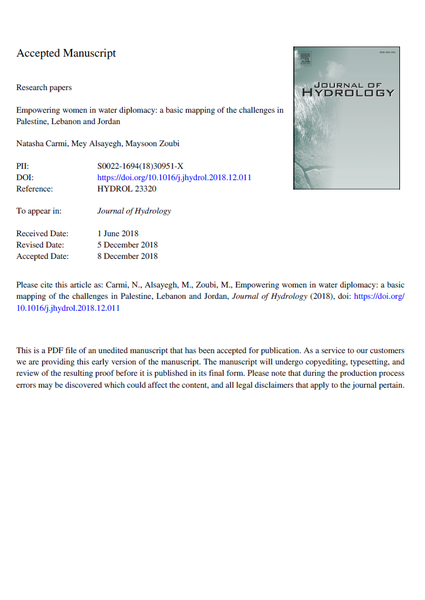
Until now, limited attention has been afforded to the role of, and challenges faced by, women involved in water diplomacy. In addition to research being at an early stage, it is mainly focused on addressing the challenges imposed by gender inequality. Thus very few applicable policy recommendations have emerged in this field to date.
This paper will explore and identify current challenges that face the women interested in attaining high level positions in water diplomacy, in three Arab countries in which hydropolitics prevails, including Jordan, Lebanon and the State of Palestine. Female experts working on water-related issues were surveyed and interviewed to ascertain key qualitative issues, perceptions and various challenges.
Year: 2018
Collections:
Topics: Water, Water law, Water diplomacy, Water governance, Transboundary Water Resources, Water Security
Authors: Charlotte Grech-Madin, Stefan Döring, Kyungmee Kim, Ashok Swain
Countries:
Source: Journal of Hydrology
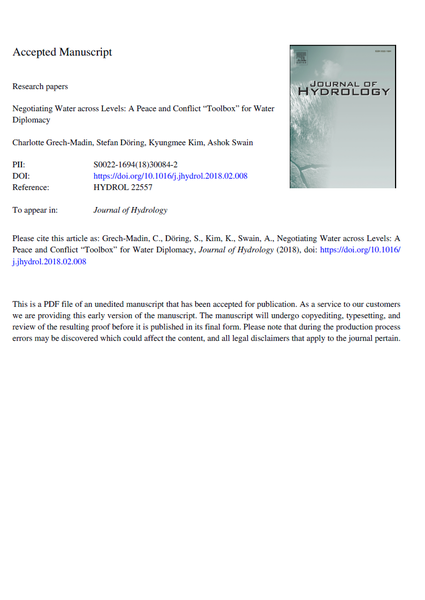
This article explores how water diplomacy can be strengthened through multi-level governance approaches. Drawing on peace and conflict research, it highlights the importance of political norms, stakeholder engagement, and local-level data in improving cooperation over shared water resources and enhancing the effectiveness of water diplomacy.
Year: 2018
Collections: Research Paper
Topics: Water governance, Water diplomacy, Hydropower
Authors: Denise Michèle Staubli Anoulak Kittikhoun,
Countries:
Source: Journal of Hydrology
The Mekong region, home to one of the world’s great rivers – the Mekong – is also one of the world’s most geostrategic regions, featuring seemingly conflicting interests among regional states including Viet Nam, Thailand, Myanmar, Laos and Cambodia and world powers such as China and the United States of America.
For nearly a century, some of the riparian states have developed parts of the basin in their territories – to great benefits and harm – and recently the remaining late developing countries are catching up with water and related resources development plans to dam, withdraw and use the mighty Mekong to fund national progress and alleviate poverty.
World leaders, academics, NGOs, media and even some government officials have warned that the current rush to development is not only bringing a sure death to a great previously untamed river, potentially displacing millions of people, and threatening livelihoods, but would also usher in an era of aggravated tensions and possibly even conflict. The Mekong River Commission (MRC), tasked to manage the river for the sake of the environment and the people, is failing its mission with work that has been ineffective, uninfluential and wasted, critics say.
Year: 2019
Collections:
Topics: Water diplomacy, Transboundary Water Resources, Water Security, Transboundary cooperation
Authors: Martina Klimes, David Michel, Elizabeth Yaari, Phillia Restiani
Countries:
Source: Journal of Hydrology
Why water diplomacy? What does diplomacy have to do with water? Is cooperation over transboundary surface and ground waters the exclusive domain of diplomats and foreign policy experts? Or mainly the purview of water professionals negotiating agreements on shared water resources? Why should non-governmental stakeholders be involved in transboundary water dialogues? These questions lie at the heart of debates and dialogues around the theory and practice of water diplomacy.
For questions about cooperation, please contact us at: