
Year: 2023
Collections: Research Paper
Topics: Water, IWRM
Authors: Гафуров А. А., Тиллакарим Т.А., Кауазов А.М.
Countries: Kazakhstan
Source: Central Asian Journal of Water Research
В статье представлена динамика изменения максимальных запасов воды в снежном покрове в Есильском водохозяйственном бассейне в период 1971–2019 гг. Основной целью работы является изучение динамики изменения влагозапасов снежного покрова, так как снежный покров играет важную роль в климатических, гидрологических и гляциологических процессах, являясь мощным климатообразующим фактором.
Year: 2023
Collections: Scientific Publications
Topics: Climate
Authors: Kulikov M., Shibkov E., Isaev E., Azarov A., Sidle R.
Countries: Kyrgyzstan
Source: Central Asian Journal of Sustainability and Climate Research
Understanding forest phenology is essential for monitoring global carbon budgets and managing vegetation resources in a changing climate. In southern Kyrgyzstan, walnut and wild apple trees dominate the forest landscape. These forests contain unique genetic diversity and offer potential for the development of climate-resilient crop varieties. They also support local communities through activities such as grazing, firewood collection, and fruit harvesting. However, these practices pose a threat to natural regeneration. Climate change exacerbates these challenges by altering their ecological niche. Despite this, few studies have examined forest phenology and its relationship to climate in Kyrgyzstan.
Year: 2023
Collections: Scientific Publications
Topics: Agriculture, Sustainable Development, Management
Authors: Conrad Christopher, Kussainova Maira, Schmidt G.
Countries: Kazakhstan, Kyrgyzstan, Uzbekistan, Tajikistan, Turkmenistan
Source: Central Asian Journal of Sustainability and Climate Research
The increasing demand for food, bioenergy and other agricultural products, as well as the intensification of climate change, pose special challenges for Central Asia’s agricultural sector in terms of implementing sustainable land management. Central Asia is a climate change hot spot. Adaptation measures of agricultural land use to climate change imply new trade-offs in terms of quality and provision of ecosystem services. Based on literature studies, this paper identifies examples of such trade-offs and presents possible solutions. The ecoregions of Central Asia show strong interdependencies. Therefore, a special focus has to be put on the transregional effects of the use of ecosystem services. Against the background of different concepts of sustainable development (ESS, SDG, Global Environmental Syndromes) integrative approaches for sustainable use and design of landscapes are necessary.
Year: 2023
Collections: Scientific Publications
Topics: Water
Authors: Оканов К., Калачев А., Роговский С.
Countries: Kazakhstan
Source:
В статье представлены результаты изучения формирования и особенностей снежного покрова в пихтовых насаждениях в сравнении с открытым закустаренным участком в условиях Юго-Западного Алтая, полученные за снежный период 2020–2021 гг.
Year: 2023
Collections: Scientific Publications
Topics: Water
Authors: Кабутов Х.К Каюмов А., Сакс Т., Наврузшоев Х.Д., Восидов Ф.К., Неккадамова Н.М., Халимов А.М.,
Countries: Tajikistan
Source:
Целью данной статьи является расчёт поверхностного баланса массы (SMB) ледника № 139 в бассейне оз. Каракуль, позволяющий на основе полученных результатов оценить степень влияния изменения климата на оледенение данной территории, а также перспективу изменения состояния ледников в будущем.
Year: 2023
Collections: Scientific Publications, Review article
Topics: Water, Water governance Water diplomacy,
Authors: Rozemarijn ter Horst, Jenniver Sehring, Alexandra Said
Countries:
Source: Journal of Hydrology X
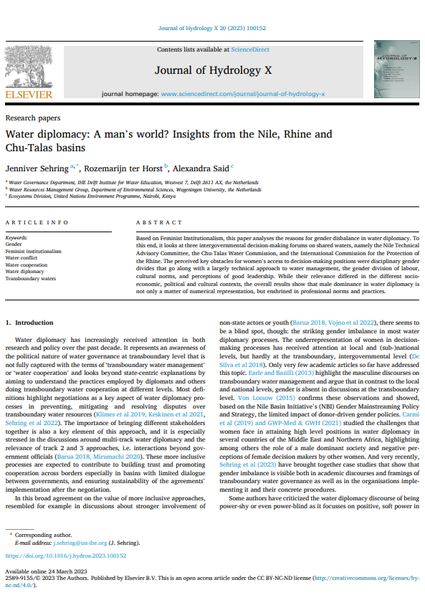
Based on Feminist Institutionalism, this paper analyses the reasons for gender disbalance in water diplomacy. To this end, it looks at three intergovernmental decision-making forums on shared waters, namely the Nile Technical Advisory Committee, the Chu-Talas Water Commission, and the International Commission for the Protection of the Rhine. The perceived key obstacles for women’s access to decision-making positions were disciplinary gender divides that go along with a largely technical approach to water management, the gender division of labour, cultural norms, and perceptions of good leadership. While their relevance differed in the different socioeconomic, political and cultural contexts, the overall results show that male dominance in water diplomacy is not only a matter of numerical representation, but enshrined in professional norms and practices.
Year: 2023
Collections: Scientific Publications
Topics: Climate
Authors: Борисова Ю.С.
Countries: Kazakhstan
Source: Цетральноазиатский журнал исследования климата и устойчивого развития
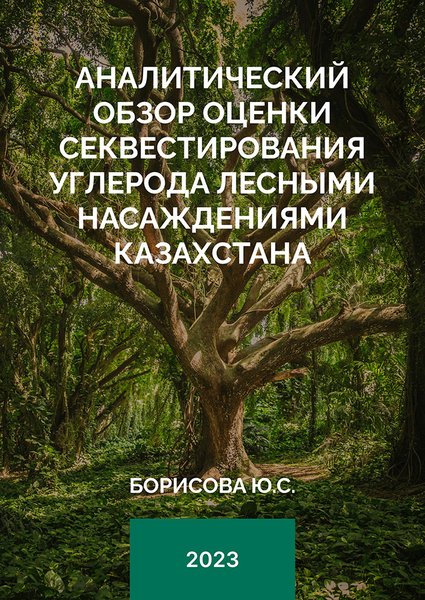
Процессы изменения климата происходят в глобальном масштабе и сопровождаются выбросами в атмосферу значительных количеств парниковых газов, преобладающими из которых являются оксид углерода и диоксид углерода. В аналитическом обзоре представлены результаты состояния изученности и оценки существующих исследований по секвестированию углерода лесными насаждениями. Леса играют ключевую роль в изменении климата, поглощая большое количество углекислого газа из атмо-сферы. Они являются наиболее важным наземным поглотителем углерода. Два ключевых показателя: биомасса и продуктивность лесов определяют уровень накопления углерода в экосистеме. Методы оценки секвестирования углерода лесными насаждениями включают использование различных моделей, таких как InVEST, CO2FIX, CBM-CFS3 и других.
Year: 2023
Collections: Scientific Publications, Review article
Topics: Water, Water diplomacy
Authors: Wondwosen Michago Seide, Emanuele Fantini
Countries:
Source: Water Alternatives 16(3): 912-929
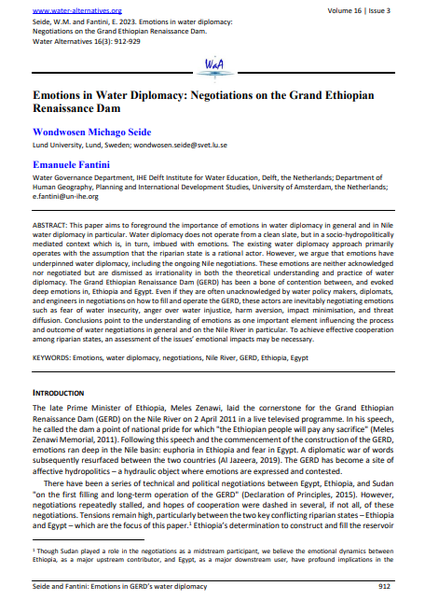
This paper aims to foreground the importance of emotions in water diplomacy in general and in Nile water diplomacy in particular. Water diplomacy does not operate from a clean slate, but in a socio-hydropolitically mediated context which is, in turn, imbued with emotions. The existing water diplomacy approach primarily operates with the assumption that the riparian state is a rational actor. However, we argue that emotions have underpinned water diplomacy, including the ongoing Nile negotiations. These emotions are neither acknowledged nor negotiated but are dismissed as irrationality in both the theoretical understanding and practice of water diplomacy.
For questions about cooperation, please contact us at: