


Year: 2023
Collections: Scientific Publications, Review article
Topics: Water, Water governance Water diplomacy,
Authors: Rozemarijn ter Horst, Jenniver Sehring, Alexandra Said
Countries:
Source: Journal of Hydrology X
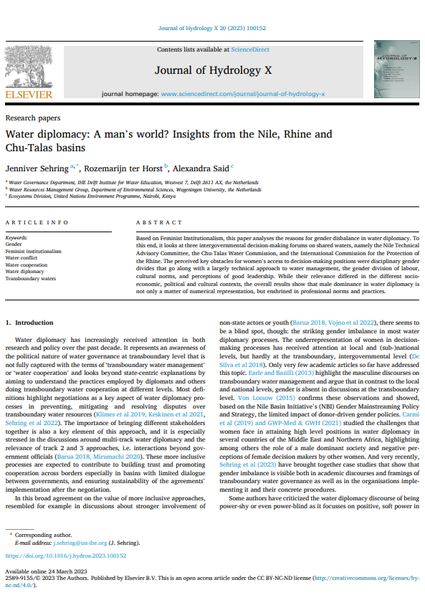
Based on Feminist Institutionalism, this paper analyses the reasons for gender disbalance in water diplomacy. To this end, it looks at three intergovernmental decision-making forums on shared waters, namely the Nile Technical Advisory Committee, the Chu-Talas Water Commission, and the International Commission for the Protection of the Rhine. The perceived key obstacles for women’s access to decision-making positions were disciplinary gender divides that go along with a largely technical approach to water management, the gender division of labour, cultural norms, and perceptions of good leadership. While their relevance differed in the different socioeconomic, political and cultural contexts, the overall results show that male dominance in water diplomacy is not only a matter of numerical representation, but enshrined in professional norms and practices.
Downloads:
Abstract: Based on Feminist Institutionalism, this paper analyses the reasons for gender disbalance in water diplomacy. To this end, it looks at three intergovernmental decision-making forums on shared waters, namely the Nile Technical Advisory Committee, the Chu-Talas Water Commission, and the International Commission for the Protection of the Rhine. The perceived key obstacles for women’s access to decision-making positions were disciplinary gender divides that go along with a largely technical approach to water management, the gender division of labour, cultural norms, and perceptions of good leadership. While their relevance differed in the different socioeconomic, political and cultural contexts, the overall results show that male dominance in water diplomacy is not only a matter of numerical representation, but enshrined in professional norms and practices.
По всем вопросам сотрудничества обращайтесь по эл.адресу или телефону: