

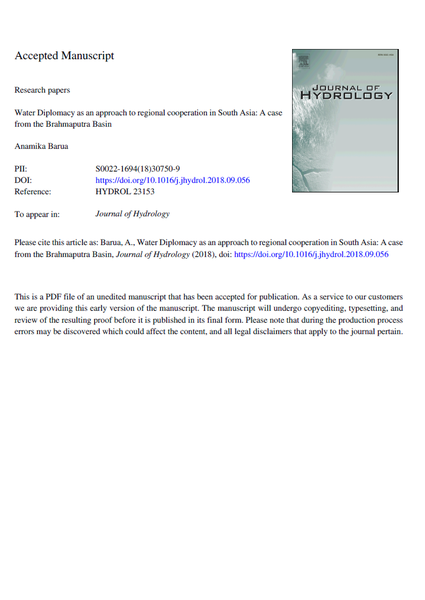
Year: 2018
Collections: Scientific Publications
Topics: Water diplomacy, Water, Transboundary Water Resources, Transboundary cooperation
Authors: Anamika Barua
Countries:
Source: Journal of Hydrology
The article examines challenges of transboundary water cooperation in the Brahmaputra River Basin shared by Bangladesh, Bhutan, China, and India. It highlights the lack of trust, information asymmetries, and absence of a regional governance framework that hinder cooperation. The authors emphasize the importance of inclusive, multi-stakeholder water diplomacy and informal dialogues as a foundation for sustainable and equitable basin-wide cooperation.
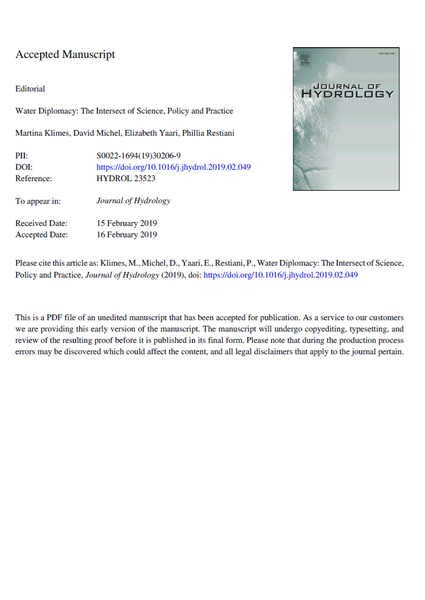
Year: 2019
Collections:
Topics: Water diplomacy, Transboundary Water Resources, Water Security, Transboundary cooperation
Authors: Martina Klimes, David Michel, Elizabeth Yaari, Phillia Restiani
Countries:
Source: Journal of Hydrology
Why water diplomacy? What does diplomacy have to do with water? Is cooperation over transboundary surface and ground waters the exclusive domain of diplomats and foreign policy experts? Or mainly the purview of water professionals negotiating agreements on shared water resources? Why should non-governmental stakeholders be involved in transboundary water dialogues? These questions lie at the heart of debates and dialogues around the theory and practice of water diplomacy.
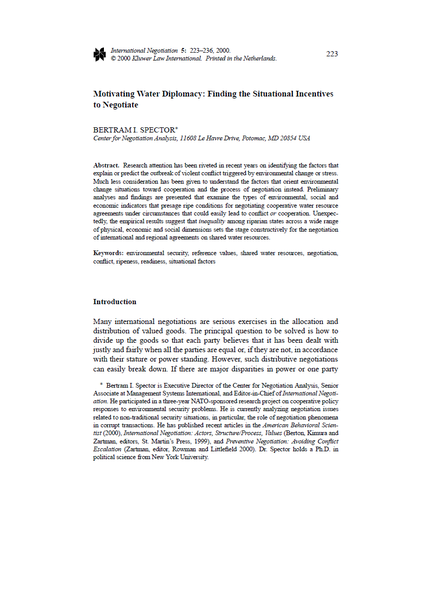
Year: 2000
Collections:
Topics: Water, Water diplomacy, Transboundary Water Resources, Transboundary cooperation, Hydropolitics
Authors: Bertram I. Spector
Countries:
Source: International Negotiation
Recent research has focused mainly on factors linking environmental change or stress to violent conflict, while less attention has been paid to conditions that promote cooperation and negotiation. This study presents preliminary findings on environmental, social, and economic indicators that may create favourable conditions for cooperative water resource agreements. The results suggest that inequality among riparian states across physical, economic, and social dimensions can, unexpectedly, facilitate the negotiation of international and regional agreements on shared water resources.
Year: 2024
Collections: Research Paper
Topics: IWRM, Water law, Water diplomacy, Transboundary Water Resources, Transboundary cooperation
Authors: Ayşegül Kibaroğlu
Countries:
Source: Theorizing Transboundary Waters in International Relations
Water diplomacy encompasses the processes and institutions through which the national interests and identities of sovereign states are represented to one another. It is enshrined in international law, which states use to explain and justify their policies to concerned actors in the international system. States mostly prefer traditional tools of water diplomacy such as negotiation and mediation to resolve disputes in transboundary river basins.
Year: 2018
Collections: Research Paper
Topics: Water governance, IWRM, Transboundary cooperation Irrigation,
Authors: Iroda Amirova, Martin Petrick, Nodir Djanibekov
Countries: Kazakhstan, Uzbekistan
Source: World Development
This study contributes to the understanding of long- and short-term determinants of cooperation among water users. We experimentally investigate the potential of water users’ self-governance in enhancing their contributions to a common pool as opposed to external regulation. Our focus is on the irrigated areas of Kazakhstan and Uzbekistan.
For questions about cooperation, please contact us at: