

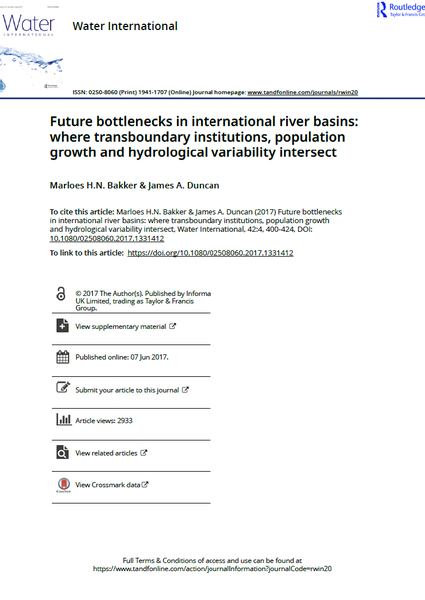
Year: 2017
Collections: Research Paper
Topics: Water, Transboundary cooperation
Authors: Marloes H.N. Bakker, James A. Duncan
Countries:
Source: Water International
Using global data, this article examines the nexus of transboundary flood events and future social vulnerability. Which international river basins are forecast to experience an increase in both hydrological variability and population in the future, but currently lack institutional provisions to deal with these shared events?
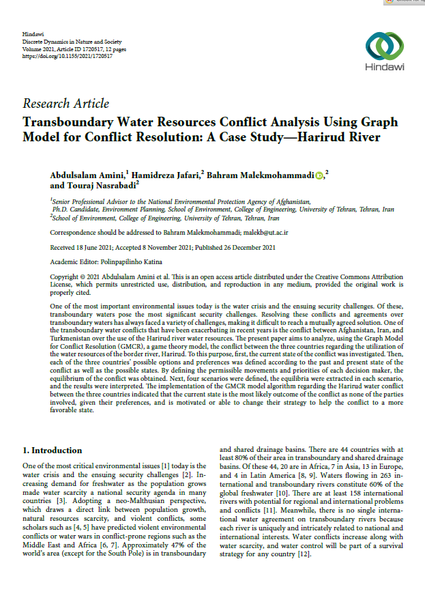
Year: 2021
Collections: Research Paper
Topics: Water, Water law, Water Security, Transboundary cooperation, Hydropolitics
Authors: Abdulsalam Amini, Hamidreza Jafari, Bahram Malekmohammadi, Touraj Nasrabadi
Countries: Iran Turkmenistan, Afghanistan,
Source: Discrete Dynamics in Nature and Society
The present paper aims to analyze, using the Graph Model for Conflict Resolution (GMCR), a game theory model, the conflict between the three countries regarding the utilization of the water resources of the border river, Harirud. To this purpose, first, the current state of the conflict was investigated.
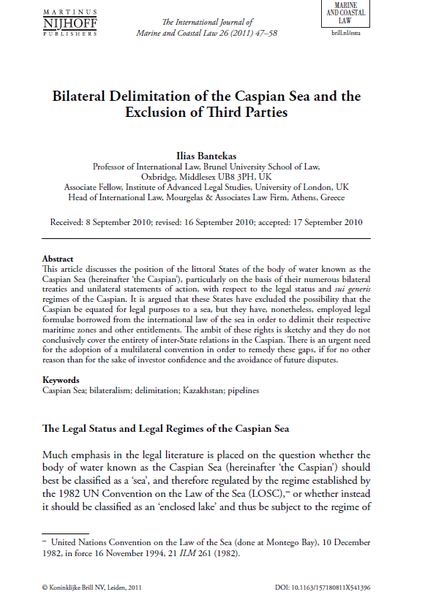
Year: 2010
Collections: Research Paper
Topics: Water, Water law, Water diplomacy, Transboundary Water Resources, Transboundary cooperation
Authors: Ilias Bantekas
Countries:
Source: The International Journal of Marine and Coastal Law
This article discusses the position of the littoral States of the body of water known as the Caspian Sea (hereinafter ‘the Caspian’), particularly on the basis of their numerous bilateral treaties and unilateral statements of action, with respect to the legal status and sui generis regimes of the Caspian.
Year: 2008
Collections: Books
Topics: Water, Sustainable Development, IWRM, Water diplomacy, Transboundary Water Resources, Water Security, Transboundary cooperation, Hydropolitics
Authors: Thomas Bernauer, Tobias Siegfried
Countries:
Source:
This book chapter examines the compliance and actual performance of an international water agreement in the Naryn/Syr Darya Basin in Central Asia. The authors analyze the 1998 agreement, which was designed to regulate the operation of the Toktogul Reservoir by balancing Kyrgyzstan’s need for winter hydropower production with Uzbekistan’s and Kazakhstan’s need for summer irrigation water. The main argument of the article is that formal compliance with an agreement does not necessarily mean that the agreement is effective in solving the real water allocation problem. Using the policy performance metric (PER), the authors show that although compliance with the agreement was relatively high, its actual performance was low and highly variable. The article concludes that the existing water management system in the Naryn/Syr Darya Basin requires urgent institutional reform.
Year: 2009
Collections: Research Paper
Topics: Water, IWRM, Transboundary Water Resources, Transboundary cooperation
Authors: Teresita Cruz-Del Rosario
Countries:
Source: Australian Journal of International Affairs
The article examines the challenges of cooperative management of transboundary water resources in Central Asia. The author analyzes water relations among Kazakhstan, Kyrgyzstan, Tajikistan, Turkmenistan, and Uzbekistan through Ulrich Beck’s concept of “risk society.” The article argues that water scarcity, the transboundary nature of the Amu Darya and Syr Darya rivers, the Soviet legacy of centralized water management, artificial borders, and ethnic tensions create significant risks for regional stability.
For questions about cooperation, please contact us at: