
Year: 2008
Collections: Conferences
Topics: IWRM, Water governance, Transboundary Water Resources, Transboundary cooperation
Authors: Mikhail Khankhasayev, Steven Leitman
Countries:
Source: Transboundary Water Resources: A Foundation for Regional Stability in Central Asia
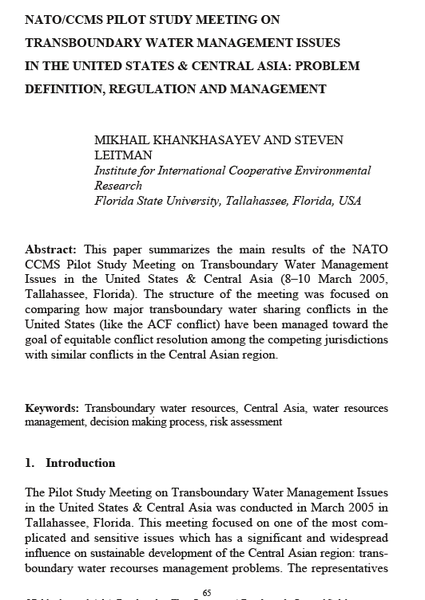
This paper summarizes the main results of the NATO CCMS Pilot Study Meeting on Transboundary Water Management Issues in the United States & Central Asia (8–10 March 2005, Tallahassee, Florida). The structure of the meeting was focused on comparing how major transboundary water sharing conflicts in the United States (like the ACF conflict) have been managed toward the goal of equitable conflict resolution among the competing jurisdictions with similar conflicts in the Central Asian region.
Year: 2025
Collections: Books
Topics: Water, IWRM, Water governance, Water diplomacy, Transboundary Water Resources, Transboundary cooperation
Authors: Shafiqul Islam, Kevin Smith, Martina Klimes, Aaron Salzberg
Countries:
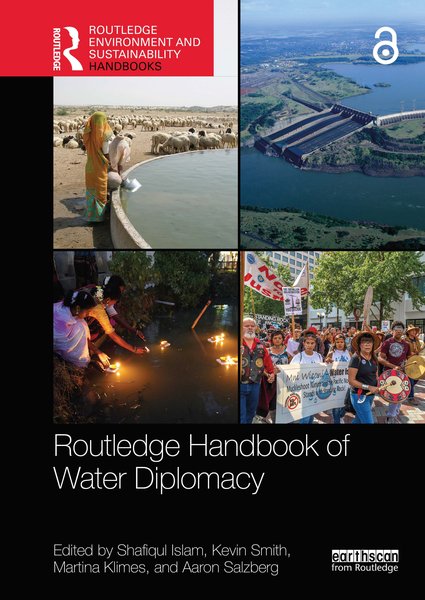
Source: Routledge Handbook of Water Diplomacy
Full book available here: https://drive.google.com/file/d/1V8lHqDiaqrMtHnU6JP9p9SBC2rsXY8gX/view?usp=sharing
The Routledge Handbook of Water Diplomacy is a comprehensive guide to understanding and practicing water diplomacy – a framework for building relationships, negotiating shared interests, and managing complex water challenges across physical, political, and societal boundaries.
In an era marked by rising scarcity, deepening uncertainty, and growing geopolitical tension, this timely volume offers actionable insights for negotiated problem-solving grounded in both scientific understanding and diplomatic skill. Moving beyond abstract theory and technical fixes, the Handbook introduces a dual-pathway structure designed to meet the diverse needs of its users. The “Working Together” pathway invites readers to engage with water diplomacy through the lens of their roles, whether as professionals, decision-makers, funders, researchers, or affected communities. The “What Matters and Why” pathway highlights key thematic dimensions, including process design, adaptive learning, trust-building, divergent worldviews, and the management of uncertainty.
Year: 2025
Collections: Research Paper
Topics: Climate, Water governance, Transboundary Water Resources, Transboundary cooperation, Hydropolitics
Authors: Albina Prniyazova, Suriya Turaeva, Daniyar Turgunov, Ben Jarihani
Countries:
Source: Sustainability
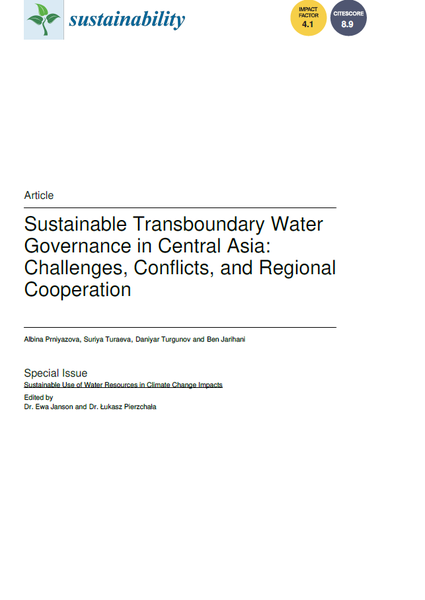
Sustainable transboundary water governance in Central Asia faces significant challenges, including political tensions, ecological issues, such as the drying Aral Sea, and seasonal hydropower disruptions impacting downstream countries. This study aims to address these problems by examining the complexities of water resource governance in the region, emphasizing the interplay between national interests and regional cooperation.
Year: 2025
Collections: Research Paper
Topics: Water, IWRM, Water governance, Water Security
Authors:
Countries:
Source: Государственное управление и государственная служба
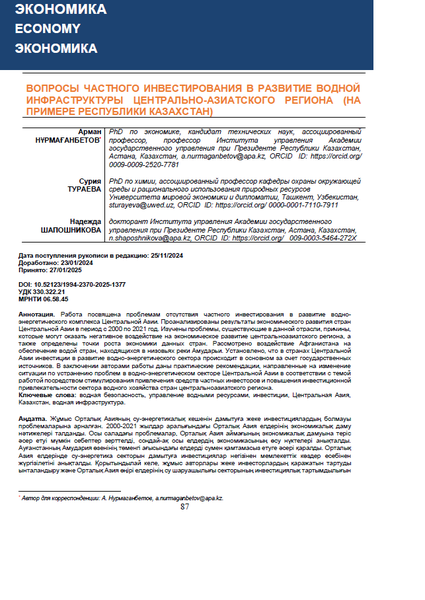
Работа посвящена проблемам отсутствия частного инвестирования в развитие водно-энергетического комплекса Центральной Азии. Проанализированы результаты экономического развития стран Центральной Азии в период с 2000 по 2021 год. Изучены проблемы, существующие в данной отрасли, причины, которые могут оказать негативное воздействие на экономическое развитие центральноазиатского региона, а также определены точки роста экономики данных стран. Рассмотрено воздействие Афганистана на обеспечение водой стран, находящихся в низовьях реки Амударьи. Установлено, что в странах Центральной Азии инвестиции в развитие водно-энергетического сектора происходит в основном за счет государственных источников.
Year: 2017
Collections: Research Paper
Topics: Water, Water governance, Transboundary Water Resources, Transboundary cooperation, Hydropolitics
Authors: Sarah Acquah, Frank A. Ward
Countries:
Source: Water Resources Management
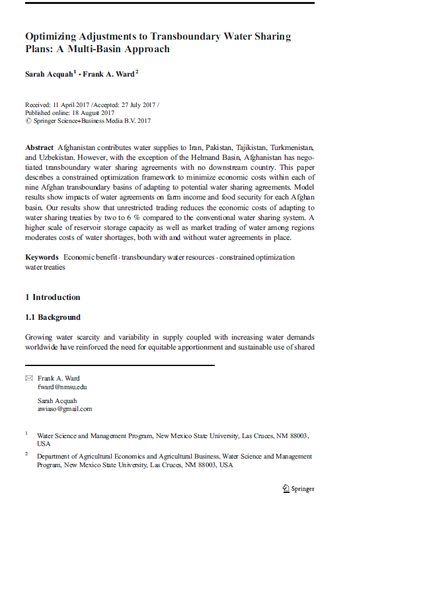
Afghanistan contributes water supplies to Iran, Pakistan, Tajikistan, Turkmenistan, and Uzbekistan. However, with the exception of the Helmand Basin, Afghanistan has negotiated transboundary water sharing agreements with no downstream country. This paper describes a constrained optimization framework to minimize economic costs within each of nine Afghan transboundary basins of adapting to potential water sharing agreements.
For questions about cooperation, please contact us at: