


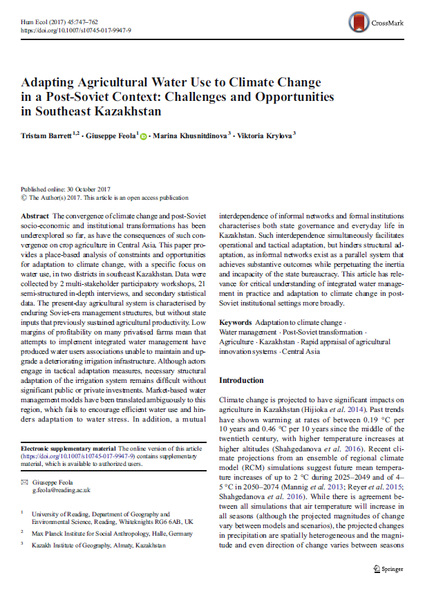
Год: 2017
Разделы:
Темы: Стратегическое управление водными ресурсами Климат, ИУВР, Ирригация,
Авторы: Tristam Barrett, Giuseppe Feola, Marina Khusnitdinova, Viktoria Krylova
Страны: Казахстан
Источник: Human Ecology
The convergence of climate change and post-Soviet socio-economic and institutional transformations has been underexplored so far, as have the consequences of such convergence on crop agriculture in Central Asia. This paper provides a place-based analysis of constraints and opportunities for adaptation to climate change, with a specific focus on water use, in two districts in southeast Kazakhstan.
Год: 2015
Разделы: Исследовательская работа
Темы: Стратегическое управление водными ресурсами, Трансграничные водные ресурсы, Гидрополитика
Авторы: Nodir Djanibekov, Kristof Van Assche, Vladislav Valentinov
Страны:
Источник: Society & Natural Resources
The article focuses on the problems of transboundary water governance in Central Asia from the perspective of Niklas Luhmann’s social systems theory. The authors examine why, after the collapse of the Soviet Union, it became difficult to coordinate the use of the water-energy infrastructure of the Amu Darya and Syr Darya rivers. During the Soviet period, water, energy, and agriculture were managed through a centralized system. However, after 1991, each country began to develop its own national policy. This strengthened contradictions between upstream countries, which need water for hydropower production, and downstream countries, which need water for irrigation.
Год: 2016
Разделы: Краткие сообщения
Темы: Вода, Климат, Сельское хозяйство, Устойчивое развитие, ИУВР
Авторы: Unger-Shayesteh Katy, Gerlitz Lars, Vorogushyn Sergiy
Страны: Казахстан, Кыргызстан, Узбекистан, Таджикистан, Туркменистан
Источник: Central Asian Journal of Water Research
An important topic of the journal “Integrated Water Resources Management in Central Asia” will be the assessment of past and future changes in climate and water resources in Central Asia. This technical note aims at providing guidance for sound data-based assessment of changes to be published in this journal. The main requirements for achieving credible results are (1) the use of consistent data series, (2) the selection of appropriate change detection methods, and (3) the discussion of the results, their uncertainties and limitations. Using an example of trend analysis, it is exemplarily shown how inhomogeneities in a data series, the selection of start and end points, the applied methods, and temporal aggregation may affect the results of change studies.
По всем вопросам сотрудничества обращайтесь по эл.адресу или телефону: