
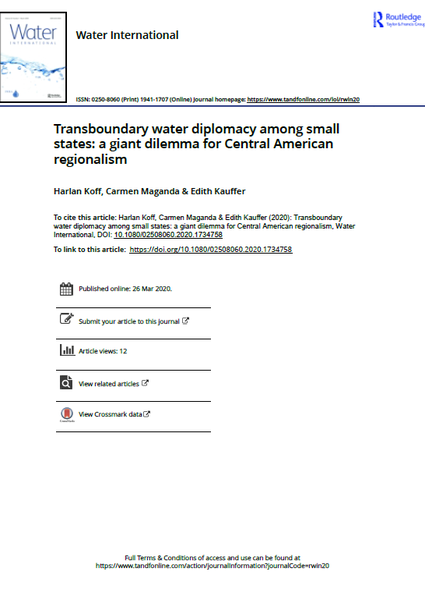
Год: 2020
Разделы: Научные публикации
Темы: Вода, Водная дипломатия
Авторы: Harlan Koff, Carmen Maganda, Edith Kauffer
Страны:
Источник: Water International
Water diplomacy aims to shift water disputes from zero-sum games into positive-sum cooperation models though actor-driven approaches. Small states are often viewed as facilitators of diplomacy through a commitment to regionalism and consensus, which highlights their influence in international affairs. Responding to the research question, ‘How do “non-decisions” lead to status quo in water diplomacy?’ this article discusses how regional water diplomacy based on influence is weakened by the domestic shortcomings of small states’ political systems, where authorities use non-decision-making to maintain a status quo that guarantees their legitimized power.
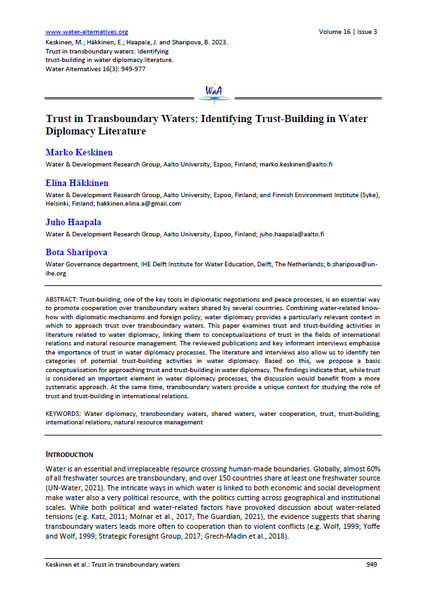
Год: 2023
Разделы: Научные публикации, Обзорная статья
Темы: Вода, Водная дипломатия
Авторы: Juho Haapala, Marko Keskinen, Elina Häkkinen, Bota Sharipova
Страны:
Источник: Water Alternatives 16(3): 949-977
This paper examines trust and trust-building activities in literature related to water diplomacy, linking them to conceptualisations of trust in the fields of international relations and natural resource management. The reviewed publications and key informant interviews emphasise the importance of trust in water diplomacy processes. The literature and interviews also allow us to identify ten categories of potential trust-building activities in water diplomacy.
Год: 2019
Разделы:
Темы: Водная дипломатия, Трансграничные водные ресурсы, Водная безопасность, Трансграничное сотрудничество
Авторы: Martina Klimes, David Michel, Elizabeth Yaari, Phillia Restiani
Страны:
Источник: Journal of Hydrology
Why water diplomacy? What does diplomacy have to do with water? Is cooperation over transboundary surface and ground waters the exclusive domain of diplomats and foreign policy experts? Or mainly the purview of water professionals negotiating agreements on shared water resources? Why should non-governmental stakeholders be involved in transboundary water dialogues? These questions lie at the heart of debates and dialogues around the theory and practice of water diplomacy.
Год: 2023
Разделы: Научные публикации, Обзорная статья
Темы: Вода, Водная дипломатия
Авторы: Wondwosen Michago Seide, Emanuele Fantini
Страны:
Источник: Water Alternatives 16(3): 912-929
This paper aims to foreground the importance of emotions in water diplomacy in general and in Nile water diplomacy in particular. Water diplomacy does not operate from a clean slate, but in a socio-hydropolitically mediated context which is, in turn, imbued with emotions. The existing water diplomacy approach primarily operates with the assumption that the riparian state is a rational actor. However, we argue that emotions have underpinned water diplomacy, including the ongoing Nile negotiations. These emotions are neither acknowledged nor negotiated but are dismissed as irrationality in both the theoretical understanding and practice of water diplomacy.
Год: 2018
Разделы: Научные публикации
Темы: Вода
Авторы: Thevs Niels, Aliev Kumar, Strenge Eva, Eraaliev Maksat, Lang Petra, Baibagysov Azim
Страны: Казахстан
Источник: Central Asian Journal of Water Research
Год: 2021
Разделы: Научные публикации, Обзорная статья
Темы: Вода, Водная дипломатия
Авторы: Juho Haapala, Marko Keskinen, Erik Salminen
Страны:
Источник: Journal of Hydrology
In this article, we seek to contribute to the practice of water diplomacy by introducing a step-wise Water Diplomacy Paths approach for analysing different water diplomacy contexts and related water diplomacy actions. To facilitate this, we recognise five key aspects for water diplomacy (Political; Preventive; Integrative; Cooperative; Technical) and propose a general definition for water diplomacy. We also discuss the possible distinctions between the related concepts of water diplomacy and transboundary water cooperation. The use of the Water Diplomacy Paths approach is demonstrated with brief case studies focusing on Central Asia, the Mekong Region, and the Finnish-Russian water cooperation. The work builds on an extensive literature review and comparative analysis of water diplomacy approaches as well as on a series of workshops and interviews among selected water diplomacy actors, including career diplomats.
Год: 2014
Разделы: Научные публикации, Доклады, Обзорная статья
Темы: Водная дипломатия, Вода, Водное законодательство, Стратегическое управление водными ресурсами
Авторы: Benjamin Pohl, et al.
Страны:
Источник: Adelphi
Water is a fundamental precondition for human life. No substitute for freshwater exists, and it is scarce in many regions. Simultaneously, much of it transcends state borders via shared river and lake basins or groundwater aquifers. The resulting political, economic, social and environmental interdependencies give water resources the crucial potential to either foster cooperation or exacerbate conflict. The significance of access to water is growing as demographic and economic drivers as well as deteriorating water quality interact with climate change that will regionally increase water scarcity and variability.
Год: 2020
Разделы: Научные публикации, Обзорная статья
Темы: Вода, Стратегическое управление водными ресурсами Водная дипломатия,
Авторы: et al., Margaret O. Wilder
Страны:
Источник: Environmental Science and Policy
The United States and Mexico have engaged in hydrodiplomacy—a practice of transboundary water management that blends water diplomacy and science diplomacy–for more than 75 years, since the adoption of the Treaty of 1944 and the creation of the International Boundary and Water Commission. We examine six major turning points in U.S.-Mexico hydrodiplomacy to ascertain the key factors in the region’s history of resolving transboundary water issues. We find that recognized adaptive governance indicators—such as social learning, sustained relationships, flexible governance mechanisms, and state and non-state networks are essential elements of hydrodiplomacy. Our research suggests that robust and foundational institutions comprise another key indicator of adaptive governance specifically in transboundary contexts. A commitment to both science and diplomacy have been important components underlying the effectiveness of hydrodiplomacy in the border region. Binational networks involving diverse state and non-state actors at multiple scales have increasingly played a pivotal role in shaping desirable hydrodiplomatic outcomes in the region.
По всем вопросам сотрудничества обращайтесь по эл.адресу или телефону: