
Год: 2013
Разделы:
Темы: Трансграничное сотрудничество, Гидроэнергетика, Гидрополитика Ирригация,
Авторы: Shlomi Dinar
Страны:
Источник: Eurasian Geography and Economics
The article focuses on the role of geography and the relative power of states in international hydropolitics. The author analyzes how a country’s position within a river basin — upstream or downstream — affects its ability to participate in water negotiations. It is often assumed that a state with greater military and economic power can dictate the terms of water allocation. However, the author shows that geographical location is also an important source of power. Even a weaker state, if it is located upstream, can influence the water regime and challenge the existing status quo.
Год: 2015
Разделы: Исследовательская работа
Темы: Вода, ИУВР, Водное законодательство, Стратегическое управление водными ресурсами, Трансграничные водные ресурсы, Трансграничное сотрудничество
Авторы: Bunyod Holmatov, Jonathan Lautze, Jusipbek Kazbekov
Страны:
Источник: International Environmental Agreements: Politics, Law and Economics
This research presents a systematic analysis of 123 agreements concerning small transboundary tributaries within the Syr Darya River Basin, highlighting the importance of sub-basin cooperation in Central Asia. The study identifies a significant increase in treaty-making activity during the first decade of the 21st century, demonstrating that local-level cooperation can remain effective even when basin-wide cooperation faces challenges. Most of the analyzed agreements are regulatory in nature and focus on technical issues, including water allocation, operation and maintenance of hydraulic infrastructure, and the management of shared water resources.
Год: 2017
Разделы: Исследовательская работа
Темы: Вода, Климат, ИУВР, Трансграничные водные ресурсы, Трансграничное сотрудничество
Авторы: Sarah Hummel
Страны:
Источник: International Studies Quarterly
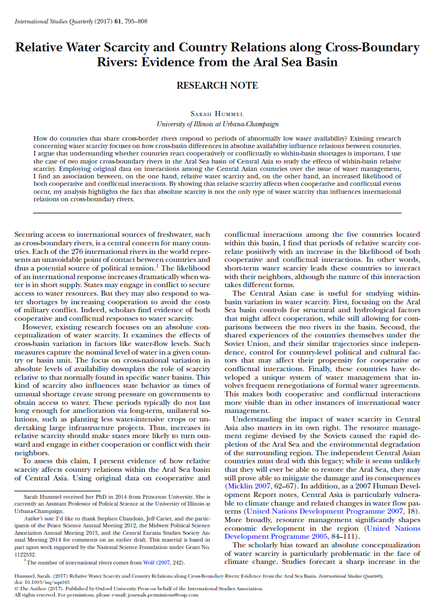
This scientific article examines the impact of relative water scarcity on international relations in the Aral Sea Basin. The author distinguishes between absolute water scarcity, determined by the overall availability of water resources, and relative water scarcity, defined as temporary deviations from normal water availability within a specific river basin. Based on an analysis of hydrological and political data from the Amu Darya and Syr Darya river basins in Central Asia, the study concludes that short-term water shortages stimulate states to take more active policy actions. The findings demonstrate that periods of water scarcity increase the likelihood of both cooperative and conflictual interactions among neighboring countries. This suggests that states employ a variety of foreign policy instruments to address transboundary water challenges under conditions of resource variability. The results highlight the importance of considering climate variability when assessing and forecasting transboundary water disputes and cooperation.
Год: 2019
Разделы: Материалы конференций
Темы: Стратегическое управление водными ресурсами, Водная дипломатия, Трансграничные водные ресурсы, Трансграничное сотрудничество, Гидрополитика
Авторы: B. A. Krasnoyarova, Y. I. Vinokurov, T. V. Antyufeeva
Страны:
Источник: IOP Conference Series: Earth and Environmental Science
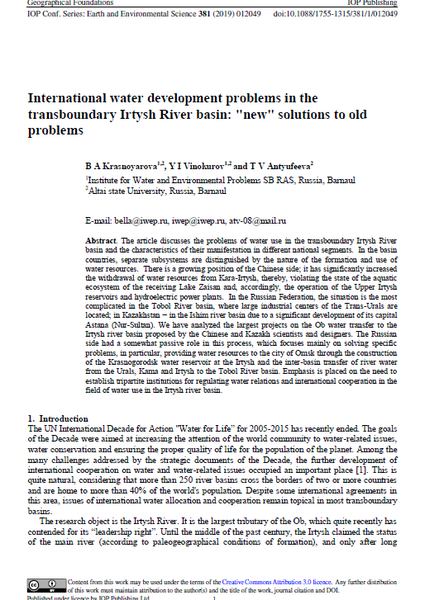
This article examines the complex challenges of water management in the transboundary Irtysh River Basin shared by China, Kazakhstan, and Russia. The authors emphasize that intensive water withdrawals by China and ongoing infrastructure development in Kazakhstan are contributing to water resource depletion and ecosystem degradation, particularly in the downstream reaches of the river. The study discusses proposed inter-basin water transfer projects aimed at addressing water scarcity, as well as the environmental risks associated with industrial pollution. Particular attention is given to Russia’s limited engagement in transboundary water governance and the need to establish trilateral institutional mechanisms for the joint management of shared water resources. The authors argue that achieving international consensus is essential to preventing further ecological deterioration of the basin. The study concludes by advocating a shift from isolated technical solutions toward an integrated transboundary water governance framework.
Год: 2013
Разделы: Исследовательская работа
Темы: Вода, Трансграничные водные ресурсы, Трансграничное сотрудничество, Гидроэнергетика
Авторы: Sanat Kushkumbayev, Azina Kushkumbayeva
Страны: Казахстан, Кыргызстан, Узбекистан, Таджикистан, Туркменистан
Источник: Chinese Journal of International Law
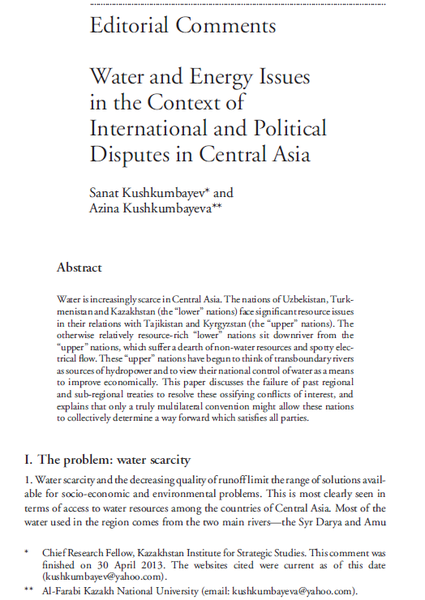
This paper discusses the failure of past regional and sub-regional treaties to resolve these ossifying conflicts of interest, and explains that only a truly multilateral convention might allow these nations to collectively determine a way forward which satisfies all parties.
По всем вопросам сотрудничества обращайтесь по эл.адресу или телефону: