

Year: 2013
Collections:
Topics: Transboundary cooperation, Hydropower, Hydropolitics Irrigation,
Authors: Shlomi Dinar
Countries:
Source: Eurasian Geography and Economics
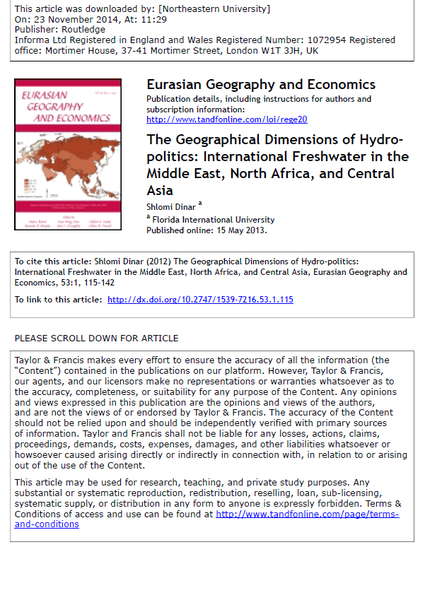
The article focuses on the role of geography and the relative power of states in international hydropolitics. The author analyzes how a country’s position within a river basin — upstream or downstream — affects its ability to participate in water negotiations. It is often assumed that a state with greater military and economic power can dictate the terms of water allocation. However, the author shows that geographical location is also an important source of power. Even a weaker state, if it is located upstream, can influence the water regime and challenge the existing status quo.
Year: 2013
Collections: Research Paper
Topics: Water, IWRM, Transboundary Water Resources
Authors: Shokhrukh-Mirzo Jalilov, Saud A. Amer, Frank A. Ward
Countries:
Source: Eurasian Geography and Economics
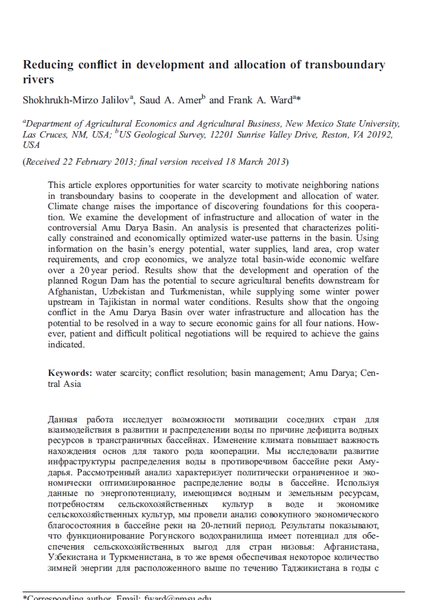
This article explores opportunities for water scarcity to motivate neighboring nations in transboundary basins to cooperate in the development and allocation of water. Climate change raises the importance of discovering foundations for this cooperation. The authors examine the development of infrastructure and allocation of water in the controversial Amu Darya Basin.
Year: 2013
Collections: Research Paper
Topics: Water, Transboundary Water Resources, Transboundary cooperation, Hydropower
Authors: Sanat Kushkumbayev, Azina Kushkumbayeva
Countries: Kazakhstan, Kyrgyzstan, Uzbekistan, Tajikistan, Turkmenistan
Source: Chinese Journal of International Law
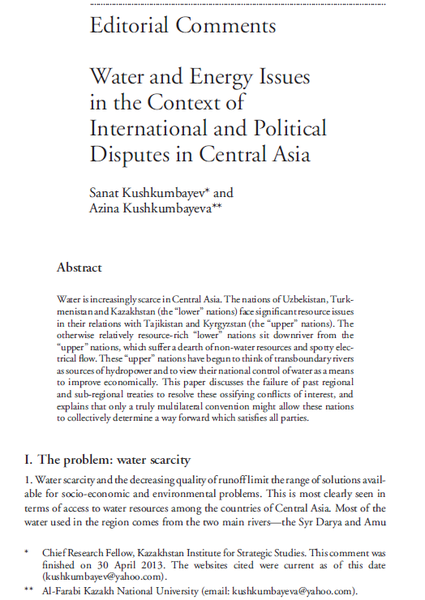
This paper discusses the failure of past regional and sub-regional treaties to resolve these ossifying conflicts of interest, and explains that only a truly multilateral convention might allow these nations to collectively determine a way forward which satisfies all parties.
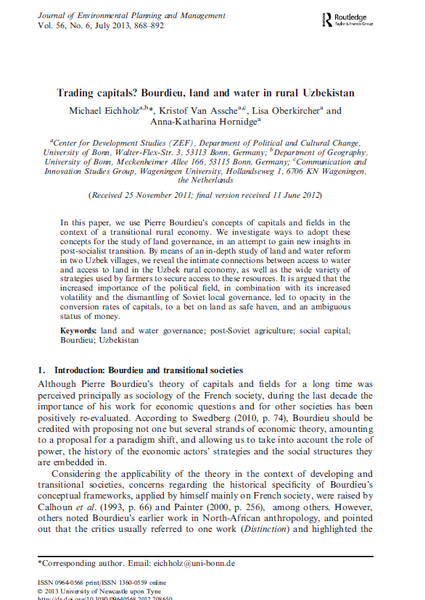
Year: 2013
Collections: Research Paper
Topics: Water, Water governance
Authors: Michael Eichholz, Kristof Van Assche, Lisa Oberkircher, Anna-Katharina Hornidge
Countries: Uzbekistan
Source: Journal of Environmental Planning and Management
This article analyzes the governance of land and water resources in rural Uzbekistan through the lens of Pierre Bourdieu’s sociological theory. The authors explore how farmers adapt to post-socialist reforms and successive waves of land consolidation by relying on different forms of capital, including social, political, and symbolic capital. The study demonstrates that, in the absence of an open market and transparent rules, access to resources becomes the outcome of continuous negotiations and exchanges of favors. Under conditions of high uncertainty, social networks and proximity to political authorities prove to be more important than direct financial investments. As a result, the rural economy is transformed into a complex system of personal arrangements, where the survival and success of farming households depend on farmers’ ability to convert their informal assets into actual access to land and water resources.
For questions about cooperation, please contact us at: