
Year: 2025
Collections: Scientific Publications
Topics: Agriculture
Authors: Ankit Garg, Sai Krishna Akash Ramineni, Neelima Satyam, Askar Zhussupbekov
Countries: Kazakhstan, Kyrgyzstan, Uzbekistan, Tajikistan, Turkmenistan
Source: https://cajscr.com/
Soil salinity in Central Asia negatively impacts soil structure, leading to degradation and reduced water infiltration. This not only hampers agricultural productivity but also makes the land less suitable for construction due to its high susceptibility to deformation. Environmentally friendly materials like biochar, a carbon-rich substance, show promise in reducing the deformation of saline soils. However, the mechanisms behind its effectiveness are not yet fully understood. This study aims to analyse saline clays’ dispersion and sedimentation behaviour under varying pore water salinity levels (0 % to 10%). A biochar content of 5 % was selected as it is found to be optimum for plant growth and erosion resistance. It was found from the study that the biochar increases the aggregation of soil particles and enhances flocculation, improving soil dispersion characteristics. Biochar facilitates soil particle aggregation by increasing the cation exchange capacity. At higher pore water salinity levels (5% and 10%), the sedimentation behaviour of biochar-treated soil particles deviates from expectations, showing slower sedimentation rates and lower sedimentation heights. This is because the sodium ions are adsorbed by biochar, reducing salt’s effect on dispersion and sedimentation. The results demonstrate that biochar effectively enhances the stability of saline soils and, hence, has a potential use for ground improvement in the Central Asian region.
Year: 2025
Collections: Research Paper
Topics: Water, IWRM, Water governance, Water Security
Authors:
Countries:
Source: Государственное управление и государственная служба
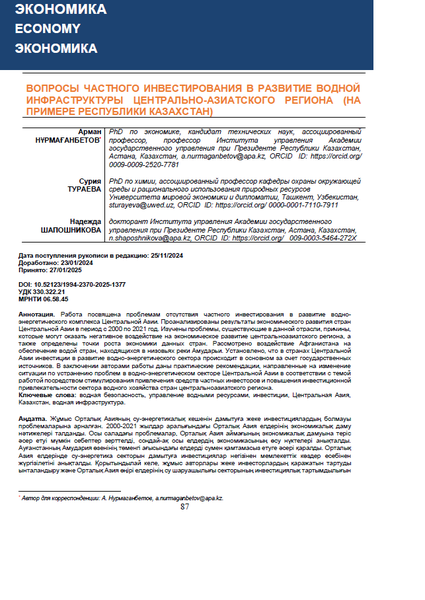
Работа посвящена проблемам отсутствия частного инвестирования в развитие водно-энергетического комплекса Центральной Азии. Проанализированы результаты экономического развития стран Центральной Азии в период с 2000 по 2021 год. Изучены проблемы, существующие в данной отрасли, причины, которые могут оказать негативное воздействие на экономическое развитие центральноазиатского региона, а также определены точки роста экономики данных стран. Рассмотрено воздействие Афганистана на обеспечение водой стран, находящихся в низовьях реки Амударьи. Установлено, что в странах Центральной Азии инвестиции в развитие водно-энергетического сектора происходит в основном за счет государственных источников.
Year: 2025
Collections: Scientific Publications
Topics: Water, Sustainable Development
Authors: Пономарева Т.С., Жирков В.В., Южаков И.Ю.
Countries: Kazakhstan
Source: https://water-ca.org
Возрастающая нагрузка на водные ресурсы, а также международные обязательства Казахстана по Повестке дня на период до 2030 г. определили необходимость скорейшей модернизации водохозяйственной инфраструктуры промыш-ленных предприятий. Между тем (в условиях отсутствия объективных гидроэкологических данных и нормативной неопределенности) принятие технологических решений по очистке и использованию шахтных и карьерных вод сопряжено водными рисками для горнодобывающей отрасли производства. Данные факторы послужили поводом для подготовки аналитического обзора с целью более широкого информирования заинтересованных сторон о существующей проблеме. Фундаментальный контекст статьи определяется научно-теоретическим сопоставлением существующей законо-дательной структуры регулирования водопользования с институциональной политикой Целей устойчивого развития № 6 (ЦУР 6) «чистая вода и санитария». В качестве ключевого аспекта исследований выступает «комплексный» индикатор 6.4.2. ЦУР «уровень водного стресса», сквозная взаимосвязь которого с другими индикаторами ЦУР 6 позволяет представить всесторонний анализ в вопросе надлежащего исполнения национальных стратегий РК по устойчивому управлению водными ресурсами. Результаты исследований показали, что несмотря на довольно полную законодательную интеграцию ЦУР в нормативно правовые акты (НПА) Казахстана, их реализация в виде экологических нормативов требуют критической переоценки для возможности практического применения при идентификации горнодобывающими предприятиями наилучших доступных техник (НДТ). Несостоятельность экологических нормативов обусловлена слабым межведомственным взаимодействием, размытом понимании ответственности, формальным характером участия промышленного и научного сообщества в разработке, экспертной оценке и научном сопровождении проектов НПА.
For questions about cooperation, please contact us at: