

Year: 2020
Collections:
Topics: Water diplomacy, Water, IWRM, Transboundary Water Resources, Hydropolitics
Authors: Naho Mirumachi
Countries:
Source: Environmental Science and Policy
Water diplomacy is regarded as a means to prevent conflict and to enhance peace through the cooperative management of transboundary water resources. There have been calls for water diplomacy to be given further attention, especially by foreign policy and security specialists, and to be extended to non-state actors through informal dialogue processes. The paper critically questions the qualitative changes water diplomacy delivers and argues for further analytical scrutiny on its efficacy. Using a critical hydropolitics perspective, the paper advances understanding of the way power asymmetries presiding over contested waters are altered or maintained, particularly through informal diplomacy.
Year: 2000
Collections:
Topics: Water, Water diplomacy, Transboundary Water Resources, Transboundary cooperation, Hydropolitics
Authors: Bertram I. Spector
Countries:
Source: International Negotiation
Recent research has focused mainly on factors linking environmental change or stress to violent conflict, while less attention has been paid to conditions that promote cooperation and negotiation. This study presents preliminary findings on environmental, social, and economic indicators that may create favourable conditions for cooperative water resource agreements. The results suggest that inequality among riparian states across physical, economic, and social dimensions can, unexpectedly, facilitate the negotiation of international and regional agreements on shared water resources.
Year: 2021
Collections: Research Paper
Topics: Water, Water law, Water Security, Transboundary cooperation, Hydropolitics
Authors: Abdulsalam Amini, Hamidreza Jafari, Bahram Malekmohammadi, Touraj Nasrabadi
Countries: Iran Turkmenistan, Afghanistan,
Source: Discrete Dynamics in Nature and Society
The present paper aims to analyze, using the Graph Model for Conflict Resolution (GMCR), a game theory model, the conflict between the three countries regarding the utilization of the water resources of the border river, Harirud. To this purpose, first, the current state of the conflict was investigated.
Year: 2012
Collections:
Topics: Water, Climate, NEXUS, Hydropolitics
Authors: Thomas Bernauer, Tobias Siegfried
Countries: Kazakhstan, Kyrgyzstan, Uzbekistan, Tajikistan
Source: Journal of Peace Research
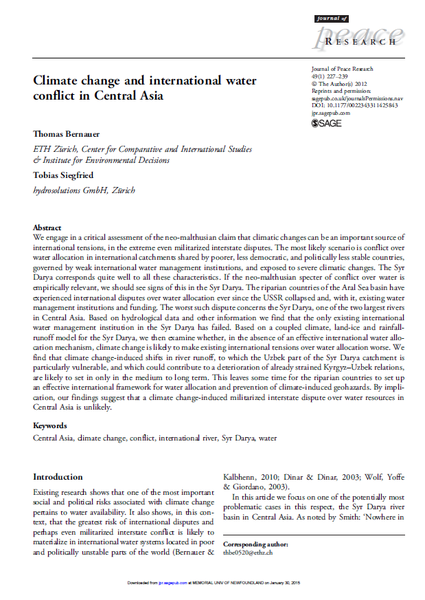
The authors engage in a critical assessment of the neo-malthusian claim that climatic changes can be an important source of international tensions, in the extreme even militarized interstate disputes.
Year: 2008
Collections: Books
Topics: Water, Sustainable Development, IWRM, Water diplomacy, Transboundary Water Resources, Water Security, Transboundary cooperation, Hydropolitics
Authors: Thomas Bernauer, Tobias Siegfried
Countries:
Source:
This book chapter examines the compliance and actual performance of an international water agreement in the Naryn/Syr Darya Basin in Central Asia. The authors analyze the 1998 agreement, which was designed to regulate the operation of the Toktogul Reservoir by balancing Kyrgyzstan’s need for winter hydropower production with Uzbekistan’s and Kazakhstan’s need for summer irrigation water. The main argument of the article is that formal compliance with an agreement does not necessarily mean that the agreement is effective in solving the real water allocation problem. Using the policy performance metric (PER), the authors show that although compliance with the agreement was relatively high, its actual performance was low and highly variable. The article concludes that the existing water management system in the Naryn/Syr Darya Basin requires urgent institutional reform.
For questions about cooperation, please contact us at: