


Year: 2014
Collections: Research Paper
Topics: Water, Transboundary Water Resources, Hydropower
Authors: Sonoko Ito, Sameh El Khatib, Mikiyasu Nakayama
Countries: Uzbekistan, Tajikistan
Source: International Journal of Water Resources Development
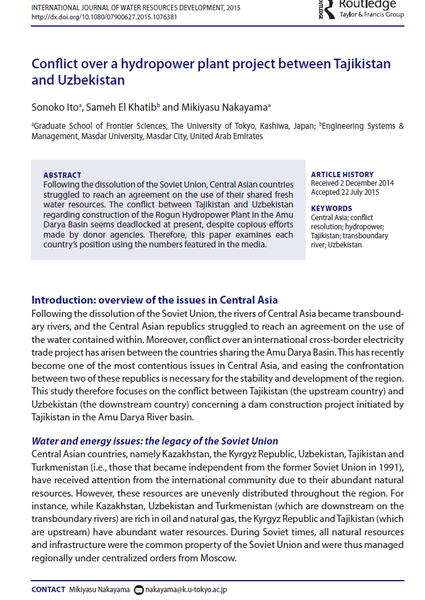
Following the dissolution of the Soviet Union, Central Asian countries struggled to reach an agreement on the use of their shared fresh water resources. The conflict between Tajikistan and Uzbekistan regarding construction of the Rogun Hydropower Plant in the Amu Darya Basin seems deadlocked at present, despite copious efforts made by donor agencies. Therefore, this paper examines each country’s position using the numbers featured in the media.
Year: 2013
Collections: Research Paper
Topics: Water, IWRM, Transboundary Water Resources
Authors: Shokhrukh-Mirzo Jalilov, Saud A. Amer, Frank A. Ward
Countries:
Source: Eurasian Geography and Economics
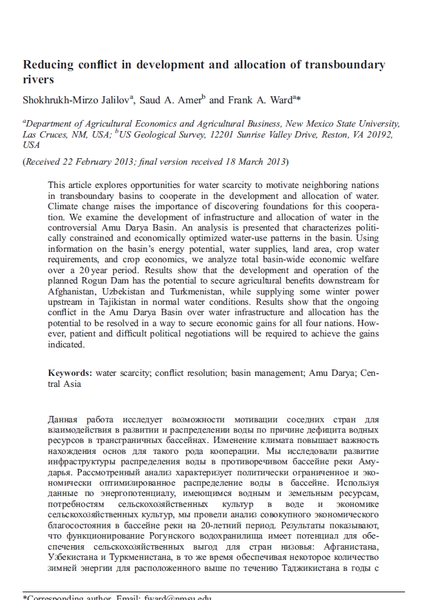
This article explores opportunities for water scarcity to motivate neighboring nations in transboundary basins to cooperate in the development and allocation of water. Climate change raises the importance of discovering foundations for this cooperation. The authors examine the development of infrastructure and allocation of water in the controversial Amu Darya Basin.
Year: 2017
Collections: Research Paper
Topics: Water, Water Security
Authors: Frederike Klümper, Thomas Herzfeld, Insa Theesfeld
Countries: Tajikistan
Source: Water
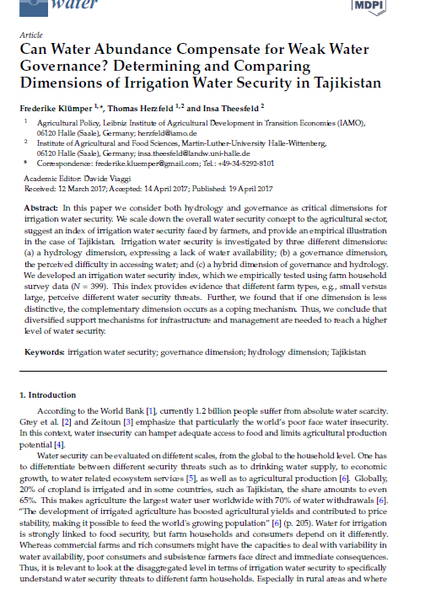
This scientific article examines the concept of water security in the irrigation sector of Tajikistan at the individual farm level. The authors develop a comprehensive Water Security Index that incorporates hydrological, governance, and hybrid dimensions to assess the actual availability and accessibility of water resources. The study reveals that, despite the physical abundance of water, weak governance and institutional barriers are the primary sources of water insecurity. Based on a survey of 399 farming households, the authors establish a typology of farms, demonstrating that large and small producers face fundamentally different water-related challenges. The findings show that effective governance can compensate for infrastructure deficiencies, thereby enhancing the resilience of agricultural production. The article concludes by emphasizing the need to shift from broad national water security indicators toward targeted support for local water distribution and management systems.
Year: 2019
Collections: Conferences
Topics: Water governance, Water diplomacy, Transboundary Water Resources, Transboundary cooperation, Hydropolitics
Authors: B. A. Krasnoyarova, Y. I. Vinokurov, T. V. Antyufeeva
Countries:
Source: IOP Conference Series: Earth and Environmental Science
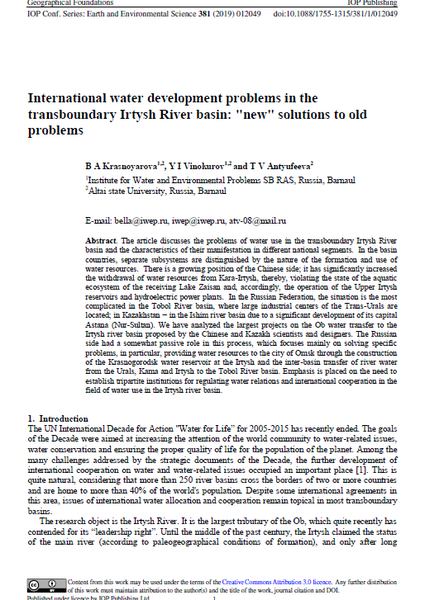
This article examines the complex challenges of water management in the transboundary Irtysh River Basin shared by China, Kazakhstan, and Russia. The authors emphasize that intensive water withdrawals by China and ongoing infrastructure development in Kazakhstan are contributing to water resource depletion and ecosystem degradation, particularly in the downstream reaches of the river. The study discusses proposed inter-basin water transfer projects aimed at addressing water scarcity, as well as the environmental risks associated with industrial pollution. Particular attention is given to Russia’s limited engagement in transboundary water governance and the need to establish trilateral institutional mechanisms for the joint management of shared water resources. The authors argue that achieving international consensus is essential to preventing further ecological deterioration of the basin. The study concludes by advocating a shift from isolated technical solutions toward an integrated transboundary water governance framework.
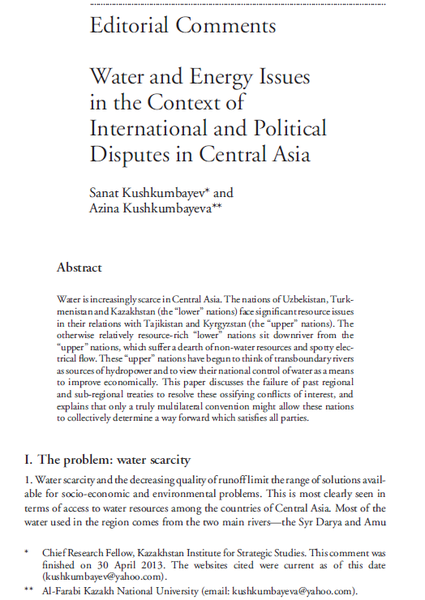
Year: 2013
Collections: Research Paper
Topics: Water, Transboundary Water Resources, Transboundary cooperation, Hydropower
Authors: Sanat Kushkumbayev, Azina Kushkumbayeva
Countries: Kazakhstan, Kyrgyzstan, Uzbekistan, Tajikistan, Turkmenistan
Source: Chinese Journal of International Law
This paper discusses the failure of past regional and sub-regional treaties to resolve these ossifying conflicts of interest, and explains that only a truly multilateral convention might allow these nations to collectively determine a way forward which satisfies all parties.
For questions about cooperation, please contact us at: