
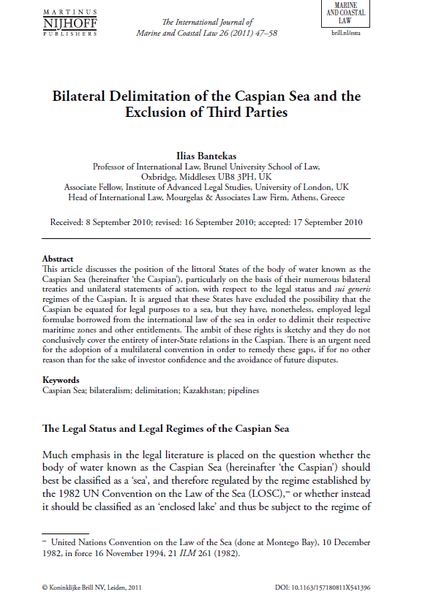
Год: 2010
Разделы: Исследовательская работа
Темы: Вода, Водное законодательство, Водная дипломатия, Трансграничные водные ресурсы, Трансграничное сотрудничество
Авторы: Ilias Bantekas
Страны:
Источник: The International Journal of Marine and Coastal Law
This article discusses the position of the littoral States of the body of water known as the Caspian Sea (hereinafter ‘the Caspian’), particularly on the basis of their numerous bilateral treaties and unilateral statements of action, with respect to the legal status and sui generis regimes of the Caspian.
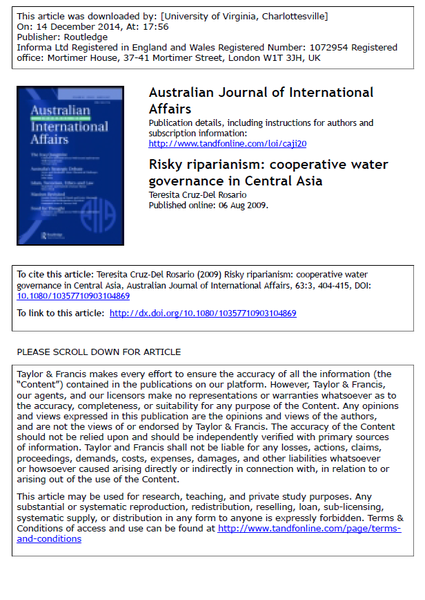
Год: 2009
Разделы: Исследовательская работа
Темы: Вода, ИУВР, Трансграничные водные ресурсы, Трансграничное сотрудничество
Авторы: Teresita Cruz-Del Rosario
Страны:
Источник: Australian Journal of International Affairs
The article examines the challenges of cooperative management of transboundary water resources in Central Asia. The author analyzes water relations among Kazakhstan, Kyrgyzstan, Tajikistan, Turkmenistan, and Uzbekistan through Ulrich Beck’s concept of “risk society.” The article argues that water scarcity, the transboundary nature of the Amu Darya and Syr Darya rivers, the Soviet legacy of centralized water management, artificial borders, and ethnic tensions create significant risks for regional stability.
Год: 2008
Разделы: Материалы конференций
Темы: ИУВР, Стратегическое управление водными ресурсами, Трансграничные водные ресурсы, Трансграничное сотрудничество
Авторы: Mikhail Khankhasayev, Steven Leitman
Страны:
Источник: Transboundary Water Resources: A Foundation for Regional Stability in Central Asia
This paper summarizes the main results of the NATO CCMS Pilot Study Meeting on Transboundary Water Management Issues in the United States & Central Asia (8–10 March 2005, Tallahassee, Florida). The structure of the meeting was focused on comparing how major transboundary water sharing conflicts in the United States (like the ACF conflict) have been managed toward the goal of equitable conflict resolution among the competing jurisdictions with similar conflicts in the Central Asian region.
Год: 2008
Разделы: Книги
Темы: Вода, Устойчивое развитие, ИУВР, Водная дипломатия, Трансграничные водные ресурсы, Водная безопасность, Трансграничное сотрудничество, Гидрополитика
Авторы: Thomas Bernauer, Tobias Siegfried
Страны:
Источник:
This book chapter examines the compliance and actual performance of an international water agreement in the Naryn/Syr Darya Basin in Central Asia. The authors analyze the 1998 agreement, which was designed to regulate the operation of the Toktogul Reservoir by balancing Kyrgyzstan’s need for winter hydropower production with Uzbekistan’s and Kazakhstan’s need for summer irrigation water. The main argument of the article is that formal compliance with an agreement does not necessarily mean that the agreement is effective in solving the real water allocation problem. Using the policy performance metric (PER), the authors show that although compliance with the agreement was relatively high, its actual performance was low and highly variable. The article concludes that the existing water management system in the Naryn/Syr Darya Basin requires urgent institutional reform.
Год: 2000
Разделы:
Темы: Вода, Водная дипломатия, Трансграничные водные ресурсы, Трансграничное сотрудничество, Гидрополитика
Авторы: Bertram I. Spector
Страны:
Источник: International Negotiation
Recent research has focused mainly on factors linking environmental change or stress to violent conflict, while less attention has been paid to conditions that promote cooperation and negotiation. This study presents preliminary findings on environmental, social, and economic indicators that may create favourable conditions for cooperative water resource agreements. The results suggest that inequality among riparian states across physical, economic, and social dimensions can, unexpectedly, facilitate the negotiation of international and regional agreements on shared water resources.
По всем вопросам сотрудничества обращайтесь по эл.адресу или телефону: