
Year: 2013
Collections: Research Paper
Topics: Water, IWRM, Transboundary Water Resources
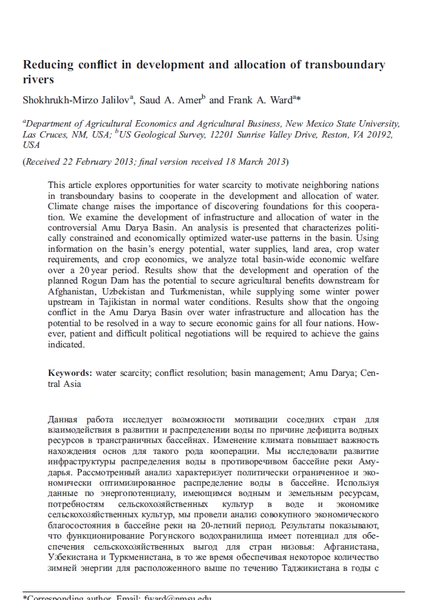
Authors: Shokhrukh-Mirzo Jalilov, Saud A. Amer, Frank A. Ward
Countries:
Source: Eurasian Geography and Economics
This article explores opportunities for water scarcity to motivate neighboring nations in transboundary basins to cooperate in the development and allocation of water. Climate change raises the importance of discovering foundations for this cooperation. The authors examine the development of infrastructure and allocation of water in the controversial Amu Darya Basin.
Year: 2017
Collections: Research Paper
Topics: Water, Water governance, Transboundary Water Resources, Transboundary cooperation, Hydropolitics
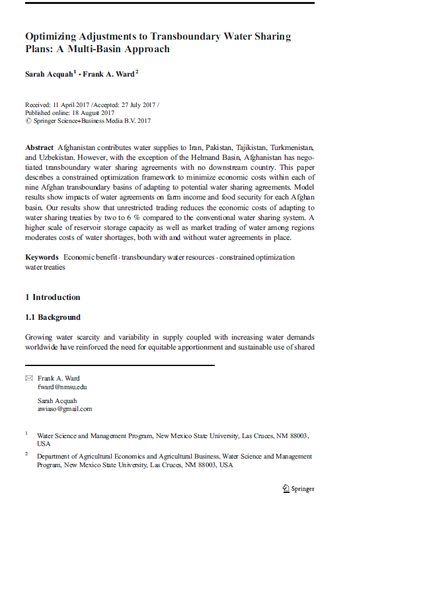
Authors: Sarah Acquah, Frank A. Ward
Countries:
Source: Water Resources Management
Afghanistan contributes water supplies to Iran, Pakistan, Tajikistan, Turkmenistan, and Uzbekistan. However, with the exception of the Helmand Basin, Afghanistan has negotiated transboundary water sharing agreements with no downstream country. This paper describes a constrained optimization framework to minimize economic costs within each of nine Afghan transboundary basins of adapting to potential water sharing agreements.
Year: 2017
Collections: Research Paper
Topics: Water, Water Security
Authors: Frederike Klümper, Thomas Herzfeld, Insa Theesfeld
Countries: Tajikistan
Source: Water
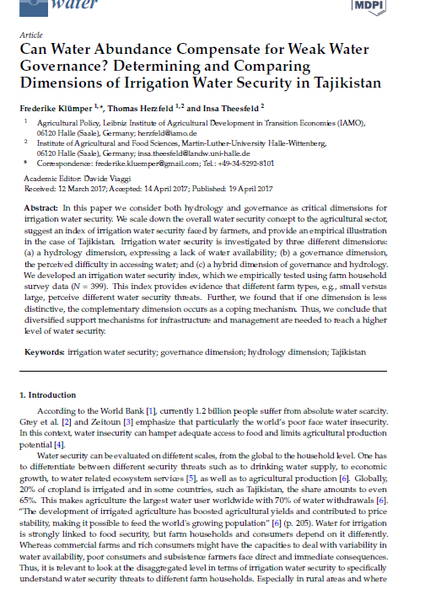
This scientific article examines the concept of water security in the irrigation sector of Tajikistan at the individual farm level. The authors develop a comprehensive Water Security Index that incorporates hydrological, governance, and hybrid dimensions to assess the actual availability and accessibility of water resources. The study reveals that, despite the physical abundance of water, weak governance and institutional barriers are the primary sources of water insecurity. Based on a survey of 399 farming households, the authors establish a typology of farms, demonstrating that large and small producers face fundamentally different water-related challenges. The findings show that effective governance can compensate for infrastructure deficiencies, thereby enhancing the resilience of agricultural production. The article concludes by emphasizing the need to shift from broad national water security indicators toward targeted support for local water distribution and management systems.
Year: 2022
Collections: Policy Briefs
Topics: Agriculture, Sustainable Development
Authors: Guggenberger Georg, Shibistova Olga, Liebelt Peter, Muminjanov Hafiz, Kassam Amir, Friedrich Theodor
Countries: Kazakhstan, Kyrgyzstan, Uzbekistan, Tajikistan, Turkmenistan, Afghanistan
Source:
Soil degradation is widespread and cross-border in Central Asia with multiple symptoms. This impairs the provision of ecosystem services, including food production, climate change mitigation, biodiversity, and human health. The soil health concept links soil management to broader sustainable development goals. Soil knowledge and its application has to be invigorated, for instance by establishing a Central Asian Soil Competence Network.
For questions about cooperation, please contact us at: