
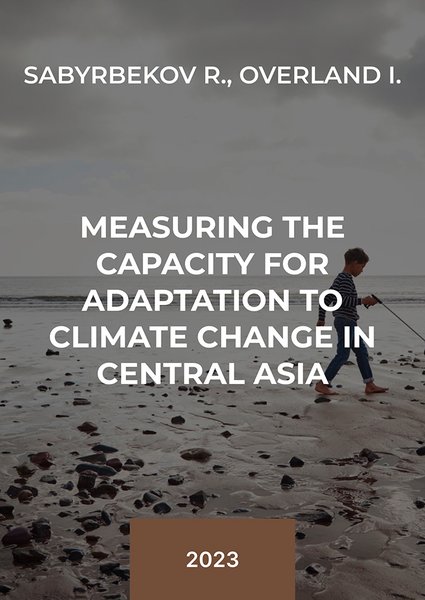
Year: 2023
Collections: Scientific Publications
Topics: Climate
Authors: Sabyrbekov R., Overland I.
Countries: Kazakhstan, Kyrgyzstan, Uzbekistan, Tajikistan, Turkmenistan
Source: Central Asian Journal of Sustainability and Climate Research
Climate change poses a formidable threat to the Central Asian region, exacerbating preexisting vulnerabilities and necessitating enhanced adaptation efforts. The economic and environmental costs of these changing climatic conditions are substantial, compelling governments to bolster their adaptive capacity. In this study, we employ the United Nations Framework Convention on Climate Change (UNFCCC) adaptation framework and high-quality data to quantitatively measure the capacities of the Central Asian countries to adapt to the impacts of climate change.
Year: 2020
Collections: Research Paper
Topics: Water
Authors: Azami A., Sagin J., Sadat S. H., Hejran H.
Countries: Afghanistan
Year: 2018
Collections: Scientific Publications
Topics: Water
Authors: Sadeqinazhad Fahima, Atef Said Shakib, Amatya Devendra M.
Countries: Afghanistan
![Manual_5.0_FINAL_12.3_3rd_edition[1]_Страница_001](/media/images/Manual_5.0_FINAL_12.3_3rd_edition1.2e16d0ba.fill-425x600.png)
Year: 2025
Collections: Manuals
Topics: Water, IWRM
Authors: Kogutenko Larissa, Safiya Asalbekova, Michael Walther
Countries: Kazakhstan, Kyrgyzstan, Uzbekistan, Tajikistan, Turkmenistan
Source: Journal of MOLARE Research Centre (MRC)
Why water monitoring and assessment are important?
Water quality assessment is one of the crucial scientific and practical analyses to identify the possibility of water consumption for different human needs and nature/ecosystem conservation for future generations. Water quality can be measured and monitored in rivers, springs, creeks, swamps, estuaries, wetlands and lakes what is called aquatic systems. Quality parameters, such as biological, chemical and physical indicators identify the combination of values that influence the composition of water. Monitoring and comparison of different water habitats (macro invertebrates) in biological monitoring provides an information of water quality and allows to make a quick assessment.
Year: 2020
Collections: Research Paper
Topics: Water
Authors: Azami A., Sagin J., Sadat S. H., Hejran H.
Countries: Afghanistan
Year: 2021
Collections: Research Paper
Topics: Irrigation
Authors: Mitusov A., Sultanbekova A.K., Sagintayev J.M., Azami A.
Countries: Kazakhstan
Year: 2017
Collections: Scientific Publications
Topics: Water, Climate
Authors: Sagintayev J.M., Kerimkulov Zhandos
Countries: Kazakhstan, Kyrgyzstan, Uzbekistan, Tajikistan, Turkmenistan
Year: 2017
Collections: Scientific Publications
Topics: Water, Climate
Authors: Gafurov A., Sagintayev J.M., Atanov Serikzhan
Countries: Kazakhstan, Kyrgyzstan, Uzbekistan, Tajikistan, Turkmenistan
Year: 2024
Collections: Scientific Publications
Topics: Water
Authors: Nematullah Fetrat, Ahmad Reza Rostayee, Sai Kala
Countries: Afghanistan
Source: https://water-ca.org
The article investigates certain low-cost filtering materials and their filtration efficiency for open well sources in terms of economic access to clean water in Anakapalle, a suburb of Visa-khapatnam, India, during the pre-monsoon period of 2022. The corresponding research aimed to study a selection of filter materials including coconut shell activated carbon, rice husk ash, manganese modified sand, and graphene oxide, as well as assess their performance against selected physico-chemical parameters of water. Considering the basic idea of slow sand and gravity-based filtration, a setup was arranged with a cartridge filled with layers of filtering materials and a ceramic candle filter. Adsorption turned out the most pronounced removal mechanism that took place when utilizing the aforementioned filter materials. The main focus of the study was to reduce pH, TDS, hardness, alkalinity, chlorides and iron content by applying dif-ferent filtration removal mechanisms. The study results show a significant drop in turbidity, pH, TDS and chlorides, and small reduction in hardness when coconut shell activated carbon and rice husk ash were used as filtration media. Whereas the chemically coated medium – manga-nese modified sand – demonstrated a considerable fall in iron concentrations, graphene oxide sand was observed to reduce alkalinity for any sample source.
Year: 2025
Collections: Scientific Publications
Topics: Agriculture
Authors: Ankit Garg, Sai Krishna Akash Ramineni, Neelima Satyam, Askar Zhussupbekov
Countries: Kazakhstan, Kyrgyzstan, Uzbekistan, Tajikistan, Turkmenistan
Source: https://cajscr.com/
Soil salinity in Central Asia negatively impacts soil structure, leading to degradation and reduced water infiltration. This not only hampers agricultural productivity but also makes the land less suitable for construction due to its high susceptibility to deformation. Environmentally friendly materials like biochar, a carbon-rich substance, show promise in reducing the deformation of saline soils. However, the mechanisms behind its effectiveness are not yet fully understood. This study aims to analyse saline clays’ dispersion and sedimentation behaviour under varying pore water salinity levels (0 % to 10%). A biochar content of 5 % was selected as it is found to be optimum for plant growth and erosion resistance. It was found from the study that the biochar increases the aggregation of soil particles and enhances flocculation, improving soil dispersion characteristics. Biochar facilitates soil particle aggregation by increasing the cation exchange capacity. At higher pore water salinity levels (5% and 10%), the sedimentation behaviour of biochar-treated soil particles deviates from expectations, showing slower sedimentation rates and lower sedimentation heights. This is because the sodium ions are adsorbed by biochar, reducing salt’s effect on dispersion and sedimentation. The results demonstrate that biochar effectively enhances the stability of saline soils and, hence, has a potential use for ground improvement in the Central Asian region.
Year: 2024
Collections: Scientific Publications
Topics: Water
Authors: Tillakarim T., Serikbay N., Satmurzayev A., Sairov S.
Countries: Kazakhstan
Source: water-ca.org
The research aimed to evaluate the possibility of applying the HBV model for assessing the flow of the Ile Alatau Mountain Range rivers. The main part of the corresponding water resources forms on the northern slopes of the Ile Alatau making them a significant water balance and water supply factor for the major cities of Almaty, Kaskelen, Talgar, and Yesik.
Year: 2021
Collections: Scientific Publications
Topics: Agriculture
Authors: Salmukhanbetova Zh.K., Imanalinova A. A., Dimeyeva L. A., Zverev N.E.
Countries: Kazakhstan
For questions about cooperation, please contact us at: