
Year: 2020
Collections: Books
Topics: Water, Sustainable Development, Irrigation, IWRM, NEXUS, Water law, Water diplomacy, Water governance, Transboundary Water Resources, Water Security
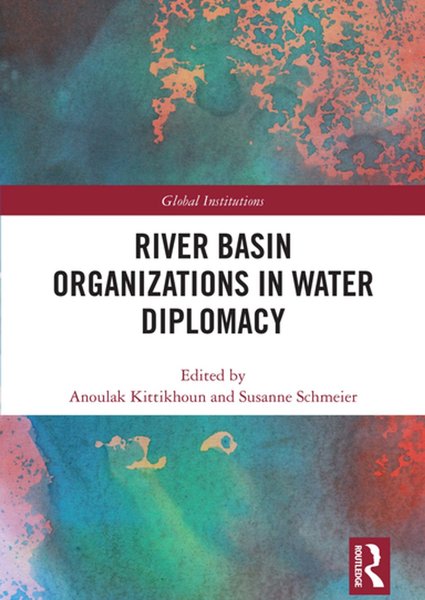
Authors: Anoulak Kittikhoun, Susanne Schmeier
Countries:
Source: Routledge
River Basin Organizations in Water Diplomacy explores the role of River Basin Organizations (RBOs) in preventing and resolving conflicts related to transboundary water resources. Through a comparative analysis of international river basins, the book examines how institutional mechanisms, legal frameworks, and diplomatic tools promote cooperation among states and support the sustainable management of shared water resources.
Year: 2018
Collections: Research Paper
Topics: Water governance, Water diplomacy, Hydropower
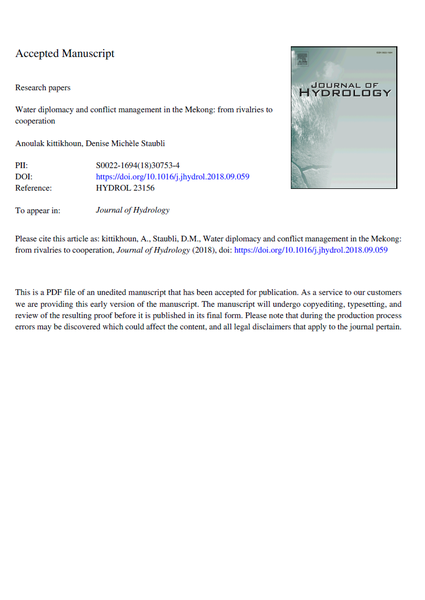
Authors: Denise Michèle Staubli Anoulak Kittikhoun,
Countries:
Source: Journal of Hydrology
The Mekong region, home to one of the world’s great rivers – the Mekong – is also one of the world’s most geostrategic regions, featuring seemingly conflicting interests among regional states including Viet Nam, Thailand, Myanmar, Laos and Cambodia and world powers such as China and the United States of America.
For nearly a century, some of the riparian states have developed parts of the basin in their territories – to great benefits and harm – and recently the remaining late developing countries are catching up with water and related resources development plans to dam, withdraw and use the mighty Mekong to fund national progress and alleviate poverty.
World leaders, academics, NGOs, media and even some government officials have warned that the current rush to development is not only bringing a sure death to a great previously untamed river, potentially displacing millions of people, and threatening livelihoods, but would also usher in an era of aggravated tensions and possibly even conflict. The Mekong River Commission (MRC), tasked to manage the river for the sake of the environment and the people, is failing its mission with work that has been ineffective, uninfluential and wasted, critics say.
Year: 2022
Collections: Scientific Publications
Topics: Climate
Authors: Khaibullina Zh., Amantaikyzy A., Ariphanova D., Temirbayeva R., Mitusov A., Zhurumbetova Zh.
Countries: Kazakhstan
Source:
Year: 2024
Collections: Policy Briefs
Topics: Climate
Authors: Zhakenova Saltanat, Arsen Tleppayev, Nodir Djanibekov, Viktoriya Krylova
Countries: Kazakhstan, Kyrgyzstan, Uzbekistan, Tajikistan, Turkmenistan
Source:
Universities and academia in Central Asia play a crucial role in addressing climate change impacts, including rising temperatures, diminishing water resources, and increased frequency of extreme weather events threatening agriculture and livelihoods. Academic efforts must prioritize research on tailored adaptation strategies to foster resilience and sustainability. However, there's an underrepresentation of climate change research from Central Asia, emphasizing the urgent need for expanded research efforts.
Year: 2020
Collections: Scientific Publications
Topics: Water
Authors: Mayar M. A., Asady H., Nelson J.
Countries: Afghanistan
Year: 2021
Collections: Scientific Publications
Topics: Agriculture
Authors: Asfaw Etenesh B.
Countries: Uzbekistan
Source: Central Asian Journal of Water Research
https://water-ca.org/article/state-led-cotton-deregulation-in-uzbekistan-reforms-and-effects
Uzbekistan’s cotton supply chain experienced a wave of deregulation reforms in the last five years. This paper attempts to assess the process and results of the State-driven transition from the centrally planned cotton sector to private cotton-textile clusters. The article employs secondary data sources to analyse the effects of the deregulation policies descriptively. The study reveals that the deregulation reforms increased productivity in the sector. The reform initiatives also vertically integrated the cotton supply chain from production to marketing. However, the reforms failed to transparently incorporate and harmonise the needs of cotton farmers that grow and sell raw cotton. Consequently, the promises of the State-led deregulation reforms and initiatives are eroded. The article highlights the emerging risks and tensions in the current cotton liberalisation and privatisation reforms in Uzbekistan.
Year: 2021
Collections: Research Paper
Topics: Irrigation
Authors: Asfaw Etenesh B.
Countries: Uzbekistan
Source:
Year: 2016
Collections: Concept paper Scientific Publications, Research Paper, Review article,
Topics: Water, Sustainable Development, IWRM, Water law, Water diplomacy, Water governance
Authors: Patrick Huntjens, Yumiko Yasuda, Ashok Swain, Rens de Man, Bjørn-Oliver Magsig, Shafiqul Islam
Countries: N/A
Source: The Hague Institute for Global Justice
This publication is part of the project Water Diplomacy: Making Water Cooperation Work, led by The Hague Institute for Global Justice, in collaboration with Stockholm International Water Institute (SIWI), UNESCO Category II Centre for International Water Cooperation (ICWC), International Union for Conservation of Nature (IUCN), Uppsala University, University of Otago, University College Cork and Tufts University Water Diplomacy Program.
Year: 2018
Collections:
Topics: Water, Water law, Water diplomacy, Water governance, Transboundary Water Resources, Water Security
Authors: Charlotte Grech-Madin, Stefan Döring, Kyungmee Kim, Ashok Swain
Countries:
Source: Journal of Hydrology
This article explores how water diplomacy can be strengthened through multi-level governance approaches. Drawing on peace and conflict research, it highlights the importance of political norms, stakeholder engagement, and local-level data in improving cooperation over shared water resources and enhancing the effectiveness of water diplomacy.
Year: 2018
Collections: Scientific Publications, Review article
Topics: Water, Water diplomacy
Authors: Yumiko Yasuda, Douglas Hill, Dipankar Aich, Patrick Huntjens, Ashok Swain
Countries:
Source: Water International
This article analyzes key factors affecting transboundary water cooperation in the Brahmaputra River basin at multiple scales. The analysis of multi-track diplomacy reaffirms the potential of actor-inclusive approaches, arguing for a need to go beyond purely focusing on formal legal norms and consider the possibilities of cultural norms of informal processes of cooperation. Various ‘windows of opportunity’ exist in the current phase of the Brahmaputra basin’s development, leading to exploration of a Zone of Possible Effective Cooperation, arising from the effort to scale up multi-track initiatives as well as broader geo-politicaleconomic changes happening across and beyond the basin.
Year: 2025
Collections: Scientific Publications
Topics: Agriculture
Authors: Ankit Garg, Sai Krishna Akash Ramineni, Neelima Satyam, Askar Zhussupbekov
Countries: Kazakhstan, Kyrgyzstan, Uzbekistan, Tajikistan, Turkmenistan
Source: https://cajscr.com/
Soil salinity in Central Asia negatively impacts soil structure, leading to degradation and reduced water infiltration. This not only hampers agricultural productivity but also makes the land less suitable for construction due to its high susceptibility to deformation. Environmentally friendly materials like biochar, a carbon-rich substance, show promise in reducing the deformation of saline soils. However, the mechanisms behind its effectiveness are not yet fully understood. This study aims to analyse saline clays’ dispersion and sedimentation behaviour under varying pore water salinity levels (0 % to 10%). A biochar content of 5 % was selected as it is found to be optimum for plant growth and erosion resistance. It was found from the study that the biochar increases the aggregation of soil particles and enhances flocculation, improving soil dispersion characteristics. Biochar facilitates soil particle aggregation by increasing the cation exchange capacity. At higher pore water salinity levels (5% and 10%), the sedimentation behaviour of biochar-treated soil particles deviates from expectations, showing slower sedimentation rates and lower sedimentation heights. This is because the sodium ions are adsorbed by biochar, reducing salt’s effect on dispersion and sedimentation. The results demonstrate that biochar effectively enhances the stability of saline soils and, hence, has a potential use for ground improvement in the Central Asian region.
For questions about cooperation, please contact us at: