
Year: 2025
Collections: Research Paper
Topics: Climate, Water governance, Transboundary Water Resources, Transboundary cooperation, Hydropolitics
Authors: Albina Prniyazova, Suriya Turaeva, Daniyar Turgunov, Ben Jarihani
Countries:
Source: Sustainability
Sustainable transboundary water governance in Central Asia faces significant challenges, including political tensions, ecological issues, such as the drying Aral Sea, and seasonal hydropower disruptions impacting downstream countries. This study aims to address these problems by examining the complexities of water resource governance in the region, emphasizing the interplay between national interests and regional cooperation.
Year: 2017
Collections: Research Paper
Topics: IWRM, Water law, Water diplomacy, Transboundary Water Resources, Hydropolitics
Authors: Daria Boklan, Barbara Janusz-Pawletta
Countries:
Source: Environmental Earth Sciences
This article explores the legal challenges of managing transboundary watercourses in Central Asia in the context of the Eurasian Economic Union (EAEU). The authors analyze whether existing international, regional, and bilateral legal mechanisms are sufficient for regulating shared rivers such as the Syr Darya, Chu, Talas, Irtysh, Ural, and others.
Year: 2019
Collections:
Topics: Water diplomacy, Transboundary Water Resources, Water Security, Transboundary cooperation
Authors: Martina Klimes, David Michel, Elizabeth Yaari, Phillia Restiani
Countries:
Source: Journal of Hydrology
Why water diplomacy? What does diplomacy have to do with water? Is cooperation over transboundary surface and ground waters the exclusive domain of diplomats and foreign policy experts? Or mainly the purview of water professionals negotiating agreements on shared water resources? Why should non-governmental stakeholders be involved in transboundary water dialogues? These questions lie at the heart of debates and dialogues around the theory and practice of water diplomacy.
Year: 2018
Collections: Research Paper
Topics: Water governance, Water diplomacy, Hydropower
Authors: Denise Michèle Staubli Anoulak Kittikhoun,
Countries:
Source: Journal of Hydrology
The Mekong region, home to one of the world’s great rivers – the Mekong – is also one of the world’s most geostrategic regions, featuring seemingly conflicting interests among regional states including Viet Nam, Thailand, Myanmar, Laos and Cambodia and world powers such as China and the United States of America.
For nearly a century, some of the riparian states have developed parts of the basin in their territories – to great benefits and harm – and recently the remaining late developing countries are catching up with water and related resources development plans to dam, withdraw and use the mighty Mekong to fund national progress and alleviate poverty.
World leaders, academics, NGOs, media and even some government officials have warned that the current rush to development is not only bringing a sure death to a great previously untamed river, potentially displacing millions of people, and threatening livelihoods, but would also usher in an era of aggravated tensions and possibly even conflict. The Mekong River Commission (MRC), tasked to manage the river for the sake of the environment and the people, is failing its mission with work that has been ineffective, uninfluential and wasted, critics say.
Year: 2022
Collections: Scientific Publications
Topics: Sustainable Development
Authors: Idrissov Marat, Yerzakovich Yelena, Dienel Hans-Liudger, Assmann Tom
Countries: Kazakhstan
Source:
Year: 2021
Collections: Scientific Publications
Topics: Agriculture
Authors: Salmukhanbetova Zh.K., Imanalinova A. A., Dimeyeva L. A., Zverev N.E.
Countries: Kazakhstan
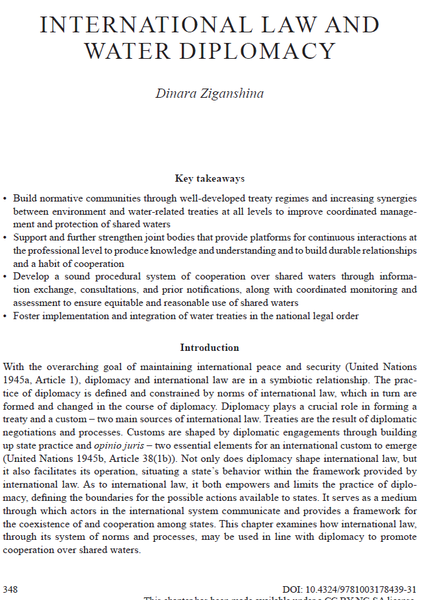
Year: 2025
Collections: Research Paper
Topics: Water diplomacy, Transboundary Water Resources, Transboundary cooperation
Authors: Dinara Ziganshina
Countries:
Source: Routledge Handbook of Water Diplomacy
This chapter explores the symbiotic relationship between international law and water diplomacy, emphasizing their role in promoting peace and security in the governance of shared water resources. The author examines the key legal principles that underpin interstate cooperation, including the principles of equitable and reasonable utilization and the obligation not to cause significant harm.
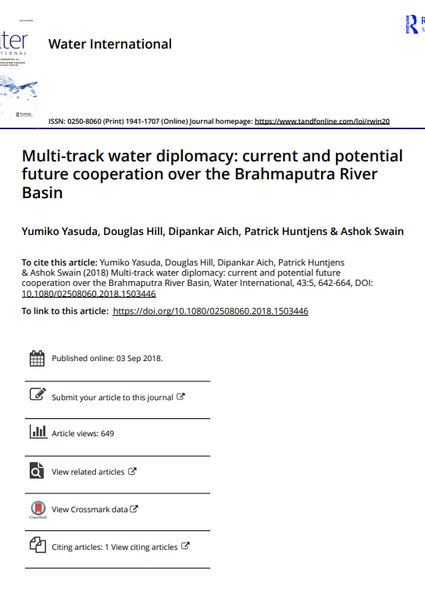
Year: 2018
Collections: Scientific Publications, Review article
Topics: Water, Water diplomacy
Authors: Yumiko Yasuda, Douglas Hill, Dipankar Aich, Patrick Huntjens, Ashok Swain
Countries:
Source: Water International
This article analyzes key factors affecting transboundary water cooperation in the Brahmaputra River basin at multiple scales. The analysis of multi-track diplomacy reaffirms the potential of actor-inclusive approaches, arguing for a need to go beyond purely focusing on formal legal norms and consider the possibilities of cultural norms of informal processes of cooperation. Various ‘windows of opportunity’ exist in the current phase of the Brahmaputra basin’s development, leading to exploration of a Zone of Possible Effective Cooperation, arising from the effort to scale up multi-track initiatives as well as broader geo-politicaleconomic changes happening across and beyond the basin.
Year: 2025
Collections: Scientific Publications
Topics: Water, IWRM
Authors: Gafurov A., Ziganshina Dinara, Assubayeva A., Nodir Djanibekov, Abdullaev Iskandar, Bobojonov Ihtiyor, Dombrowsky Ines, Hamidov Ahmad, Herrfahrdt-Pähle Elke, Janusz-Pawletta Barbara, Ishangulyyev Rovshen, Kasymov Ulan, Mirkasimov Bakhrom, Petrick Martin, Strobehn Katrin
Countries: Kazakhstan, Kyrgyzstan, Uzbekistan, Tajikistan, Turkmenistan
Source: water-ca.org
Political tensions over water management in the Central Asia region have intensified since the Soviet era, as ecological issues like the drying Aral Sea and seasonal hydropower disruptions impact downstream countries. The paper discusses the region’s water governance challenges, including climate-induced uncertainties, water resource demands, and the limited capacity of local research institutions. While Central Asia’s governments have initiated reforms, including new infrastructure and agreements, resilience in water management remains underdeveloped. The paper also explores the role of higher education institutions in fostering capacity-building for sustainable governance, emphasizing the need for local expertise and regional collaboration. The proposed establishment of a Central Asian water research platform aims to enhance science-policy integration, promote sustainable water governance, and support informed regional cooperation on transboundary water issues.
Year: 2023
Collections:
Topics: Water, IWRM
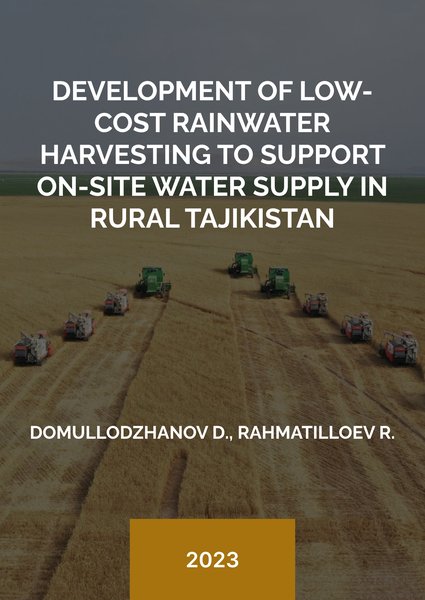
Authors: Domullodzhanov D., Rahmatilloev R.
Countries: Tajikistan
Source: Central Asian Journal of Water Research
Farmers in remote, arid areas, far from available water sources, need affordable water solutions for household and livestock use. In this study, the water needs and potential for rainwater harvesting (RWH) in the Kysylsu River Basin are estimated at different altitudes.
For questions about cooperation, please contact us at: