
Year: 2025
Collections: Scientific Publications
Topics: Water
Authors: Abdul Basit Da’ie, Hedayatullah Arian, Ahmad Shahir Popalzai, Homayoun Khoshnod
Countries: Afghanistan
Source: https://water-ca.org
Year: 2021
Collections:
Topics: Climate, Sustainable Development, IWRM, Water diplomacy, Transboundary Water Resources, Water Security
Authors: Soheila Zareie, Omid Bozorg‑Haddad, Hugo A. Loáiciga
Countries:
Source: Environment, Development and Sustainability
Diplomacy is the art and skill of managing international relations through negotiations between representatives of states or agencies. Water diplomacy is an innovative approach and strategic tool to resolve water issues at local and trans-boundary scales when water conflicts rise in sharing water resources. Complex water supply and sharing issues arise from the existence of multiple stakeholders such as agriculture, industry, urban and domestic users, environmental use, and others competing for scarce water. Water diplomacy may contribute to solving a variety of water conflicts and in this sense is a tool for sustainable water resources management.
Year: 2022
Collections: Research Paper
Topics: Water, Sustainable Development, NEXUS, Water governance, Transboundary Water Resources
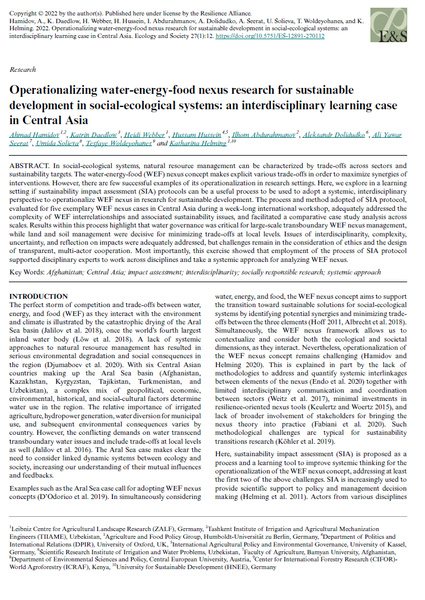
Authors: Ahmad Hamidov, Katrin Daedlow, Heidi Webber, Hussam Hussein, Ilhom Abdurahmanov, Aleksandr Dolidudko, Ali Yawar Seerat, Umida Solieva, Tesfaye Woldeyohanes, Katharina Helming
Countries:
Source: Ecology and Society
This article focuses on the operationalization of the Water–Energy–Food (WEF) Nexus concept as a framework for promoting sustainable development in Central Asia. The researchers examine the application of the Sustainability Impact Assessment (SIA) protocol as a tool for interdisciplinary analysis of five different environmental systems across the region. The findings demonstrate that a systems-based approach helps experts identify critical trade-offs between water resource management, energy production, and soil conservation. The authors emphasize that the SIA framework is effective in addressing interdisciplinary complexity; however, it requires further development in areas related to ethics and stakeholder engagement. Overall, the study highlights that regional cooperation and the integration of scientific approaches are essential for mitigating the impacts of environmental degradation, including challenges such as the desiccation of the Aral Sea. The article therefore provides a methodological foundation for translating theoretical nexus concepts into practical strategies for natural resource management and sustainable development.
Year: 2023
Collections: Research Paper
Topics: Water, Green business
Authors: Hutson N., Taganova J.
Countries: Kazakhstan
Source: Central Asian Journal of Water Research
Recent geopolitical events have thrust the Caspian region into a time of unparalleled opportunity. Specifically, the Middle Corridor (“MC”) has been presented as a potential savior for trans-Eurasian commerce. At the same time, its success relies on a sea that is in an ecologically precarious state.
For questions about cooperation, please contact us at: