
Year: 2018
Collections: Research Paper
Topics: Water diplomacy, Gender, IWRM, Water Security
Authors: Natasha Carmi, Mey Alsayegh, Maysoon Zoubi
Countries:
Source: Journal of Hydrology
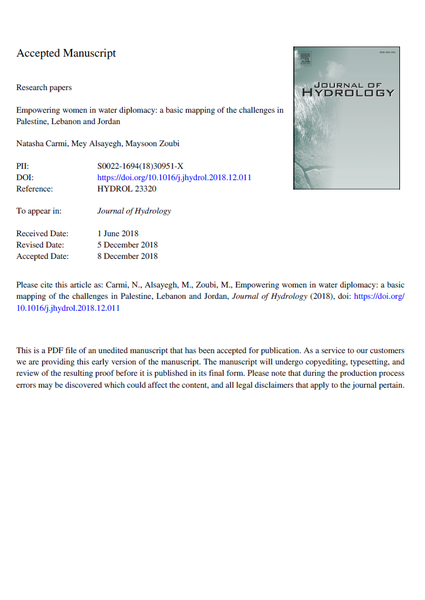
Until now, limited attention has been afforded to the role of, and challenges faced by, women involved in water diplomacy. In addition to research being at an early stage, it is mainly focused on addressing the challenges imposed by gender inequality. Thus very few applicable policy recommendations have emerged in this field to date.
This paper will explore and identify current challenges that face the women interested in attaining high level positions in water diplomacy, in three Arab countries in which hydropolitics prevails, including Jordan, Lebanon and the State of Palestine. Female experts working on water-related issues were surveyed and interviewed to ascertain key qualitative issues, perceptions and various challenges.
Year: 2013
Collections: Research Paper
Topics: Water, Water governance
Authors: Michael Eichholz, Kristof Van Assche, Lisa Oberkircher, Anna-Katharina Hornidge
Countries: Uzbekistan
Source: Journal of Environmental Planning and Management
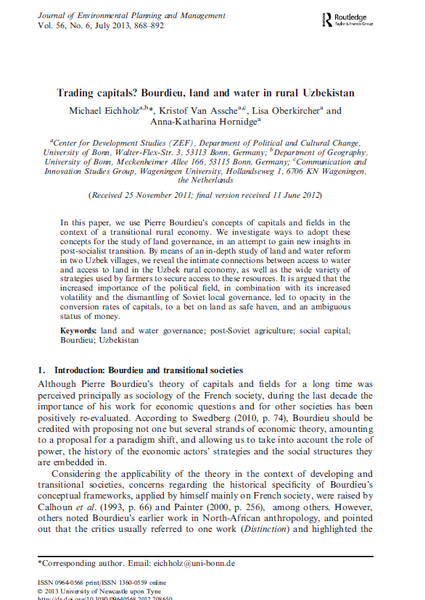
This article analyzes the governance of land and water resources in rural Uzbekistan through the lens of Pierre Bourdieu’s sociological theory. The authors explore how farmers adapt to post-socialist reforms and successive waves of land consolidation by relying on different forms of capital, including social, political, and symbolic capital. The study demonstrates that, in the absence of an open market and transparent rules, access to resources becomes the outcome of continuous negotiations and exchanges of favors. Under conditions of high uncertainty, social networks and proximity to political authorities prove to be more important than direct financial investments. As a result, the rural economy is transformed into a complex system of personal arrangements, where the survival and success of farming households depend on farmers’ ability to convert their informal assets into actual access to land and water resources.
![Manual_5.0_FINAL_12.3_3rd_edition[1]_Страница_001](/media/images/Manual_5.0_FINAL_12.3_3rd_edition1.2e16d0ba.fill-425x600.png)
Year: 2025
Collections: Manuals
Topics: Water, IWRM
Authors: Kogutenko Larissa, Safiya Asalbekova, Michael Walther
Countries: Kazakhstan, Kyrgyzstan, Uzbekistan, Tajikistan, Turkmenistan
Source: Journal of MOLARE Research Centre (MRC)
Why water monitoring and assessment are important?
Water quality assessment is one of the crucial scientific and practical analyses to identify the possibility of water consumption for different human needs and nature/ecosystem conservation for future generations. Water quality can be measured and monitored in rivers, springs, creeks, swamps, estuaries, wetlands and lakes what is called aquatic systems. Quality parameters, such as biological, chemical and physical indicators identify the combination of values that influence the composition of water. Monitoring and comparison of different water habitats (macro invertebrates) in biological monitoring provides an information of water quality and allows to make a quick assessment.
Year: 2008
Collections: Conferences
Topics: IWRM, Water governance, Transboundary Water Resources, Transboundary cooperation
Authors: Mikhail Khankhasayev, Steven Leitman
Countries:
Source: Transboundary Water Resources: A Foundation for Regional Stability in Central Asia
This paper summarizes the main results of the NATO CCMS Pilot Study Meeting on Transboundary Water Management Issues in the United States & Central Asia (8–10 March 2005, Tallahassee, Florida). The structure of the meeting was focused on comparing how major transboundary water sharing conflicts in the United States (like the ACF conflict) have been managed toward the goal of equitable conflict resolution among the competing jurisdictions with similar conflicts in the Central Asian region.
Year: 2014
Collections: Research Paper
Topics: Water, Transboundary Water Resources, Hydropower
Authors: Sonoko Ito, Sameh El Khatib, Mikiyasu Nakayama
Countries: Uzbekistan, Tajikistan
Source: International Journal of Water Resources Development
Following the dissolution of the Soviet Union, Central Asian countries struggled to reach an agreement on the use of their shared fresh water resources. The conflict between Tajikistan and Uzbekistan regarding construction of the Rogun Hydropower Plant in the Amu Darya Basin seems deadlocked at present, despite copious efforts made by donor agencies. Therefore, this paper examines each country’s position using the numbers featured in the media.
Year: 2025
Collections: Scientific Publications
Topics: Water, IWRM
Authors: Gafurov A., Ziganshina Dinara, Assubayeva A., Nodir Djanibekov, Abdullaev Iskandar, Bobojonov Ihtiyor, Dombrowsky Ines, Hamidov Ahmad, Herrfahrdt-Pähle Elke, Janusz-Pawletta Barbara, Ishangulyyev Rovshen, Kasymov Ulan, Mirkasimov Bakhrom, Petrick Martin, Strobehn Katrin
Countries: Kazakhstan, Kyrgyzstan, Uzbekistan, Tajikistan, Turkmenistan
Source: water-ca.org
Political tensions over water management in the Central Asia region have intensified since the Soviet era, as ecological issues like the drying Aral Sea and seasonal hydropower disruptions impact downstream countries. The paper discusses the region’s water governance challenges, including climate-induced uncertainties, water resource demands, and the limited capacity of local research institutions. While Central Asia’s governments have initiated reforms, including new infrastructure and agreements, resilience in water management remains underdeveloped. The paper also explores the role of higher education institutions in fostering capacity-building for sustainable governance, emphasizing the need for local expertise and regional collaboration. The proposed establishment of a Central Asian water research platform aims to enhance science-policy integration, promote sustainable water governance, and support informed regional cooperation on transboundary water issues.
Year: 2022
Collections: Scientific Publications
Topics: Climate
Authors: Khaibullina Zh., Amantaikyzy A., Ariphanova D., Temirbayeva R., Mitusov A., Zhurumbetova Zh.
Countries: Kazakhstan
Source:
Year: 2021
Collections: Research Paper
Topics: Irrigation
Authors: Mitusov A., Sultanbekova A.K., Sagintayev J.M., Azami A.
Countries: Kazakhstan
Year: 2020
Collections: Research Paper
Topics: Water
Authors: Mitusov A., Normakhmedova Z. O., Kurbonov N. B.
Countries: Tajikistan
Year: 2024
Collections: Scientific Publications
Topics: Water, Sustainable Development
Authors: Catalin Stefan, Jana Sallwey, Nurlan Ongdas, Mohammad Al-Hosban
Countries: Kazakhstan
Source: https://water-ca.org
MAR remains relatively underutilized in Central Asia despite its potential to address water scarcity issues, particularly those related to seasonal fluctuations in water availability. Thus, the objective of this study was to produce a map depicting the potential suitability of managed aquifer recharge (MAR) implementation in Kazakhstan. Employing a multi-criteria decision analysis framework, five distinct physical criteria were integrated and visualized within a Geographic Information System (GIS) to delineate the intrinsic potential for MAR. To demonstrate the practical utility of the generated map, it was applied to the Zhambyl region in Southern Kazakhstan, an area previously afflicted by water scarcity challenges. The intrinsic MAR potential map was overlaid with remote sensing data identifying potential water sources and water utilization patterns. This overlay facilitated the identification of priority areas with potential for further evaluation for MAR implementation. The map developed for Kazakhstan represents the first spatial representation of MAR potential within the region, serving to raise awareness regarding the feasibility of MAR application. It is anticipated that dissemination of this map will enhance understanding among water management professionals, potentially catalysing the integration of MAR methodologies into regional water management strategies.
Year: 2025
Collections: Scientific Publications
Topics: Water, Climate
Authors: Rohullah Mayar, Mohammad Assem Mayar, Mohammad Hamid Omar
Countries: Afghanistan
Source: https://water-ca.org
For questions about cooperation, please contact us at: