
Year: 2020
Collections:
Topics: Water diplomacy, Water, IWRM, Transboundary Water Resources, Hydropolitics
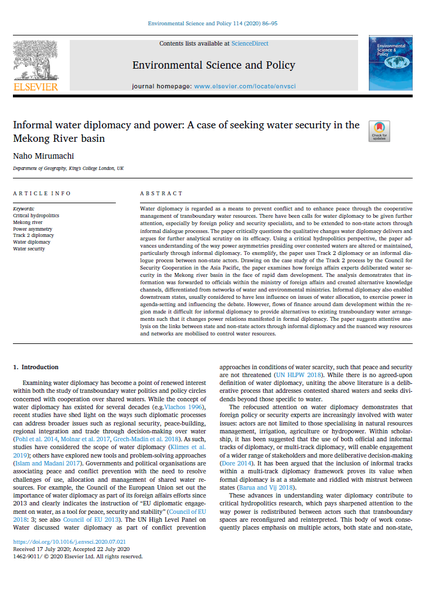
Authors: Naho Mirumachi
Countries:
Source: Environmental Science and Policy
Water diplomacy is regarded as a means to prevent conflict and to enhance peace through the cooperative management of transboundary water resources. There have been calls for water diplomacy to be given further attention, especially by foreign policy and security specialists, and to be extended to non-state actors through informal dialogue processes. The paper critically questions the qualitative changes water diplomacy delivers and argues for further analytical scrutiny on its efficacy. Using a critical hydropolitics perspective, the paper advances understanding of the way power asymmetries presiding over contested waters are altered or maintained, particularly through informal diplomacy.
Year: 2018
Collections: Research Paper
Topics: Water diplomacy, Gender, IWRM, Water Security
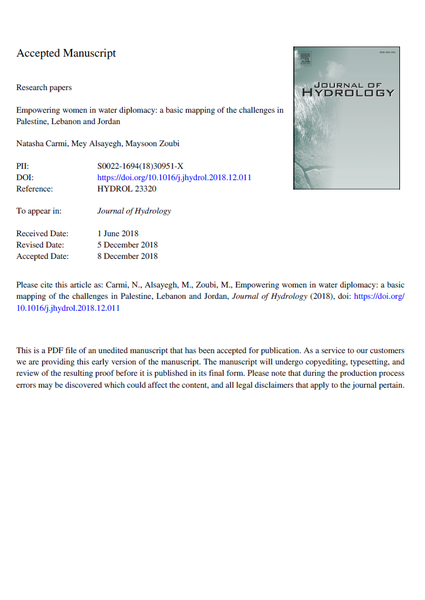
Authors: Natasha Carmi, Mey Alsayegh, Maysoon Zoubi
Countries:
Source: Journal of Hydrology
Until now, limited attention has been afforded to the role of, and challenges faced by, women involved in water diplomacy. In addition to research being at an early stage, it is mainly focused on addressing the challenges imposed by gender inequality. Thus very few applicable policy recommendations have emerged in this field to date.
This paper will explore and identify current challenges that face the women interested in attaining high level positions in water diplomacy, in three Arab countries in which hydropolitics prevails, including Jordan, Lebanon and the State of Palestine. Female experts working on water-related issues were surveyed and interviewed to ascertain key qualitative issues, perceptions and various challenges.
Year: 2020
Collections:
Topics: Water, Climate, IWRM, Water diplomacy, Transboundary Water Resources, Water Security, Hydropower
Authors: Melinda Davies, Nathanial Matthews
Countries:
Source: International Journal of Water Resources Development
The article focuses on how China’s Belt and Road Initiative (BRI) may affect water resources and water governance in Central Asia. The authors consider Central Asia as a region that already faces a complex water situation, including transboundary rivers, water scarcity, the dependence of agriculture on irrigation, the environmental problems of the Aral Sea, weak coordination between countries, and the impacts of climate change. Against this background, the development of infrastructure, industry, hydropower, and agriculture under the BRI may increase pressure on water resources.
Year: 2017
Collections: Scientific Publications
Topics: Water, Climate
Authors: Klove B., Naurozbayeva Zhanar, Ivkina Natalya
Countries: Kazakhstan, Kyrgyzstan, Uzbekistan, Tajikistan, Turkmenistan
Year: 2024
Collections: Scientific Publications
Topics: Water
Authors: Naurozbayeva Zhanar
Countries: Kazakhstan
Source: https://water-ca.org
The research aimed to assess the influence of atmospheric processes in the Northern Hemi-sphere’s Atlantic-European Sector on the Caspian Sea level based on the data for the days with Wangenheim-Girs atmospheric general circulation forms.
Year: 2024
Collections: Scientific Publications
Topics: Water, Climate, Agriculture
Authors: Nazar Nurzoda
Countries: Tajikistan
Source: https://water-ca.org/
This study aimed to examine the efficiency of different drip irrigation regimes in spring film greenhouses for early tomato harvesting. The field (small-plot) experiment included designing and testing the watering technology suitable for rural Tajikistan. Irrigation, soil moisture, and tomato growth were followed for several seasons under four irrigation pilots. The experiments showed that the most effective drip irrigation regime for Elpida hybrid tomato was carrying it out while regulating soil moisture within 75-85%, with the irrigation demand of 4,978 m3/ha and irrigation norm of 99.0 m3/ha, also contributing to better water efficiency. The volume of irrigation water for the production of one unit of tomato crop in the second experiment was 5.73 m3/ha, i.e. 14.18% less than in the control plot. The study showed that the tomato evapotranspiration coefficient tends to increase as the threshold of soil mois-ture before and after irrigation grows. The maximum net yield amounted to 1,342 thou. Somoni/ha – 1.9 times or 52.7% higher compared to the control plot. The research findings can guide individual farmers and production facilities, as well as the overall development of agrarian economies like Tajikistan.
Year: 2024
Collections:
Topics: Climate, Sustainable Development
Authors: Aliya Tskhay, Nazilya Kulpeshova
Countries: Kazakhstan
Source: Central Asian Journal of Sustainability and Climate Research
Recycling is one of the key components in reduction of carbon emissions and improving environmental conditions, especially in the urban context. In Central Asia, the legislation and infrastructure necessary for waste management is still under development. Thus, the knowledge gap and public awareness campaigns are mostly done at the grassroots level. This paper looks at the case of recycling promotion through civic community initiatives that also have a charitable component in Almaty. It explores the ethical considerations that are being entangled with the introduction of recycling culture in the city and is grounded in the literature on civil society, environmental ethics and social entrepreneurship. The data was collected through semi-structured interviews with organizers of recycling fairs and NGOs working on recycling. The paper reveals that by appealing to the ethical considerations of people to “do good” and contribute to charitable cause, the organizers of the recycling fair also demonstrate the effects of over-consumerism, ways of doing waste management, and educate about reuse and upcycle culture. The single case of Darmarka in Almaty present a limitation of the study. Therefore, a more in-depth research on the organisation of Darmarka events in other cities in Kazakhstan and CIS, as well as on similar initiatives in other Central Asian countries would be beneficial in the future. This is an important contribution in understanding what challenges and opportunities exist in promotion of recycling in Central Asia, that can be useful to national governments, experts, and international organizations working in this area.
Year: 2025
Collections: Scientific Publications
Topics: Agriculture
Authors: Ankit Garg, Sai Krishna Akash Ramineni, Neelima Satyam, Askar Zhussupbekov
Countries: Kazakhstan, Kyrgyzstan, Uzbekistan, Tajikistan, Turkmenistan
Source: https://cajscr.com/
Soil salinity in Central Asia negatively impacts soil structure, leading to degradation and reduced water infiltration. This not only hampers agricultural productivity but also makes the land less suitable for construction due to its high susceptibility to deformation. Environmentally friendly materials like biochar, a carbon-rich substance, show promise in reducing the deformation of saline soils. However, the mechanisms behind its effectiveness are not yet fully understood. This study aims to analyse saline clays’ dispersion and sedimentation behaviour under varying pore water salinity levels (0 % to 10%). A biochar content of 5 % was selected as it is found to be optimum for plant growth and erosion resistance. It was found from the study that the biochar increases the aggregation of soil particles and enhances flocculation, improving soil dispersion characteristics. Biochar facilitates soil particle aggregation by increasing the cation exchange capacity. At higher pore water salinity levels (5% and 10%), the sedimentation behaviour of biochar-treated soil particles deviates from expectations, showing slower sedimentation rates and lower sedimentation heights. This is because the sodium ions are adsorbed by biochar, reducing salt’s effect on dispersion and sedimentation. The results demonstrate that biochar effectively enhances the stability of saline soils and, hence, has a potential use for ground improvement in the Central Asian region.
Year: 2020
Collections: Scientific Publications
Topics: Water
Authors: Mayar M. A., Asady H., Nelson J.
Countries: Afghanistan
Year: 2024
Collections: Scientific Publications
Topics: Water
Authors: Nematullah Fetrat, Ahmad Reza Rostayee, Sai Kala
Countries: Afghanistan
Source: https://water-ca.org
The article investigates certain low-cost filtering materials and their filtration efficiency for open well sources in terms of economic access to clean water in Anakapalle, a suburb of Visa-khapatnam, India, during the pre-monsoon period of 2022. The corresponding research aimed to study a selection of filter materials including coconut shell activated carbon, rice husk ash, manganese modified sand, and graphene oxide, as well as assess their performance against selected physico-chemical parameters of water. Considering the basic idea of slow sand and gravity-based filtration, a setup was arranged with a cartridge filled with layers of filtering materials and a ceramic candle filter. Adsorption turned out the most pronounced removal mechanism that took place when utilizing the aforementioned filter materials. The main focus of the study was to reduce pH, TDS, hardness, alkalinity, chlorides and iron content by applying dif-ferent filtration removal mechanisms. The study results show a significant drop in turbidity, pH, TDS and chlorides, and small reduction in hardness when coconut shell activated carbon and rice husk ash were used as filtration media. Whereas the chemically coated medium – manga-nese modified sand – demonstrated a considerable fall in iron concentrations, graphene oxide sand was observed to reduce alkalinity for any sample source.
For questions about cooperation, please contact us at: