
Year: 2018
Collections: Scientific Publications
Topics: Water
Authors: Thevs Niels, Aliev Kumar, Strenge Eva, Eraaliev Maksat, Lang Petra, Baibagysov Azim
Countries: Kazakhstan
Year: 2018
Collections: Manuals
Topics: IWRM
Authors: Петраков Игорь
Countries: Kazakhstan
Source:
Year: 2018
Collections: Manuals
Topics: IWRM
Authors: Мец Лутц, Санду-Даниэль Копп, Ведель Марко, Ибатуллин Сагит
Countries: Kazakhstan
Source:
Year: 2018
Collections: Research Paper
Topics: Water governance, IWRM, Transboundary cooperation Irrigation,
Authors: Iroda Amirova, Martin Petrick, Nodir Djanibekov
Countries: Kazakhstan, Uzbekistan
Source: World Development
This study contributes to the understanding of long- and short-term determinants of cooperation among water users. We experimentally investigate the potential of water users’ self-governance in enhancing their contributions to a common pool as opposed to external regulation. Our focus is on the irrigated areas of Kazakhstan and Uzbekistan.
Year: 2018
Collections: Scientific Publications, Review article
Topics: Water, Water diplomacy
Authors: Yumiko Yasuda, Douglas Hill, Dipankar Aich, Patrick Huntjens, Ashok Swain
Countries:
Source: Water International
This article analyzes key factors affecting transboundary water cooperation in the Brahmaputra River basin at multiple scales. The analysis of multi-track diplomacy reaffirms the potential of actor-inclusive approaches, arguing for a need to go beyond purely focusing on formal legal norms and consider the possibilities of cultural norms of informal processes of cooperation. Various ‘windows of opportunity’ exist in the current phase of the Brahmaputra basin’s development, leading to exploration of a Zone of Possible Effective Cooperation, arising from the effort to scale up multi-track initiatives as well as broader geo-politicaleconomic changes happening across and beyond the basin.
Year: 2018
Collections: Scientific Publications
Topics: Water, Water law
Authors: Ziganshina Dinara
Countries: Kazakhstan, Kyrgyzstan, Uzbekistan, Tajikistan, Turkmenistan, Afghanistan
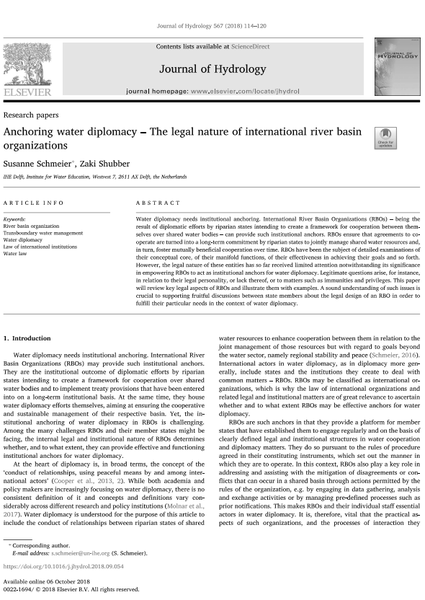
Year: 2018
Collections: Scientific Publications, Review article
Topics: Water, Water diplomacy
Authors: Susanne Schmeier, Zaki Shubber
Countries:
Source: Journal of Hydrology
Water diplomacy needs institutional anchoring. International River Basin Organizations (RBOs) – being the result of diplomatic efforts by riparian states intending to create a framework for cooperation between themselves over shared water bodies – can provide such institutional anchors. RBOs ensure that agreements to cooperate are turned into a long-term commitment by riparian states to jointly manage shared water resources and, in turn, foster mutually beneficial cooperation over time. RBOs have been the subject of detailed examinations of their conceptual core, of their manifold functions, of their effectiveness in achieving their goals and so forth. However, the legal nature of these entities has so far received limited attention notwithstanding its significance in empowering RBOs to act as institutional anchors for water diplomacy.
Year: 2018
Collections: Scientific Publications
Topics: Water, Sustainable Development
Authors: Liang Xiao
Countries: China
Year: 2018
Collections: Research Paper
Topics: Water, Water law
Authors: Stephan Raya Marina
Countries: Kazakhstan, Kyrgyzstan, Uzbekistan, Tajikistan, Turkmenistan, Afghanistan
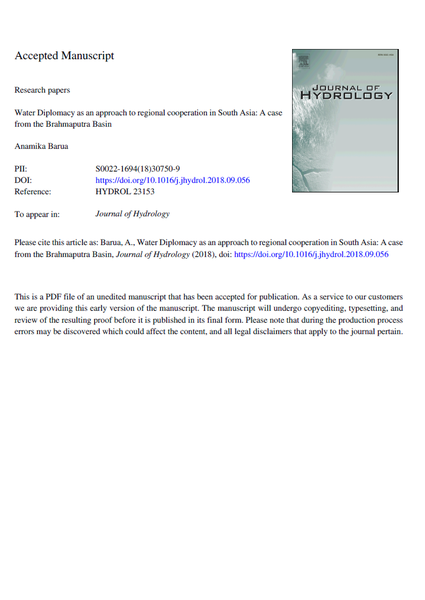
Year: 2018
Collections: Scientific Publications
Topics: Water diplomacy, Water, Transboundary Water Resources, Transboundary cooperation
Authors: Anamika Barua
Countries:
Source: Journal of Hydrology
The article examines challenges of transboundary water cooperation in the Brahmaputra River Basin shared by Bangladesh, Bhutan, China, and India. It highlights the lack of trust, information asymmetries, and absence of a regional governance framework that hinder cooperation. The authors emphasize the importance of inclusive, multi-stakeholder water diplomacy and informal dialogues as a foundation for sustainable and equitable basin-wide cooperation.
Year: 2018
Collections: Scientific Publications
Topics: Water, Water law
Authors: Зиганшина Динара Р.
Countries: Kazakhstan, Kyrgyzstan, Uzbekistan, Tajikistan, Turkmenistan
Year: 2018
Collections: Manuals, Synopsis
Topics: IWRM
Authors: Мец Лутц, Санду-Даниэль Копп, Ведель Марко, Ибатуллин Сагит
Countries: Kazakhstan
Source:
Year: 2018
Collections: Manuals, Synopsis
Topics: IWRM
Authors: Януш-Павлетта Барбара, Ибатуллин Сагит, Петраков Игорь, Николаенко Александр, Ахметов Серик Кабдуалиевич
Countries: Kazakhstan
Source:
Year: 2018
Collections: Scientific Publications
Topics: Water, Sustainable Development
Authors: Мартенс Патрик
Countries: Kazakhstan, Kyrgyzstan, Uzbekistan, Tajikistan, Turkmenistan
Year: 2018
Collections: Research Paper
Topics: Water governance, Water diplomacy, Hydropower
Authors: Denise Michèle Staubli Anoulak Kittikhoun,
Countries:
Source: Journal of Hydrology
The Mekong region, home to one of the world’s great rivers – the Mekong – is also one of the world’s most geostrategic regions, featuring seemingly conflicting interests among regional states including Viet Nam, Thailand, Myanmar, Laos and Cambodia and world powers such as China and the United States of America.
For nearly a century, some of the riparian states have developed parts of the basin in their territories – to great benefits and harm – and recently the remaining late developing countries are catching up with water and related resources development plans to dam, withdraw and use the mighty Mekong to fund national progress and alleviate poverty.
World leaders, academics, NGOs, media and even some government officials have warned that the current rush to development is not only bringing a sure death to a great previously untamed river, potentially displacing millions of people, and threatening livelihoods, but would also usher in an era of aggravated tensions and possibly even conflict. The Mekong River Commission (MRC), tasked to manage the river for the sake of the environment and the people, is failing its mission with work that has been ineffective, uninfluential and wasted, critics say.
For questions about cooperation, please contact us at: