
Year: 2021
Collections: Scientific Publications, Research Paper
Topics: Water
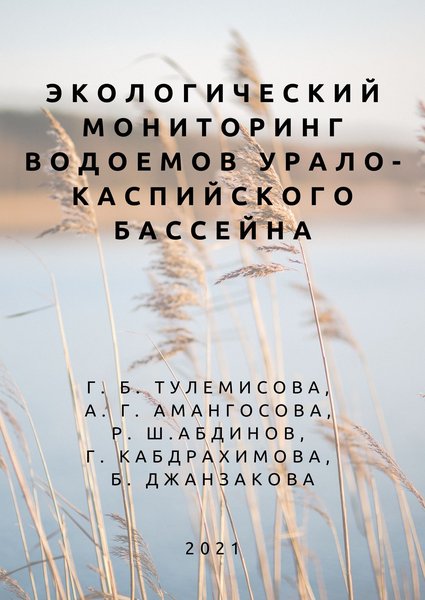
Authors: Тулемисова Г. Б., Амангосова А. Г., Абдинов Р. Ш., Кабдрахимова Г., Джанзакова Б.
Countries: Kazakhstan
Year: 2021
Collections: Books
Topics: Climate
Authors: Кобзев Алексей, Януш-Павлетта Барбара, Когутенко Лариса, Асанов Д., Асанова Ж., Аухинова Н., Байматова Н., Гемеджиева Н., Долгих С., Ерзакович Е., Зикрина З., Капенов Н., Карибаева К., Керимрай А., Мищенко А., Ни В., Пачикин К., Родионов А., Сапаров А., Скляренко С., Трофимов Г., Тукенова З.
Countries: Kazakhstan
Source:
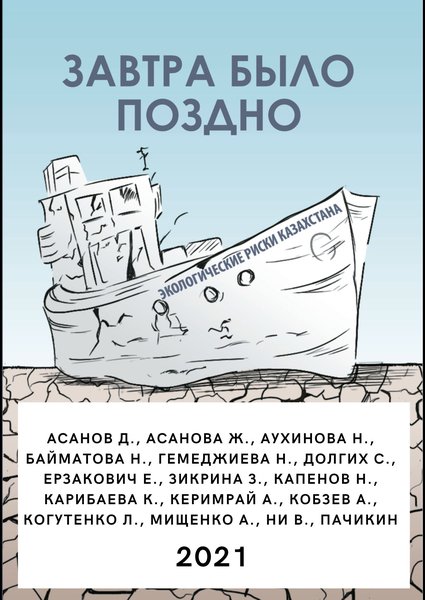
Данная коллективная монография знакомит широкий круг читателей с ключевыми экологическими проблемами и путями их решения в Казахстане. Монография является результатом совместного труда специалистов по важнейшим направлениям охраны окружающей среды, включая ученых, практиков и лидеров гражданского общества. Самое заветное желание сплоченной команды авторов заключается в том, чтобы не только казахстанцы, но и жители других стран и регионов сохраняли, заботились и защищали свое природное наследие, ставили интересы окружающей среды во главу угла при принятии решений на пути к лучшему будущему для каждого. Монография была подготовлена и опубликована в результате партнерства Казахстанско-Немецкого Университета, частного фонда Досыма Сатпаева и Группы оценки рисков, а также при поддержке Офиса программ ОБСЕ в Нур-Султане, Фонда им. Фридриха Эберта и информационной поддержке онлайн-журнала «Living Asia» .
Year: 2021
Collections: Research Paper
Topics: Water, Water law, Water Security, Transboundary cooperation, Hydropolitics
Authors: Abdulsalam Amini, Hamidreza Jafari, Bahram Malekmohammadi, Touraj Nasrabadi
Countries: Iran Turkmenistan, Afghanistan,
Source: Discrete Dynamics in Nature and Society
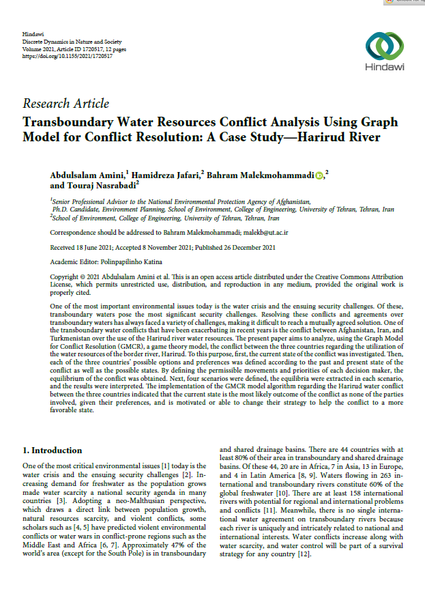
The present paper aims to analyze, using the Graph Model for Conflict Resolution (GMCR), a game theory model, the conflict between the three countries regarding the utilization of the water resources of the border river, Harirud. To this purpose, first, the current state of the conflict was investigated.
Year: 2021
Collections: Scientific Publications
Topics: Water
Authors: Assubayeva A.
Countries: Kazakhstan, Kyrgyzstan, Uzbekistan, Tajikistan, Turkmenistan

Year: 2021
Collections: Scientific Publications, Review article
Topics: Water, Water law, Water diplomacy
Authors: Susanne Schmeier
Countries:
Source: American Journal of International Law, 115, 173-177
International water law (IWL) principles are often called upon to address disagreements and conflict between riparian states to a shared watercourse, with various parties invoking them to guide states’ behavior towards cooperative solutions that benefit the water resources as well as broader regional cooperation and peace. This essay argues that it is particularly important to acknowledge the role IWL principles play in negotiation processes, that is, in an ex ante and non-judicial function, providing a framework for cooperation and contributing to lawmaking, which makes them important tools of international relations and water diplomacy.
Year: 2021
Collections:
Topics: Climate, Sustainable Development, IWRM, Water diplomacy, Transboundary Water Resources, Water Security
Authors: Soheila Zareie, Omid Bozorg‑Haddad, Hugo A. Loáiciga
Countries:
Source: Environment, Development and Sustainability
Diplomacy is the art and skill of managing international relations through negotiations between representatives of states or agencies. Water diplomacy is an innovative approach and strategic tool to resolve water issues at local and trans-boundary scales when water conflicts rise in sharing water resources. Complex water supply and sharing issues arise from the existence of multiple stakeholders such as agriculture, industry, urban and domestic users, environmental use, and others competing for scarce water. Water diplomacy may contribute to solving a variety of water conflicts and in this sense is a tool for sustainable water resources management.
Year: 2021
Collections: Scientific Publications, Review article
Topics: Water, Water diplomacy
Authors: Juho Haapala, Marko Keskinen, Erik Salminen
Countries:
Source: Journal of Hydrology
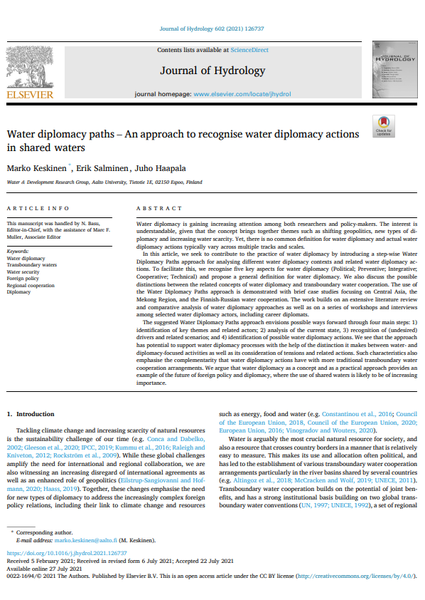
In this article, we seek to contribute to the practice of water diplomacy by introducing a step-wise Water Diplomacy Paths approach for analysing different water diplomacy contexts and related water diplomacy actions. To facilitate this, we recognise five key aspects for water diplomacy (Political; Preventive; Integrative; Cooperative; Technical) and propose a general definition for water diplomacy. We also discuss the possible distinctions between the related concepts of water diplomacy and transboundary water cooperation. The use of the Water Diplomacy Paths approach is demonstrated with brief case studies focusing on Central Asia, the Mekong Region, and the Finnish-Russian water cooperation. The work builds on an extensive literature review and comparative analysis of water diplomacy approaches as well as on a series of workshops and interviews among selected water diplomacy actors, including career diplomats.
Year: 2021
Collections: Research Paper
Topics: IWRM
Authors: Alamanos A., Zeng Q.
Countries: N/A
Year: 2021
Collections: Scientific Publications
Topics: Water, Agriculture
Authors: Петров Г., Митусов А.
Countries: Kazakhstan, Kyrgyzstan, Uzbekistan, Tajikistan, Turkmenistan
Source: Central Asian Journal of Water Research
Целью статьи является оценка резервов водосбережения в орошаемом земледелии Центральной Азии (ЦА) по сравнению с Израилем. Были сопоставлены такие показатели, как удельное водопотребление, атмосферные осадки и эвапотранспирация в период вегетации.
Year: 2020
Collections: Manuals
Topics: IWRM
Authors: Кобзев Алексей, Януш-Павлетта Барбара, Такенов Жарас, Когутенко Лариса, Кусаинова Майра, Ёдалиева Мархабо
Countries: Kazakhstan
Source:
Year: 2020
Collections: Scientific Publications, Research Paper
Topics: Gender
Authors: Бозорова М. А.
Countries: Uzbekistan
Source: Central Asian Journal of Water Research
В статье анализируются вопросы освещения в прессе гендерного распределения труда в водном секторе Узбекистана. Предметом исследования определены контент, виды, методы, формы, приёмы и принципы освещения темы в периодических изданиях «Народное слово», «Правда Востока», «Даракчи». Цель научного исследования – изучить на основе анализа деятельность и подходы узбекистанской прессы по освещению гендерного распределения труда в водном секторе, стереотипы в освещаемой теме и пути их устранения.

Year: 2020
Collections: Scientific Publications, Review article
Topics: Water, Water governance Water diplomacy,
Authors: Anita Milman, Andrea K. Gerlak
Countries:
Source: Environmental Science and Policy 107, 137–149
This paper examines the production and use of science by three IRBOs: the (US – Canada) International Joint Commission, the International Commission for the Protection of the Danube River, and the Mekong River Commission. We find the science produced by the IRBOs to support hydrodiplomacy extends beyond measuring and monitoring to include more advanced and analytical forms of science.
Year: 2020
Collections: Scientific Publications
Topics: Water
Authors: Hamdard M. H., Soliev I., Xiong L., Klove B.
Countries: Afghanistan
Year: 2020
Collections: Books
Topics: Water, Sustainable Development, Irrigation, IWRM, NEXUS, Water law, Water diplomacy, Water governance, Transboundary Water Resources, Water Security
Authors: Anoulak Kittikhoun, Susanne Schmeier
Countries:
Source: Routledge
River Basin Organizations in Water Diplomacy explores the role of River Basin Organizations (RBOs) in preventing and resolving conflicts related to transboundary water resources. Through a comparative analysis of international river basins, the book examines how institutional mechanisms, legal frameworks, and diplomatic tools promote cooperation among states and support the sustainable management of shared water resources.
Year: 2020
Collections:
Topics: Water diplomacy, Water, IWRM, Transboundary Water Resources, Hydropolitics
Authors: Naho Mirumachi
Countries:
Source: Environmental Science and Policy
Water diplomacy is regarded as a means to prevent conflict and to enhance peace through the cooperative management of transboundary water resources. There have been calls for water diplomacy to be given further attention, especially by foreign policy and security specialists, and to be extended to non-state actors through informal dialogue processes. The paper critically questions the qualitative changes water diplomacy delivers and argues for further analytical scrutiny on its efficacy. Using a critical hydropolitics perspective, the paper advances understanding of the way power asymmetries presiding over contested waters are altered or maintained, particularly through informal diplomacy.
For questions about cooperation, please contact us at: